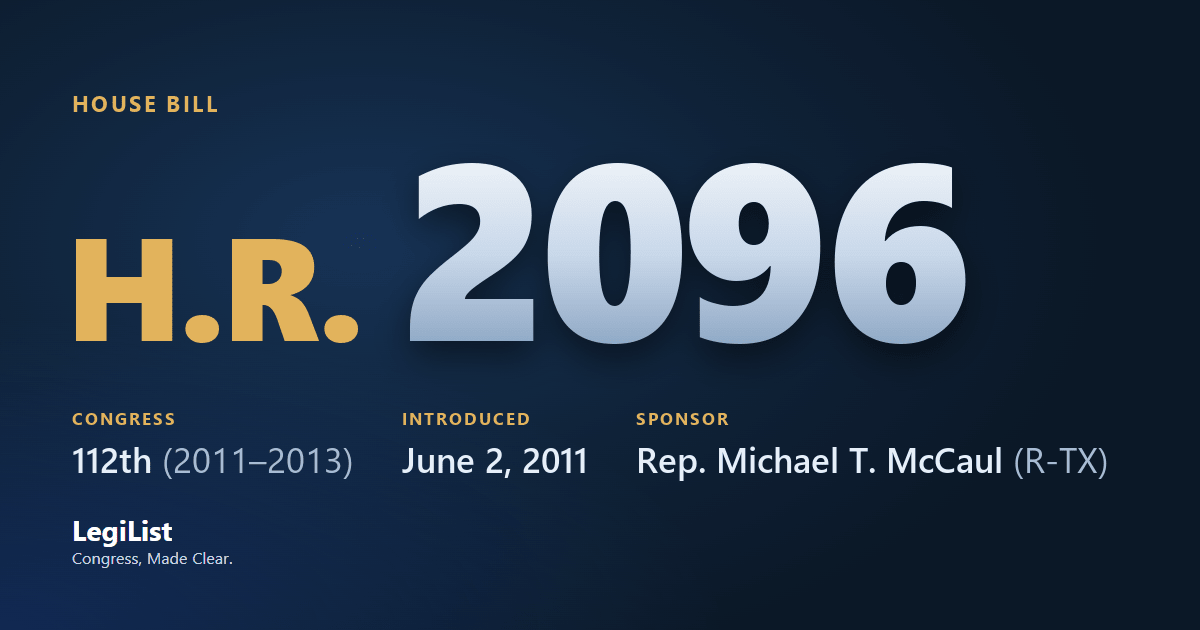
Cybersecurity Enhancement Act of 2012
Latest action · May 7, 2012 Received in the Senate and Read twice and referred to the Committee on Commerce, Science, and Transportation.
Progress
Where this bill reached, and when. A stage with no date was not reached; one that failed a vote and later carried shows the date it carried.
- IntroducedJun 2, 2011
- Passed HouseApr 27, 2012
- Passed SenateNot reached
- To the PresidentNot reached
- Became lawNot reached
Summary
Cybersecurity Enhancement Act of
Instructs the participating agencies, in developing and updating the strategic plan, to solicit recommendations and advice from the advisory committee on high-performance computing and a wide range of specified stakeholders.
(Sec. 104) Provides for the award of computer and network security research grants by the National Science Foundation (NSF) in the research areas of social and behavioral factors, including human-computer interactions, identity management, as well as the detection, investigation, and prosecution of cyber-crimes involving organized crime and crimes against children. Authorizes appropriations for FY2013-FY2015 for such grants.
(Sec. 105) Requires applications for the establishment of Computer and Network Security Research Centers to include a description of how such Centers will partner with government laboratories, for-profit entities, other institutions of higher education, or nonprofit research institutions. Authorizes appropriations for FY2013-FY2015 for such Centers.
Authorizes appropriations to NSF for FY2013-FY2015 for: (1) computer and network security capacity building grants, (2) grants under the Scientific and Advanced Technology Act for the national advanced scientific and technical education program and national centers of scientific and technical education, and (3) grants for graduate traineeships programs in computer and network security research.
Repeals the Cyber Security Faculty Development Traineeship Program.
(Sec. 106) Requires the NSF Director to continue carrying out a Scholarship for Service program under the Cyber Security Research and Development Act to recruit and train the next generation of federal cybersecurity professionals and to increase the capacity of the higher education system to produce an information technology workforce with the skills necessary to enhance the security of the nation's communications and information infrastructure.
Requires the program to: (1) provide scholarships for tuition, fees, and a stipend for up to two years to students pursuing a bachelor's or master's degree and up to three years to students pursuing a doctoral degree in a cybersecurity field upon condition that a scholarship recipient, upon the completion of the degree, serves as a cybersecurity professional within the federal workforce (or in another specified cybersecurity capacity) for a specified period of time; (2) provide scholarship recipients with summer internships or other temporary appointments in the federal information technology workforce; and (3) increase, through competitive grants, the capacity of U.S. higher education institutions to produce highly qualified cybersecurity professionals.
(Sec. 107) Directs the President to transmit a report to Congress addressing the cybersecurity workforce needs of the federal government.
(Sec. 108) Requires the Director of the Office of Science and Technology Policy to convene a cybersecurity university-industry task force to explore mechanisms for carrying out collaborative R&D activities through a consortium or other appropriate entity. Terminates the task force upon transmittal of a report to Congress.
(Sec. 109) Revises provisions under the Cyber Security Research and Development Act concerning the development and dissemination by the National Institute of Standards and Technology (NIST) of security risk checklists associated with computer systems that are, or are likely to become, widely used within the federal government.
Requires the NIST Director to establish priorities for the development, and revision as necessary, of security automation standards, associated reference materials (including protocols), and checklists associated with such systems in order to enable standardized and interoperable technologies, architectures, and frameworks to continuously monitor information security within the federal government.
Instructs the NIST Director to ensure that federal agencies are informed of the availability of any standard, reference material, checklist, or other item developed pursuant to this section.
(Sec. 110) Requires NIST to conduct
Title II: Advancement of Cybersecurity Technical Standards - (Sec. 202) Requires the NIST Director to ensure the coordination of federal agencies engaged in the development of international technical standards related to information system security. Requires the development and transmittal to Congress of a plan to ensure coordination by such federal agencies. Instructs the Director to ensure consultation with appropriate private sector stakeholders.
(Sec. 203) Requires the NIST Director, in collaboration with the federal Chief Information Officers Council, to continue to develop and encourage implementation of a comprehensive strategy for the use and adoption of cloud computing services by the federal government.
Requires consideration to be given to activities that: (1) accelerate the development, in collaboration with the private sector, of standards that address the interoperability and portability of cloud computing services; (2) advance the development of conformance testing performed by the private sector in support of cloud computing standardization; and (3) support, in consultation with the private sector, the development of appropriate security frameworks and reference materials, and the identification of best practices, for federal agencies to use in addresssing security and privacy requirements.
(Sec. 204) Requires the NIST Director, in collaboration with the National Coordination Office of the Networking and Information Technology Research and Development program, to continue the coordination of a cybersecurity awareness and education program for increasing the knowledge, skills, and awareness of cybersecurity risks, consequences, and best practices through: (1) the widespread dissemination of cybersecurity technical standards and best practices identified by NIST; (2) efforts to make cybersecurity best practices usable by individuals, small to medium-sized businesses, state, local, and tribal governments, and educational institutions; and (3) efforts to attract, recruit, and retain qualified professionals to the federal cybersecurity workforce. Requires the NIST Director to implement and transmit a strategic plan to Congress to guide federal programs and activities in support of a specified comprehensive cybersecurity awareness and education program.
(Sec. 205) Requires the NIST Director to continue a program to support the development of technical standards, metrology, testbeds, and conformance criteria with regard to identity management research and development.
(Sec. 206) Prohibits the authorization of any additional funds to carry out this title, the amendments made by this title, or to carry out amendments made by sections 109 and 110 of this Act. Requires this title and the amendments made by this title and such sections to be carried out using otherwise authorized or appropriated amounts.
Recorded votes 1
Newest first. Open one to see how every member voted.
Cosponsors 7
Members who signed on, in the order they did. Signatures ran from Jun 2, 2011 to Jun 24, 2011; 1 is an original cosponsor, there from the day it was introduced.
| Seat | Cosponsor | Signed on | |
|---|---|---|---|
| D-IL | Daniel Lipinski | Original | Jun 2, 2011 |
| R-IL | Aaron Schock | Jun 14, 2011 | |
| D-NM | Ben Ray Luján | Jun 14, 2011 | |
| D-OR | David Wu | Jun 14, 2011 | |
| R-TX | Ralph M. Hall | Jun 14, 2011 | |
| R-TX | Lamar Smith | Jun 24, 2011 | |
| R-AL | Mo Brooks | Jun 24, 2011 |
Committees 2
Where it was sent and what each committee and subcommittee did with it, in order.
| Chamber | Committee | What it did |
|---|---|---|
| House | Science, Space, and Technology Committee | Referred Jun 2, 2011Markup Jul 21, 2011Reported Oct 31, 2011 |
| Senate | Commerce, Science, and Transportation Committee | Referred May 7, 2012 |
Actions 14
Everything that happened, newest first.
- May 7, 2012Received in the Senate and Read twice and referred to the Committee on Commerce, Science, and Transportation.
- Apr 27, 2012Mr. McCaul moved to suspend the rules and pass the bill, as amended.
- Apr 27, 2012Considered under suspension of the rules. (consideration: CR H2215-2222)
- Apr 27, 2012DEBATE - The House proceeded with forty minutes of debate on H.R. 2096.
- Apr 27, 2012At the conclusion of debate, the Yeas and Nays were demanded and ordered. Pursuant to the provisions of clause 8, rule XX, the Chair announced that further proceedings on the motion would be postponed.
In the Congressional Record 1
Days the Record’s own index lists this bill, newest first, with the pages and the members it names. Pages starting H are the House, S the Senate, E Extensions of Remarks.
| Where | In the Record | Members | Date |
|---|---|---|---|
| House | Debate and remarks H2215–H2222Text printed H2215–H2218Recorded votes H2246enact | Daniel Lipinski D-IL, Eddie Bernice Johnson D-TX, James R. Langevin D-RI, Mac Thornberry R-TX, Michael T. McCaul R-TX, Ralph M. Hall R-TX, Sheila Jackson Lee D-TX | Apr 27, 2012 |
Research
What has been written about this bill: committee reports, cost estimates, the sponsor’s authority statement, printed hearings and the Congressional Research Service’s work.
Committee report
Congressional Budget Office cost estimate
- Aug 24, 2011H.R. 2096, Cybersecurity Enhancement Act of 2011Cost estimate for the bill as ordered reported by the House Committee on Science, Space, and Technology on July 21, 2011
Constitutional authority
The sponsor’s statement, as printed in the page H3986.
CRS reports 2
Congressional Research Service work that CRS links to this bill or the law it became, newest first.
Cite it 2
Products on other subjects that cite it, usually among other measures.
| Product | Title | Kind | Published |
|---|---|---|---|
| RL30153 | Critical Infrastructures: Background, Policy, and Implementation Archived | Report | Jun 10, 2015 |
| R42114 | Federal Laws Relating to Cybersecurity: Overview of Major Issues, Current Laws, and Proposed Legislation Archived | Report | Dec 12, 2014 |
Related bills 2
Companion bills and other measures the record links to this one.
| Bill | Title | Relationship | Latest action |
|---|---|---|---|
| S 1152 | Cybersecurity Enhancement Act of 2011 | Identical bill | Jun 7, 2011 |
| HR 4263 | SECURE IT Act of 2012 | Related bill | Jul 10, 2012 |
Titles 4
Every title it has carried, official and short, at each stage.
- Official Title as Introduced
- To advance cybersecurity research, development, and technical standards, and for other purposes.
- Short Titles as Introduced
- Cybersecurity Enhancement Act of 2011
- Short Titles as Reported to House
- Cybersecurity Enhancement Act of 2011
- Short Titles as Passed House
- Cybersecurity Enhancement Act of 2012
Subjects
Assigned by the Library of Congress. Policy area: Science, Technology, Communications.
- Advanced technology and technological innovations
- Advisory bodies
- Computer security and identity theft
- Computers and information technology
- Crime prevention
- Crimes against children
- Education programs funding
- Employment and training programs
- Fraud offenses and financial crimes
- Government employee pay, benefits, personnel management
- Higher education
- Organized crime
- Research administration and funding
- Research and development
- Right of privacy
- Science and engineering education
- Science, Technology, Communications
- Student aid and college costs
- Veterans' education, employment, rehabilitation
Text 4
Each version as it was printed, newest first.
- May 7, 2012Referred in Senate
- Apr 27, 2012Engrossed in House
- Oct 31, 2011Reported in House
- Jun 2, 2011Introduced in House
Everything here is as published by Congress: the summary is the Congressional Research Service's, the action wording is the clerks', and the subjects are the Library of Congress's. How far it got is read from the actions themselves, taking the most recent one of each kind, so a bill that failed a vote and later passed is shown as having passed. Records come from this bill on Congress.gov and govinfo.gov; cost estimates are the Congressional Budget Office's, and the hearings are the printed hearings GovInfo publishes, which can appear months after the hearing.