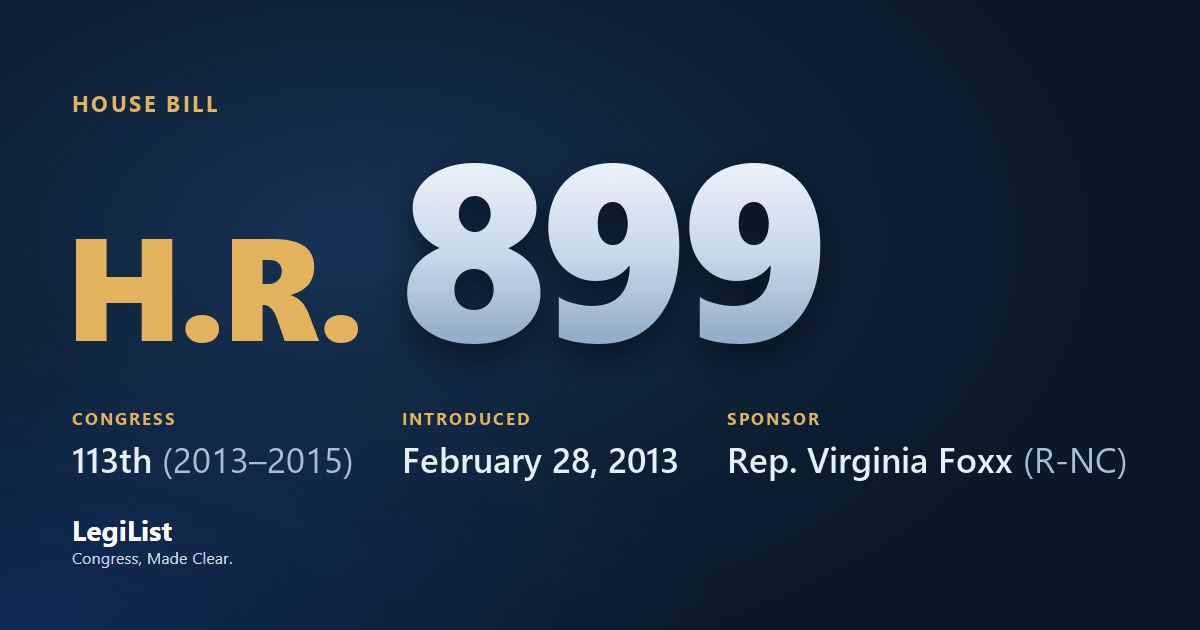
Unfunded Mandates Information and Transparency Act of 2014
Latest action · Mar 4, 2014 Received in the Senate and Read twice and referred to the Committee on Homeland Security and Governmental Affairs.
Progress
Where this bill reached, and when. A stage with no date was not reached; one that failed a vote and later carried shows the date it carried.
- IntroducedFeb 28, 2013
- Passed HouseFeb 28, 2014
- Passed SenateNot reached
- To the PresidentNot reached
- Became lawNot reached
Summary
(This measure has not been amended since it was introduced. The summary of that version is repeated here, with an updated short title.)
Unfunded Mandates Information and Transparency Act of 2014 - States as the purposes of this Act to: (1) improve the quality of the deliberations of Congress with respect to proposed federal mandates by providing Congress and the public with more complete information about the effects of such mandates and by ensuring that Congress acts on such mandates only after focused deliberation on their effects; and (2) enhance the ability of Congress and the public to identify federal mandates that may impose undue harm on consumers, workers, employers, small businesses, and state, local, and tribal governments.
Amends the Congressional Budget Act of 1974 to: (1) require the Congressional Budget Office (CBO), at the request of the chairman or ranking member of a congressional committee, to conduct an assessment comparing the authorized level of funding in legislation to the prospective costs of carrying out any changes to a condition of federal assistance being imposed on state, local, or tribal governments participating in the federal assistance program; (2) modify the definition of "direct costs" to require CBO to consider, in accounting for the costs of federal mandates, forgone business profits, costs passed onto consumers and other entities, and behavioral changes; (3) eliminate the exemption of independent regulatory agencies (except the Board of Governors of the Federal Reserve System or the Federal Open Market Committee) from reporting requirements under the Unfunded Mandates Reform Act of 1995 (UMRA); and (4) make the raising of points of order in the consideration of congressional legislation applicable to legislation that would increase the direct cost of private sector mandates beyond limits established by UMRA.
Amends UMRA to: (1) transfer certain responsibilities under such Act from the Director of the Office of Management and Budget (OMB) to the Administrator of the Office of Information and Regulatory Affairs; (2) set forth detailed criteria to guide agencies in assessing the effects of federal regulatory actions on state, local, and tribal governments and the private sector; (3) revise requirements for agency statements accompanying significant regulatory actions to require an analysis of the annual effect of a proposed final rule on state, local, or tribal governments or the private sector and to require all statements and summaries under UMRA to be detailed; and (4) extend to the the private sector (including small business) the requirement for consultation with agencies in the development of regulatory proposals containing significant federal mandates and set forth detailed guidelines for such consultation.
Revises UMRA reporting requirements to require: (1) the Administrator of the Office of Information and Regulatory Affairs to provide guidance and oversight so that agency regulations are consistent with the principles and policies of UMRA and do not conflict with the policies or actions of another agency; and (2) agencies to include in their annual compliance statements an appendix detailing consultation activities with state, local, and tribal governments and the private sector.
Amends UMRA to require an agency, at the request of the chairman or ranking member of a standing or select House or Senate Committee, to conduct a retrospective analysis of an existing regulation promulgated by such agency and submit to the chairman of the relevant committee, Congress, and the Comptroller General (GAO) a report on such regulation.
Expands judicial review under UMRA to include review of provisions of such Act relating to agency assessment of the effects of the regulatory process and agency selection of the least costly or least burdensome alternative to a regulatory mandate. Grants courts expanded powers to compel agencies to comply with UMRA reporting requirements.
Recorded votes 5
Newest first. Open one to see how every member voted.
Cosponsors 4
Members who signed on, in the order they did. All signed on Feb 28, 2013.
| Seat | Cosponsor | Signed on | |
|---|---|---|---|
| D-MN | Collin C. Peterson | Original | Feb 28, 2013 |
| R-OK | James Lankford | Original | Feb 28, 2013 |
| D-CA | Loretta Sanchez | Original | Feb 28, 2013 |
| D-NC | Mike McIntyre | Original | Feb 28, 2013 |
Committees 5
Where it was sent and what each committee and subcommittee did with it, in order.
| Chamber | Committee | What it did |
|---|---|---|
| House | Oversight and Government Reform Committee | Referred Feb 28, 2013Markup Jul 24, 2013Reported Feb 14, 2014 |
| House | Budget Committee | Referred Feb 28, 2013Discharged Feb 14, 2014 |
| House | Rules Committee | Referred Feb 28, 2013Discharged Feb 14, 2014 |
| House | Judiciary Committee | Referred Feb 28, 2013Discharged Feb 14, 2014 |
| Administrative State, Regulatory Reform, and Antitrust Subcommittee | Referred Apr 8, 2013 | |
| Senate | Homeland Security and Governmental Affairs Committee | Referred Mar 4, 2014 |
Actions 32
Everything that happened, newest first.
- Mar 4, 2014Received in the Senate and Read twice and referred to the Committee on Homeland Security and Governmental Affairs.
- Feb 28, 2014Considered under the provisions of rule H. Res. 492. (consideration: CR H2069-2086; text of measure as reported in House: CR H2075-2076)
- Feb 28, 2014Rule provides for consideration of H.R. 899. The resolution provides for one hour of debate. The resolution makes in order only those amendments printed in the report. The resolution provides one motion to recommit with or without instructions.
- Feb 28, 2014House resolved itself into the Committee of the Whole House on the state of the Union pursuant to H. Res. 492 and Rule XVIII.
- Feb 28, 2014The Speaker designated the Honorable Randy Hultgren to act as Chairman of the Committee.
In the Congressional Record 9
Days the Record’s own index lists this bill, newest first, with the pages and the members it names. Pages starting H are the House, S the Senate, E Extensions of Remarks.
| Where | In the Record | Members | Date |
|---|---|---|---|
| House | Debate and remarks H7904 | Virginia Foxx R-NC | Nov 12, 2014 |
| House | Debate and remarks H2568 | Virginia Foxx R-NC | Mar 24, 2014 |
| Extensions | Debate and remarks E361 | Chris Van Hollen D-MD | Mar 12, 2014 |
| House | Debate and remarks H2102 | Virginia Foxx R-NC | Mar 4, 2014 |
| House | Debate and remarks H2069–H2086Text printed H2075Amendments H2077, H2079Motions H2083Recorded votes H2081, H2082, H2084, H2085Jackson Lee amendment (clarify that requirements of the Unfunded Mandates Reform Act do not apply if the benefits of the regulations exceeds its costs)Cummings amendment (continue to exempt independent agencies from certain regulations under the Unfunded Mandates Reform Act)enactGarcia motion to recommit (exempt regulatory actions affecting veterans, seniors, consumers, and communities affected by natural disasters from certain regulations) | Darrell Issa R-CA, Elijah E. Cummings D-MD (amendment), Gerald E. Connolly D-VA (amendment), James Lankford R-OK, Joe Garcia D-FL (motion), Mark Meadows R-NC, Rob Woodall R-GA, Sheila Jackson Lee D-TX (amendment), Tammy Duckworth D-IL, Virginia Foxx R-NC, Wm. Lacy Clay D-MO | Feb 28, 2014 |
Research
What has been written about this bill: committee reports, cost estimates, the sponsor’s authority statement, printed hearings and the Congressional Research Service’s work.
Committee report
Congressional Budget Office cost estimate
- Aug 2, 2013H.R. 899, Unfunded Mandates Information and Transparency Act of 2013As ordered reported by the House Committee on Oversight and Government Reform on July 24, 2013
Constitutional authority
The sponsor’s statement, as printed in the page H816.
CRS reports 2
Congressional Research Service work that CRS links to this bill or the law it became, newest first.
Cite it 2
Products on other subjects that cite it, usually among other measures.
| Product | Title | Kind | Published |
|---|---|---|---|
| R40957 | Unfunded Mandates Reform Act: History, Impact, and Issues Archived | Report | Feb 23, 2021 |
| R41974 | Cost-Benefit and Other Analysis Requirements in the Rulemaking Process Archived | Report | Dec 9, 2014 |
Amendments 3
Amendments offered to this bill.
| Amendment | Description | Offered by | Status |
|---|---|---|---|
| HAmdt 573 | Amendment sought to strike section 5 of the bill which would eliminate the current exemption from the Unfunded Mandate Reform Act for certain independent agencies. | Elijah E. Cummings D-MD | On agreeing to the Cummings amendment (A001) Failed by recorded vote: 185 - 224 (Roll no. 86). |
| HAmdt 574 | Amendment sought to ensure that other impacted entities, such as public interest organizations, are provided the opportunity for consultation afforded to the private sector under the Act. | Gerald E. Connolly D-VA | On agreeing to the Connolly amendment (A002) Failed by recorded vote: 194 - 216 (Roll no. 87). |
| HAmdt 575 | Amendment sought to add a section to the bill to clarify that the requirements of UMRA, as amended, do not apply if a cost-benefit analysis demonstrates that the benefits of the regulatory action exceed its costs. | Sheila Jackson Lee D-TX | On agreeing to the Jackson Lee amendment (A003) Failed by recorded vote: 180 - 232 (Roll no. 88). |
Related bills 2
Companion bills and other measures the record links to this one.
| Bill | Title | Relationship | Latest action |
|---|---|---|---|
| HR 4 | Jobs for America Act | Related bill | Nov 13, 2014 |
| HRES 492 | Providing for consideration of the bill (H.R. 899) to provide for additional safeguards with respect to imposing Federal mandates, and for other purposes. | Procedurally related | Feb 27, 2014 |
Titles 4
Every title it has carried, official and short, at each stage.
- Official Title as Introduced
- To provide for additional safeguards with respect to imposing Federal mandates, and for other purposes.
- Short Titles as Introduced
- Unfunded Mandates Information and Transparency Act of 2013
- Short Titles as Reported to House
- Unfunded Mandates Information and Transparency Act of 2013
- Short Titles as Passed House
- Unfunded Mandates Information and Transparency Act of 2014
Subjects
Assigned by the Library of Congress. Policy area: Government Operations and Politics.
- Administrative law and regulatory procedures
- Congressional oversight
- Executive agency funding and structure
- Federal-Indian relations
- Government information and archives
- Government Operations and Politics
- Government studies and investigations
- Intergovernmental relations
- Judicial review and appeals
- Legislative rules and procedure
- Office of Management and Budget (OMB)
- State and local finance
Text 4
Each version as it was printed, newest first.
- Mar 4, 2014Referred in Senate
- Feb 28, 2014Engrossed in House
- Feb 14, 2014Reported in House
- Feb 28, 2013Introduced in House
Everything here is as published by Congress: the summary is the Congressional Research Service's, the action wording is the clerks', and the subjects are the Library of Congress's. How far it got is read from the actions themselves, taking the most recent one of each kind, so a bill that failed a vote and later passed is shown as having passed. Records come from this bill on Congress.gov and govinfo.gov; cost estimates are the Congressional Budget Office's, and the hearings are the printed hearings GovInfo publishes, which can appear months after the hearing.