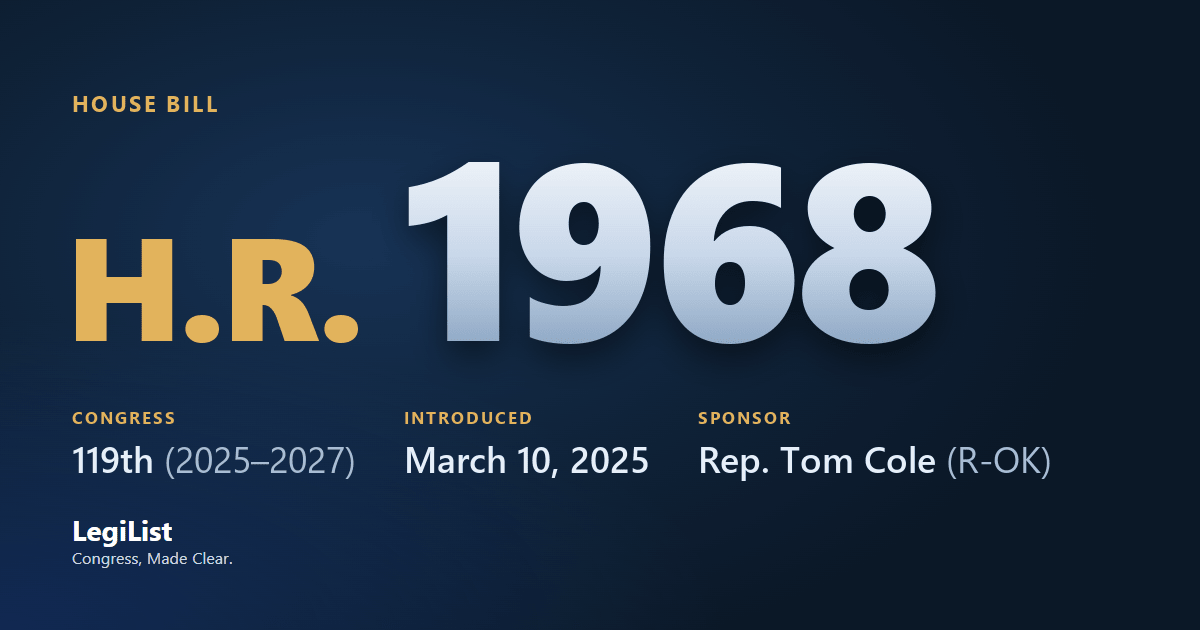
Full-Year Continuing Appropriations and Extensions Act, 2025
Latest action · Mar 15, 2025 Became Public Law No: 119-4.
Progress
Where this bill reached, and when. A stage with no date was not reached; one that failed a vote and later carried shows the date it carried.
- IntroducedMar 10, 2025
- Passed HouseMar 11, 2025
- Passed SenateMar 14, 2025
- To the PresidentMar 14, 2025
- Became lawMar 15, 2025Public Law 119-4
Summary
Full-Year Continuing Appropriations and Extensions Act, 2025
This act provides continuing FY2025 appropriations for federal agencies and extends various expiring programs and authorities.
DIVISION A--FULL-YEAR CONTINUING APPROPRIATIONS ACT, 2025
Full-Year Continuing Appropriations Act, 2025
This division provides continuing FY2025 appropriations to federal agencies for the remainder of FY2025 and extends various expiring programs and authorities. It is known as a continuing resolution (CR) and prevents a government shutdown that would otherwise occur if the FY2025 appropriations bills have not been enacted when the existing CR expires on March 14, 2025.
The CR funds most programs and activities at the FY2024 levels. It also includes several additional provisions that increase or decrease funding for various programs compared to FY2024 levels.
For more information, see CRS Report R48517, Section-by-Section Summary of the Full-Year Continuing Appropriations Act, 2025 (Division A of P.L. 119-4)
DIVISION B--HEALTH
This division extends several expiring programs and authorities related to public health, Medicare, and Medicaid.
TITLE I--PUBLIC HEALTH EXTENDERS
(Sec. 2101) This section extends through FY2025 funding for the Teaching Health Center Graduate Medical Education Program, the Community Health Center Fund, and the National Health Service Corps.
The Teaching Health Center Graduate Medical Education Program supports education and training of medical students in primary care residency programs in community-based ambulatory patient care centers. The Community Health Center Fund supports (1) grants for outpatient health care facilities that serve medically underserved populations; and (2) the National Health Service Corps, which provides scholarships and student loan repayment awards to health care providers who agree to work in areas with health care provider shortages.
(Sec. 2102) This section extends funding through FY2025 for the Special Diabetes Program for Type I Diabetes and the Special Diabetes Program for Indians. (The Special Diabetes Program for Type I Diabetes supports research on the prevention and cure of Type I diabetes, and the Special Diabetes Program for Indians supports diabetes treatment and prevention for tribal populations.)
(Sec. 2103) This section extends through FY2025 the authority that allows states and tribes to request the temporary reassignment of state and local health department personnel who are funded through certain federal programs to immediately address a public health emergency.
It also extends through FY2025 provisions that prohibit the disclosure of information about Department of Health and Human Services (HHS) programs that could compromise national security (e.g., information regarding biomedical threats).
The section extends through FY2025 provisions that authorize HHS to engage with developers of medical countermeasures, and that provide for related antitrust exemptions, for the purpose of furthering product development.
Additionally, the section extends through FY2025 the National Advisory Committee on Children and Disasters, the National Advisory Committee on Seniors and Disasters, and the National Advisory Committee on Individuals with Disabilities and Disasters.
It also extends through FY2025 the authority of HHS to directly appoint candidates to positions within the National Disaster Medical System if HHS determines the number of personnel in the system is insufficient to address a public health emergency or potential public health emergency. (The National Disaster Medical System is a partnership between HHS, the Department of Defense, and other federal departments that responds to public health and other emergencies, including by deploying medical response teams.)
TITLE II--MEDICARE
(Sec. 2201) This section extends through FY2025 certain increased payment adjustments for low-volume hospitals under Medicare's inpatient prospective payment system.
(Sec. 2202) This section extends through FY2025 the Medicare-Dependent Hospital Program, which provides additional payments to certain small rural hospitals that have a high proportion of Medicare patients.
(Sec. 2203) This section extends through FY2025 certain increased payment adjustments for ground ambulance services in rural and other areas under Medicare.
(Sec. 2204) This section extends through FY2025 funding for certain Medicare quality-measurement activities.
(Sec. 2205) This section extends through FY2025 funding for state health insurance programs, area agencies on aging, aging and disability resource centers, and technical assistance related to outreach and enrollment with respect to Medicare and other programs.
(Sec. 2206) This section extends through FY2025 certain minimum adjustments to the work geographic index with respect to payments for physician services under Medicare.
(Sec. 2207) This section extends through FY2025 certain telehealth flexibilities under Medicare.
Specifically, the section (1) removes geographic restrictions on originating sites (i.e., the location of the beneficiary); (2) allows the home of the beneficiary to serve as the originating site for all services; (3) allows audiologists, physical therapists, occupational therapists, and speech-language pathologists to furnish telehealth services; (4) allows federally qualified health centers and rural health clinics to serve as the distant site (i.e., the location of the health care practitioner); (5) delays implementation of certain in-person evaluation requirements for mental health telehealth services; (6) expands coverage to include audio-only services for evaluation and management and behavioral health services; and (7) allows, for purposes of hospice care recertification under Medicare, physicians and nurse practitioners to fulfill the requirement of a face-to-face encounter with the hospice patient via telehealth.
(Sec. 2208) This section extends through FY2025 the Acute Hospital Care at Home Program under Medicare. (The program allows hospitals to treat certain patients from emergency departments or inpatient hospital beds at home.)
(Sec. 2209) This section extends through FY2025 coverage under the Medicare prescription drug benefit of prescription oral antiviral drugs that were authorized in response to the COVID-19 public health emergency.
(Sec. 2210) This section increases funding for the Medicare Improvement Fund beginning in FY2026.
(Sec. 2211) This section extends by two months the sequestration that applies to Medicare payments in FY2032.
TITLE III--HUMAN SERVICES
(Sec. 2301) This section extends through FY2025 the Sexual Risk Avoidance Education Program. This program supports projects to implement sexual risk avoidance education that teaches participants to voluntarily refrain from nonmarital sexual activities.
(Sec. 2302) This section extends through FY2025 the Personal Responsibility Education Program. This program provides grants to states to (1) educate young people about abstinence and contraception to prevent pregnancy and sexually transmitted infections, and (2) support pregnant youth and mothers under the age of 21.
(Sec. 2303) This section extends through FY2025 the Family-to-Family Health Information Centers Program, which is administered by the Health Resources and Services Administration. The program awards grants to family-run organizations to support the provision of information and peer support to families of children with special health care needs.
TITLE IV--MEDICAID
This section delays reductions to Medicaid disproportionate-share hospital (DSH) allotments until FY2026. (DSHs are hospitals that receive additional payments under Medicaid for treating a large share of low-income patients.)
DIVISION C--OTHER MATTERS
This division extends several expiring programs and authorities through FY2025.
(Sec. 3101) This section extends authorities related to the Commodity Futures Trading Commission’s whistleblower program.
(Sec. 3102) This section extends the authority of the Department of Homeland Security (DHS) and the Department of Justice to take certain actions to mitigate a credible threat to certain facilities or assets from an unmanned aircraft system (UAS). These include certain facilities that are located in the United States and identified as high-risk and a potential target for unlawful UAS activity.
(Sec. 3103) This section extends the special assessment on nonindigent persons or entities convicted of certain offenses involving sexual abuse or human trafficking. The assessment funds programs for human trafficking survivors.
(Sec. 3104) This section extends the authority for DHS’s National Cybersecurity Protection System and related reporting requirements. The system authorizes multiple activities by DHS to help defend federal agencies from cyberthreats.
(Sec. 3105) This section extends, the temporary scheduling order issued by the Drug Enforcement Administration to place fentanyl-related substances in schedule I of the Controlled Substances Act.
(Sec. 3106) This section exempts the budgetary effects of Divisions B and C of this act from (1) the Statutory Pay-As-You-Go (PAYGO) Act of 2010, (2) the Senate PAYGO rule, and (3) certain budget scorekeeping rules.
Recorded votes 4
Newest first. Open one to see how every member voted.
Cosponsors
Members who signed on, in the order they did.
Committees 2
Where it was sent and what each committee and subcommittee did with it, in order.
| Chamber | Committee | What it did |
|---|---|---|
| House | Appropriations Committee | Referred Mar 10, 2025 Mar 11, 2025 |
| House | Budget Committee | Referred Mar 10, 2025 |
Actions 29
Everything that happened, newest first.
- Mar 15, 2025Signed by President.
- Mar 15, 2025Became Public Law No: 119-4.
- Mar 14, 2025Cloture motion on the motion to proceed to the measure withdrawn by unanimous consent in Senate. (CR S1768)
- Mar 14, 2025Motion to proceed to consideration of measure agreed to in Senate by Unanimous Consent. (CR S1768)
- Mar 14, 2025Measure laid before Senate by unanimous consent. (consideration: CR S1768-1772)
In the Congressional Record 6
Days the Record’s own index lists this bill, newest first, with the pages and the members it names. Pages starting H are the House, S the Senate, E Extensions of Remarks.
| Where | In the Record | Members | Date |
|---|---|---|---|
| Senate | Amendments S1803 | Brian Schatz D-HI (amendment) | Mar 24, 2025 |
| Senate | Debate and remarks S1753, S1754, S1757–S1762, S1765, S1768–S1772Amendments S1769, S1770, S1771, S1778, S1783, S1784, S1785Cloture motions S1768Recorded votes S1768, S1769, S1770, S1771, S1772cloture motionDuckworth amendment (require reports to Congress on number of veteran employees fired from agencies and provide for reinstatement of veteran Federal employees)makingMerkley amendment (except application of certain rescissions)Van Hollen amendment (prohibit use of continuing appropriations by Dept. of Government Efficiency and detailees) | Andy Kim D-NJ (amendment), Angela D. Alsobrooks D-MD (amendment), Angus S. King Jr. I-ME (amendment), Bernie Moreno R-OH (cloture motion), Brian Schatz D-HI (amendment), Catherine Cortez Masto D-NV (amendment), Charles E. Schumer D-NY, Chris Van Hollen D-MD (amendment), Christopher A. Coons D-DE (amendment), Cindy Hyde-Smith R-MS (cloture motion), Cory A. Booker D-NJ (amendment), Gary C. Peters D-MI (amendment), Jack Reed D-RI (amendment), Jacky Rosen D-NV (amendment), James E. Risch R-ID (cloture motion), James Lankford R-OK, Jeanne Shaheen D-NH (amendment), Jeff Merkley D-OR (amendment), John Barrasso R-WY (cloture motion), John Kennedy R-LA (cloture motion), John Thune R-SD (cloture motion), Jon Husted R-OH (cloture motion), Joni Ernst R-IA (amendment, cloture motion), Katie Boyd Britt R-AL (cloture motion), Kevin Cramer R-ND (cloture motion), Kirsten E. Gillibrand D-NY (amendment), Lisa Murkowski R-AK, Margaret Wood Hassan D-NH (amendment), Mark Kelly D-AZ (amendment), Mark R. Warner D-VA (amendment), Markwayne Mullin R-OK (cloture motion), Martin Heinrich D-NM (amendment), Mazie K. Hirono D-HI (amendment), Mike Crapo R-ID, Patty Murray D-WA, Pete Ricketts R-NE (cloture motion), Rand Paul R-KY (amendment), Richard Blumenthal D-CT (amendment), Richard J. Durbin D-IL (amendment), Roger F. Wicker R-MS, Ron Wyden D-OR (amendment), Ruben Gallego D-AZ (amendment), Shelley Moore Capito R-WV (cloture motion), Susan M. Collins R-ME, Tammy Duckworth D-IL (amendment), Tim Kaine D-VA (amendment), Tim Scott R-SC (cloture motion), Tim Sheehy R-MT (cloture motion), Todd Young R-IN (cloture motion), Tom Cotton R-AR (cloture motion) | Mar 14, 2025 |
| Senate | Debate and remarks S1723–S1726, S1730–S1736Amendments S1744, S1747, S1748, S1750 | Angela D. Alsobrooks D-MD (amendment), Bernard Sanders I-VT, Charles E. Schumer D-NY, Chris Van Hollen D-MD (amendment), John Barrasso R-WY, John Thune R-SD, Mark R. Warner D-VA (amendment), Patty Murray D-WA (amendment), Ron Johnson R-WI (amendment), Tim Kaine D-VA (amendment), Tom Cotton R-AR | Mar 13, 2025 |
| Senate | Debate and remarks S1681, S1685, S1690, S1695–S1697, S1700Amendments S1721Motions S1681, S1700Cloture motions S1700 | Angela D. Alsobrooks D-MD (amendment), Charles E. Schumer D-NY, Chuck Grassley R-IA (cloture motion), Cindy Hyde-Smith R-MS (cloture motion), Cynthia M. Lummis R-WY (cloture motion), James Lankford R-OK (cloture motion), John Barrasso R-WY (cloture motion), John Cornyn R-TX, John R. Curtis R-UT (cloture motion), John Thune R-SD (cloture motion, motion), Kevin Cramer R-ND (cloture motion), Lindsey Graham R-SC (cloture motion), Markwayne Mullin R-OK (cloture motion), Marsha Blackburn R-TN (cloture motion), Patty Murray D-WA, Rand Paul R-KY (amendment), Rick Scott R-FL (cloture motion), Ted Budd R-NC (cloture motion), Thom Tillis R-NC (cloture motion), Tim Sheehy R-MT (cloture motion), Todd Young R-IN (cloture motion), Tommy Tuberville R-AL (cloture motion) | Mar 12, 2025 |
| House · Senate | Debate and remarks H1076–H1078, H1080, H1082, H1083–H1093, H1102–H1126, H1127, H1128, H1129, H1130, S1645, S1649, S1650, S1675, S1677Text printed H1083, H1102–H1113Amendments H1092Motions H1123Recorded votes H1092, H1124, H1125consideration (H. Res. 211), previous questionmakingMeng motion to recommit (protect access to Medicaid, Medicare, Social Security programs, and Supplemental Nutrition Assistance Program)Declaratory Statements H1154 | Al Green D-TX, Betty McCollum D-MN, Chellie Pingree D-ME, Chip Roy R-TX, Daniel Meuser R-PA, Daniel S. Goldman D-NY, Debbie Wasserman Schultz D-FL, Delia C. Ramirez D-IL, Doug LaMalfa R-CA, Eleanor Holmes Norton D-DC, Elizabeth Warren D-MA, Frank J. Mrvan D-IN, Frank Pallone, Jr. D-NJ, George Latimer D-NY, Grace Meng D-NY (motion), Gregory W. Meeks D-NY, Hakeem S. Jeffries D-NY, James P. McGovern D-MA (amendment), Jared Moskowitz D-FL, Joe Wilson R-SC, John H. Rutherford R-FL, John Thune R-SD, Katherine M. Clark D-MA, Ken Calvert R-CA, Laura Friedman D-CA, Lisa Murkowski R-AK, Lois Frankel D-FL, Marcy Kaptur D-OH, Mark Alford R-MO, Mark Takano D-CA, Mary Gay Scanlon D-PA, Maxine Dexter D-OR, Maxwell Frost D-FL, Melanie A. Stansbury D-NM, Michael K. Simpson R-ID, Michael Lawler R-NY, Michelle Fischbach R-MN, Mike Quigley D-IL, Nancy Pelosi D-CA, Nydia M. Velázquez D-NY, Patty Murray D-WA, Ralph Norman R-SC, Robin L. Kelly D-IL, Rosa L. DeLauro D-CT, Sheila Cherfilus-McCormick D-FL, Steny H. Hoyer D-MD, Stephanie I. Bice R-OK, Steve Scalise R-LA, Teresa Leger Fernandez D-NM, Tom Cole R-OK | Mar 11, 2025 |
Research
What has been written about this bill: committee reports, cost estimates, the sponsor’s authority statement, printed hearings and the Congressional Research Service’s work.
Congressional Budget Office cost estimate
- Mar 11, 2025H.R. 1968, Full-Year Continuing Appropriations and Extensions Act, 2025As Posted on the Website of the House Committee on Rules, March 8, 2025
Constitutional authority
The sponsor’s statement, as printed in the Congressional Record, vol. 171, no. 44, March 10, 2025, page H1067.
Printed hearings 1
Hearings whose printed record names this bill, newest first: hearings on it, and wider hearings where it came up.
| Number | Hearing | Committee | Held |
|---|---|---|---|
| Serial No. 119-12 | AMERICA ON THE GLOBAL STAGE: EXAMINING EFFORTS TO SECURE AND IMPROVE THE U.S. TRAVEL SYSTEM AND PREPARE FOR SIGNIFICANT INTERNATIONAL EVENTS146 pages | Homeland Security Committee | Apr 8, 2025 |
CRS reports 239
Congressional Research Service work that CRS links to this bill or the law it became, newest first.
About this bill 1
Products that name it in their title: its number, its law number or one of its short titles.
| Product | Title | Kind | Published |
|---|---|---|---|
| R48517 | Section-by-Section Summary of the Full-Year Continuing Appropriations Act, 2025 (Division A of P.L. 119-4) | Report | Apr 25, 2025 |
Also cite it 238
Products on other subjects that cite it, usually among other measures.
| Product | Title | Kind | Published |
|---|---|---|---|
| R46234 | School Meals and Other Child Nutrition Programs: Background and Funding | Report | Nov 20, 2026 |
| R49518 | Saudi Arabia’s Nuclear Energy Program and Proposed U.S.-Saudi Nuclear Cooperation | Report | Nov 20, 2026 |
| 97-1011 | Salaries of Members of Congress: Recent Actions and Historical Tables | Report | Nov 18, 2026 |
| 97-615 | Salaries of Members of Congress: Congressional Votes, 1990-2026 | Report | Nov 18, 2026 |
| IF10266 | Child Nutrition Reauthorization (CNR): An Overview | Resource | Nov 9, 2026 |
Amendments 23
Amendments offered to this bill.
| Amendment | Description | Offered by | Status |
|---|---|---|---|
| HAmdt 8 | Pursuant to the provisions of H. Res. 211, the amendment printed in report 119-15 is considered adopted. | Rules Committee | On agreeing to the Rules amendment (A001) Agreed to without objection. |
| SA 1266 | To reduce the amount appropriated for the United States Agency for International Development. | Rand Paul R-KY | Amendment SA 1266 not agreed to in Senate by Yea-Nay Vote. 27 - 73. Record Vote Number: 132. |
| SA 1267 | No description on file | Angela D. Alsobrooks D-MD | Senate amendment submitted |
| SA 1268 | No description on file | Ron Johnson R-WI | Senate amendment submitted |
| SA 1269 | No description on file | Patty Murray D-WA | Senate amendment submitted |
Related bills 2
Companion bills and other measures the record links to this one.
Titles 6
Every title it has carried, official and short, at each stage.
- Official Title as Introduced
- Making further continuing appropriations and other extensions for the fiscal year ending September 30, 2025, and for other purposes.
- Short Title(s) as Introduced
- Full-Year Continuing Appropriations and Extensions Act, 2025
- Short Title(s) as Passed House
- Full-Year Continuing Appropriations and Extensions Act, 2025
- Short Titles from ENR (Enrolled) bill text
- Full-Year Continuing Appropriations and Extensions Act, 2025
- Short Title(s) from PCS (Placed on Senate Calendar) bill text
- Full-Year Continuing Appropriations and Extensions Act, 2025
- Official Title from EH (Engrossed in House) bill text
- Making further continuing appropriations and other extensions for the fiscal year ending September 30, 2025, and for other purposes.
Subjects
Assigned by the Library of Congress. Policy area: Economics and Public Finance.
- Abortion
- Access Board
- Accounting and auditing
- Administrative law and regulatory procedures
- Administrative remedies
- Adoption and foster care
- Advanced technology and technological innovations
- Advisory bodies
- Aging
- Agricultural conservation and pollution
- Agricultural education
- Agricultural equipment and machinery
- Agricultural insurance
- Agricultural marketing and promotion
- Agricultural prices, subsidies, credit
- Agricultural research
- Agricultural trade
- Air quality
- Alabama
- Alaska
- Alaska Natives and Hawaiians
- Alliances
- Alternative and renewable resources
- American Battle Monuments Commission
- American Samoa
- Animal and plant health
- Animal protection and human-animal relationships
- Appalachian Regional Commission
- Appropriations
- Aquatic ecology
- Architect of the Capitol
- Arizona
- Arkansas
- Armed Forces Retirement Home
- Arms control and nonproliferation
- Army Corps of Engineers
- Asia
- Assault and harassment offenses
- Athletes
- Atmospheric science and weather
- Aviation and airports
- Birds
- Border security and unlawful immigration
- Budget process
- Building construction
- Business investment and capital
- Buy American requirements
- California
- Canada
- Cardiovascular and respiratory health
- Cell biology and embryology
- Cemeteries and funerals
- Census and government statistics
- Child health
- Child safety and welfare
- China
- Civil actions and liability
- Climate change and greenhouse gases
- Coal
- Coast guard
- Collective security
- Colorado
- Commission of Fine Arts
- Commission on Civil Rights
- Commodities markets
- Commodity Credit Corporation
- Commodity Futures Trading Commission
- Community life and organization
- Competition and antitrust
- Competitiveness, trade promotion, trade deficits
- Computer security and identity theft
- Computers and information technology
- Conflicts and wars
- Congressional officers and employees
- Connecticut
- Correctional facilities and imprisonment
- Crime prevention
- Crime victims
- Crimes against children
- Crimes against women
- Criminal investigation, prosecution, interrogation
- Criminal justice information and records
- Criminal procedure and sentencing
- Cuba
- Currency
- Customs enforcement
- Dams and canals
- Defense Nuclear Facilities Safety Board
- Defense spending
- Delta Regional Authority
- Denali Commission
- Department of Agriculture
- Department of Commerce
- Department of Defense
- Department of Energy
- Department of Health and Human Services
- Department of Homeland Security
- Department of Housing and Urban Development
- Department of Justice
- Department of Labor
- Department of State
- Department of the Interior
- Department of the Treasury
- Department of Transportation
- Department of Veterans Affairs
- Detention of persons
- Digestive and metabolic diseases
- Disability and paralysis
- Disability assistance
- Disaster relief and insurance
- District of Columbia
- Domestic violence and child abuse
- Drug Enforcement Administration (DEA)
- Drug safety, medical device, and laboratory regulation
- Drug therapy
- Drug trafficking and controlled substances
- Drug, alcohol, tobacco use
- Economic development
- Economics and Public Finance
- Education of the disadvantaged
- Education programs funding
- Educational technology and distance education
- Election Assistance Commission
- Elections, voting, political campaign regulation
- Electric power generation and transmission
- Elementary and secondary education
- Emergency communications systems
- Emergency planning and evacuation
- Employee benefits and pensions
- Employment and training programs
- Employment discrimination and employee rights
- Endangered and threatened species
- Energy efficiency and conservation
- Environmental assessment, monitoring, research
- Environmental health
- Environmental Protection Agency (EPA)
- Environmental regulatory procedures
- Environmental technology
- Equal Employment Opportunity Commission (EEOC)
- Europe
- Evidence and witnesses
- Executive agency funding and structure
- Executive Office of the President
- Family planning and birth control
- Family relationships
- Family services
- Farm Credit Administration
- Farmland
- Federal appellate courts
- Federal Bureau of Investigation (FBI)
- Federal Crop Insurance Corporation
- Federal Emergency Management Agency (FEMA)
- Federal Energy Regulatory Commission (FERC)
- Federal Maritime Commission
- Federal officials
- Federal-Indian relations
- Firearms and explosives
- Fires
- First responders and emergency personnel
- Fishes
- Floods and storm protection
- Florida
- Food and Drug Administration (FDA)
- Food assistance and relief
- Food industry and services
- Food supply, safety, and labeling
- Foreign aid and international relief
- Forests, forestry, trees
- Fraud offenses and financial crimes
- General Services Administration
- Genetics
- Geography and mapping
- Georgia
- Government buildings, facilities, and property
- Government employee pay, benefits, personnel management
- Government information and archives
- Government lending and loan guarantees
- Government National Mortgage Association (Ginnie Mae)
- Government studies and investigations
- Government trust funds
- Great Lakes
- Guam
- Hate crimes
- Hawaii
- Hazardous wastes and toxic substances
- Health care costs and insurance
- Health care coverage and access
- Health facilities and institutions
- Health information and medical records
- Health personnel
- Health programs administration and funding
- Health promotion and preventive care
- Health technology, devices, supplies
- Hereditary and development disorders
- Higher education
- Historic sites and heritage areas
- Historical and cultural resources
- HIV/AIDS
- Home and outpatient care
- Homelessness and emergency shelter
- Hong Kong
- Hospital care
- House of Representatives
- Housing and community development funding
- Housing discrimination
- Housing finance and home ownership
- Housing for the elderly and disabled
- Housing industry and standards
- Housing supply and affordability
- Human rights
- Human trafficking
- Humanities programs funding
- Idaho
- Illinois
- Immigration status and procedures
- Immunology and vaccination
- Indian claims
- Indian lands and resources rights
- Indian social and development programs
- Infectious and parasitic diseases
- Infrastructure development
- Insects
- Intellectual property
- Intelligence activities, surveillance, classified information
- Interagency Council on Homelessness
- Intergovernmental relations
- International exchange and broadcasting
- International monetary system and foreign exchange
- International organizations and cooperation
- Internet, web applications, social media
- Iran
- Judges
- Juvenile crime and gang violence
- Kansas
- Kentucky
- Lakes and rivers
- Land transfers
- Land use and conservation
- Landlord and tenant
- Law enforcement administration and funding
- Law enforcement officers
- Lawyers and legal services
- Lease and rental services
- Legal fees and court costs
- Legal Services Corporation
- Libraries and archives
- Licensing and registrations
- Livestock
- Long-term, rehabilitative, and terminal care
- Louisiana
- Low- and moderate-income housing
- Maine
- Mammals
- Manufacturing
- Marine and coastal resources, fisheries
- Marine Mammal Commission
- Marine pollution
- Marshall Islands
- Maryland
- Meat
- Medicaid
- Medical education
- Medical research
- Medical tests and diagnostic methods
- Medicare
- Members of Congress
- Mental health
- Metals
- Mexico
- Michigan
- Micronesia
- Middle East
- Migrant, seasonal, agricultural labor
- Military facilities and property
- Military history
- Military law
- Military personnel and dependents
- Military procurement, research, weapons development
- Mining
- Minnesota
- Minority and disadvantaged businesses
- Minority education
- Missing persons
- Mississippi
- Missouri
- Monuments and memorials
- Motor carriers
- Motor vehicles
- Museums, exhibitions, cultural centers
- National Aeronautics and Space Administration
- National and community service
- National Archives and Records Administration
- National Capital Planning Commission
- National Foundation on the Arts and the Humanities
- National Guard and reserves
- National Institutes of Health (NIH)
- National Railroad Passenger Corporation (Amtrak)
- National Science Foundation
- National Transportation Safety Board (NTSB)
- Natural disasters
- Navigation, waterways, harbors
- Neighborhood Reinvestment Corporation
- Neurological disorders
- Nevada
- New Hampshire
- New Jersey
- New Mexico
- New York State
- North America
- North Carolina
- North Korea
- Northern Mariana Islands
- Nuclear power
- Nuclear Regulatory Commission (NRC)
- Nuclear weapons
- Nursing
- Nutrition and diet
- Oceania
- Office of Personnel Management (OPM)
- Office of Science and Technology Policy
- Office of the U.S. Trade Representative
- Ohio
- Oil and gas
- Oklahoma
- Oregon
- Organ and tissue donation and transplantation
- Organized crime
- Palau
- Parks, recreation areas, trails
- Pennsylvania
- Performing arts
- Personnel records
- Pest management
- Philippines
- Photography and imaging
- Pipelines
- Postal service
- Poverty and welfare assistance
- Preschool education
- Prescription drugs
- Presidents and presidential powers, Vice Presidents
- Protection of officials
- Public contracts and procurement
- Public housing
- Public transit
- Public utilities and utility rates
- Radioactive wastes and releases
- Railroads
- Regional and metropolitan planning
- Religion
- Reptiles
- Research administration and funding
- Research and development
- Residential rehabilitation and home repair
- Retail and wholesale trades
- Roads and highways
- Rural conditions and development
- Russia
- School athletics
- Science and engineering education
- Seashores and lakeshores
- Senate
- Service animals
- Sex and reproductive health
- Sex offenses
- Small business
- Smithsonian Institution
- Smuggling and trafficking
- Social security and elderly assistance
- Solid waste and recycling
- South Carolina
- Space flight and exploration
- Spacecraft and satellites
- Specialized courts
- State and local finance
- State and local government operations
- Strategic materials and reserves
- Student aid and college costs
- Surface Transportation Board
- Technology transfer and commercialization
- Telecommunication rates and fees
- Telephone and wireless communication
- Tennessee
- Texas
- Trade restrictions
- Transportation costs
- Transportation programs funding
- Transportation safety and security
- U.S. Agency for International Development (USAID)
- U.S. Capitol
- U.S. history
- U.S. Holocaust Memorial Council
- U.S. International Trade Commission
- U.S. Postal Service
- Unemployment
- User charges and fees
- Utah
- Vermont
- Veterans' education, employment, rehabilitation
- Veterans' loans, housing, homeless programs
- Veterans' medical care
- Veterans' organizations and recognition
- Veterans' pensions and compensation
- Veterinary medicine and animal diseases
- Virgin Islands
- Virginia
- War crimes, genocide, crimes against humanity
- Washington State
- Water quality
- Water resources funding
- Water storage
- Watersheds
- West Virginia
- Wetlands
- Wilderness and natural areas, wildlife refuges, wild rivers, habitats
- Wildlife conservation and habitat protection
- Women's health
- World history
Text 4
Each version as it was printed, newest first.
- —Enrolled Bill
- Mar 11, 2025Placed on Calendar Senate
- Mar 11, 2025Engrossed in House
- Mar 10, 2025Introduced in House
Support LegiList
This page is free, carries no paywall, and is built and maintained by one person. If the record here is useful to you, a few dollars keeps it going.
Everything here is as published by Congress: the summary is the Congressional Research Service's, the action wording is the clerks', and the subjects are the Library of Congress's. How far it got is read from the actions themselves, taking the most recent one of each kind, so a bill that failed a vote and later passed is shown as having passed. Records come from this bill on Congress.gov and govinfo.gov; cost estimates are the Congressional Budget Office's, and the hearings are the printed hearings GovInfo publishes, which can appear months after the hearing.