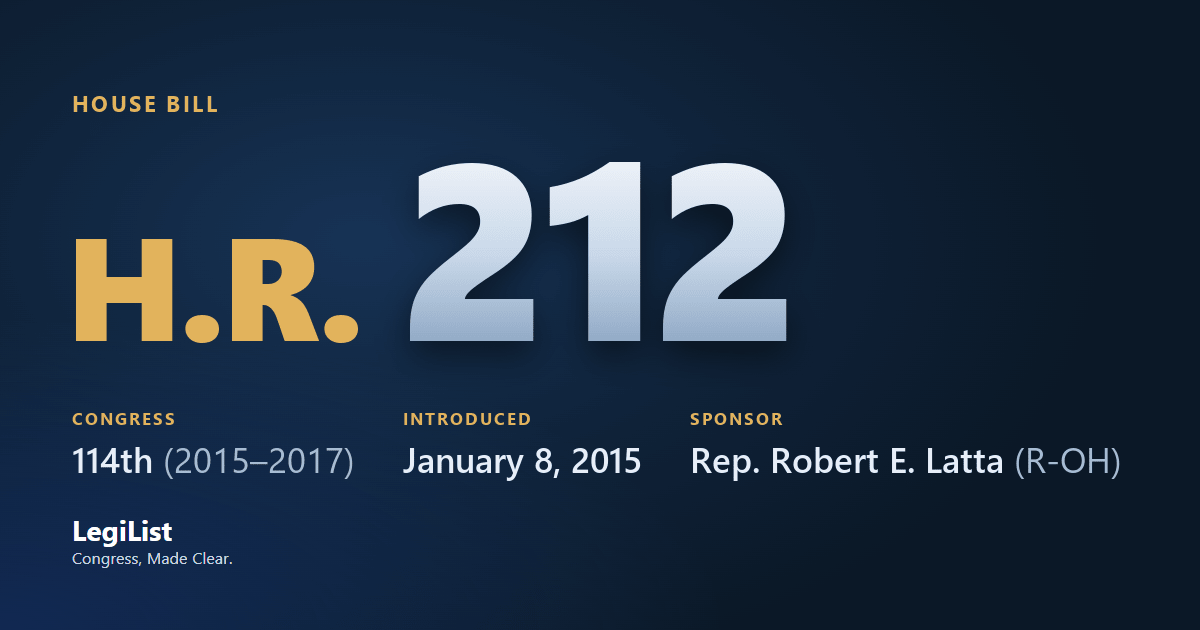
To amend the Safe Drinking Water Act to provide for the assessment and management of the risk of algal toxins in drinking water, and for other purposes.
Latest action · Aug 7, 2015 Became Public Law No: 114-45.
Progress
Where this bill reached, and when. A stage with no date was not reached; one that failed a vote and later carried shows the date it carried.
- IntroducedJan 8, 2015
- Passed HouseFeb 24, 2015
- Passed SenateAug 5, 2015
- To the PresidentAug 6, 2015
- Became lawAug 7, 2015Public Law 114-45
Summary
(This measure has not been amended since it was passed by the House on February 24, 2015. The summary of that version is repeated here.)
Drinking Water Protection Act
(Sec. 2) This bill amends the Safe Drinking Water Act to direct the Environmental Protection Agency (EPA) to develop and submit to Congress a strategic plan for assessing and managing risks associated with algal toxins in drinking water provided by public water systems. Cyanobacteria, also known as blue-green algae, have the ability to produce cyanotoxins, or algal toxins. When certain conditions are favorable, algae can rapidly multiply causing blooms, or dense surface scums, that may be toxic.
The plan must include steps and time lines to:
- evaluate the risk to human health from drinking water contaminated with algal toxins;
- establish, publish, and update a comprehensive list of algal toxins that may have an adverse effect on human health, taking into account likely exposure levels;
- summarize the known adverse human health effects of algal toxins and the factors that cause toxin-producing cyanobacteria and algae to grow rapidly and make toxins;
- determine whether to publish health advisories for algal toxins and establish guidance regarding feasible analytical methods to quantify the presence of algal toxins and guidance regarding the frequency of monitoring necessary to determine if the algal toxins are present;
- recommend feasible treatment options, including procedures, equipment, and source water protection practices; and
- enter into cooperative agreements with, and provide technical assistance to, affected states and public water systems to manage risks associated with algal toxins.
The EPA must update and resubmit the plan as appropriate.
The EPA must identify gaps in its understanding of algal toxins. It must also assemble and publish information from each agency that has examined or analyzed cyanobacteria or algal toxins or addressed public health concerns related to harmful algal blooms.
The Government Accountability Office must submit to Congress an inventory of funds expended by the United States for each of FY2010 through 2014 to examine or analyze toxin-producing cyanobacteria and algae or address public health concerns related to harmful algal blooms. The inventory must include the specific purpose for which the funds were made available, the law under which the funds were authorized, and the agency that received or spent the funds.
Recorded votes 1
Newest first. Open one to see how every member voted.
Cosponsors 6
Members who signed on, in the order they did. Signatures ran from Jan 8, 2015 to Feb 10, 2015; 3 are original cosponsors, there from the day it was introduced.
| Seat | Cosponsor | Signed on | |
|---|---|---|---|
| R-MI | Candice S. Miller | Original | Jan 8, 2015 |
| D-OH | Marcy Kaptur | Original | Jan 8, 2015 |
| D-IL | Mike Quigley | Original | Jan 8, 2015 |
| R-WV | David B. McKinley | Feb 10, 2015 | |
| R-OH | David P. Joyce | Feb 10, 2015 | |
| R-PA | Tim Murphy | Feb 10, 2015 |
Committees 1
Where it was sent and what each committee and subcommittee did with it, in order.
| Chamber | Committee | What it did |
|---|---|---|
| House | Energy and Commerce Committee | Referred Jan 8, 2015Reported Feb 24, 2015 |
| Environment Subcommittee | Referred Jan 9, 2015 |
Actions 19
Everything that happened, newest first.
- Aug 7, 2015Signed by President.
- Aug 7, 2015Became Public Law No: 114-45.
- Aug 6, 2015Message on Senate action sent to the House.
- Aug 6, 2015Presented to President.
- Aug 5, 2015Passed/agreed to in Senate: Passed Senate without amendment by Voice Vote. (consideration: CR S6348-6349)
In the Congressional Record 5
Days the Record’s own index lists this bill, newest first, with the pages and the members it names. Pages starting H are the House, S the Senate, E Extensions of Remarks.
| Where | In the Record | Members | Date |
|---|---|---|---|
| Senate | Debate and remarks S6348–S6350 | Rob Portman R-OH, Sheldon Whitehouse D-RI | Aug 5, 2015 |
| Senate | Debate and remarks S6228–S6231 | Rob Portman R-OH, Sheldon Whitehouse D-RI, Sherrod Brown D-OH | Aug 3, 2015 |
| Senate | Debate and remarks S6175, S6176, S6177 | Rob Portman R-OH, Tom Udall D-NM | Jul 30, 2015 |
| Extensions | Debate and remarks E258 | Candice S. Miller R-MI | Feb 26, 2015 |
| House | Debate and remarks H1094, H1095Text printed H1094Recorded votes H1100enact | Frank Pallone, Jr. D-NJ, Marcy Kaptur D-OH, Robert E. Latta R-OH | Feb 24, 2015 |
Research
What has been written about this bill: committee reports, cost estimates, the sponsor’s authority statement, printed hearings and the Congressional Research Service’s work.
Committee report
Congressional Budget Office cost estimate
- Feb 18, 2015H.R. 212, Drinking Water Protection ActAs ordered reported by the House Committee on Energy and Commerce on February 12, 2015
Constitutional authority
The sponsor’s statement, as printed in the Congressional Record, vol. 161, no. 3, January 8, 2015, page H156.
Printed hearings 1
Hearings whose printed record names this bill, newest first: hearings on it, and wider hearings where it came up.
| Number | Hearing | Committee | Held |
|---|---|---|---|
| Serial No. 114-7 | H.R. 212, THE DRINKING WATER PROTECTION ACT88 pages | Energy and Commerce Committee | Feb 5, 2015 |
CRS reports 5
Congressional Research Service work that CRS links to this bill or the law it became, newest first.
Cite it 5
Products on other subjects that cite it, usually among other measures.
| Product | Title | Kind | Published |
|---|---|---|---|
| R46921 | Marine Harmful Algal Blooms (HABs): Background, Statutory Authorities, and Issues for Congress | Report | Sep 27, 2021 |
| RL31243 | Safe Drinking Water Act (SDWA): A Summary of the Act and Its Major Requirements | Report | Jul 1, 2021 |
| IF10690 | Freshwater Harmful Algal Blooms: An Overview Archived | Resource | Jul 8, 2020 |
| R44871 | Freshwater Harmful Algal Blooms: Causes, Challenges, and Policy Considerations Archived | Report | Jul 8, 2020 |
| IF10269 | Algal Toxins in Drinking Water: EPA Health Advisories Archived | Resource | Aug 18, 2015 |
Related bills 2
Companion bills and other measures the record links to this one.
| Bill | Title | Relationship | Latest action |
|---|---|---|---|
| S 460 | Drinking Water Protection Act | Related bill | Feb 11, 2015 |
| HR 1709 | To amend the Safe Drinking Water Act to provide for the assessment and management of the risks of drought to drinking water, and for other purposes. | Related bill | Mar 27, 2015 |
Titles 3
Every title it has carried, official and short, at each stage.
- Official Title as Introduced
- To amend the Safe Drinking Water Act to provide for the assessment and management of the risk of cyanotoxins in drinking water, and for other purposes.
- Official Titles as Amended by House
- To amend the Safe Drinking Water Act to provide for the assessment and management of the risk of algal toxins in drinking water, and for other purposes.
- Short Titles as Introduced
- Drinking Water Protection Act
Subjects
Assigned by the Library of Congress. Policy area: Environmental Protection.
Text 5
Each version as it was printed, newest first.
- —Enrolled Bill
- Feb 25, 2015Received in Senate
- Feb 24, 2015Reported in House
- Feb 24, 2015Engrossed in House
- Jan 8, 2015Introduced in House
Support LegiList
This page is free, carries no paywall, and is built and maintained by one person. If the record here is useful to you, a few dollars keeps it going.
Everything here is as published by Congress: the summary is the Congressional Research Service's, the action wording is the clerks', and the subjects are the Library of Congress's. How far it got is read from the actions themselves, taking the most recent one of each kind, so a bill that failed a vote and later passed is shown as having passed. Records come from this bill on Congress.gov and govinfo.gov; cost estimates are the Congressional Budget Office's, and the hearings are the printed hearings GovInfo publishes, which can appear months after the hearing.