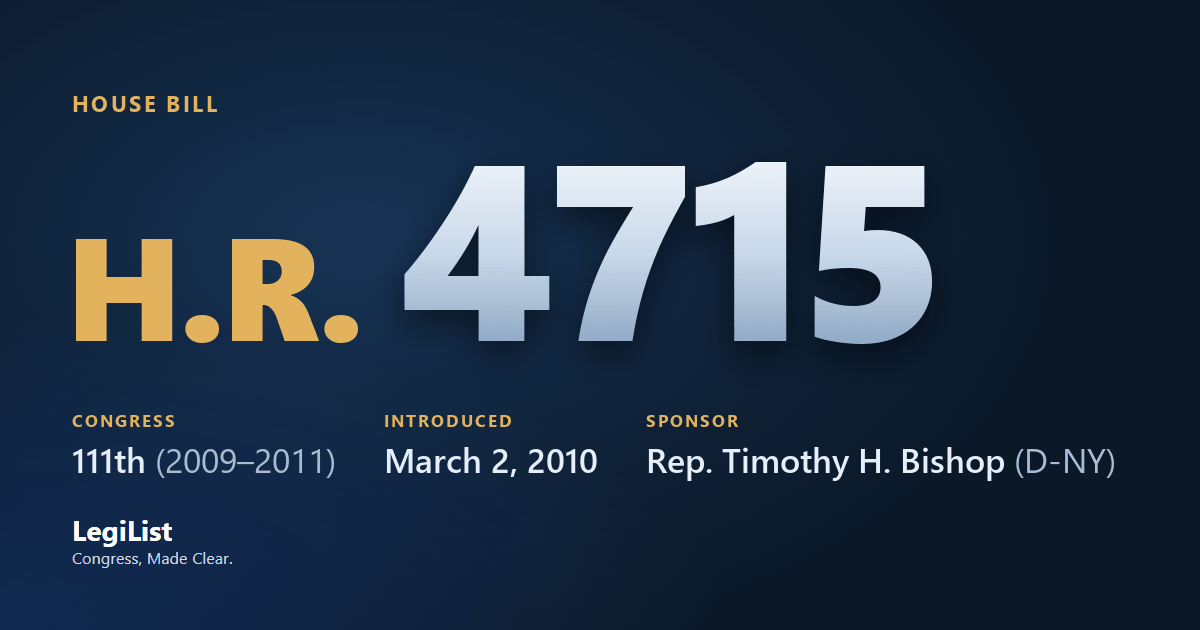
Clean Estuaries Act of 2010
Latest action · Sep 16, 2010 Placed on Senate Legislative Calendar under General Orders. Calendar No. 569.
Progress
Where this bill reached, and when. A stage with no date was not reached; one that failed a vote and later carried shows the date it carried.
- IntroducedMar 2, 2010
- Passed HouseApr 15, 2010
- Passed SenateNot reached
- To the PresidentNot reached
- Became lawNot reached
Summary
Clean Estuaries Act of 2010 - Amends the Federal Water Pollution Control Act (commonly known as the Clean Water Act) to reauthorize the National Estuary Program.
Revises the purpose of management conferences convened with respect to estuaries to expand requirements governing a comprehensive conservation and management plan by requiring such a plan to: (1) identify the estuary and the associated upstream waters to be addressed by the plan; (2) identify healthy watershed components for protection and conservation by carrying out integrated assessments of aquatic habitat and biological integrity, water quality; and natural hydrologic flows; (3) consider sustainable commercial activities in the estuary; (4) address the impacts of climate change on the estuary; (5) increase public education and awareness with respect to the ecological health and water quality conditions of the estuary and to ocean, estuarine, land, and atmospheric connections and interactions; (6) identify, assess, and provide the applicable state with information on impairments, including significant adverse upstream impairments coming from outside of the area addressed by the plan, and the sources of those impairments; (7) include performance measures and goals to track implementation of the plan; (8) include a coordinated monitoring strategy for government and other entities; (9) monitor (and make results available to the public regarding) water quality conditions in the estuary and the associated upstream waters, healthy watershed and habitat conditions that relate to the ecological health and water quality conditions of the estuary, and the effectiveness of actions taken pursuant to the plan; and (10) provide information and educational activities on the estuary's ecological health and water quality conditions.
Requires a management conference's membership to include, among other entities, not-for-profit organizations.
Requires a management conference, in updating or developing a new plan, to make use of collaborative processes to: (1) ensure equitable inclusion of affected interests and the accessibility of relevant information to members; (2) engage with members of the conference through the use of consensus-based decision rules and assistance from impartial facilitators; (3) promote accountability and transparency by ensuring members are informed of conference purposes and objectives and evaluation results in a timely manner; (4) identify roles and responsibilities of members in conference proceedings and plan implementation; and (5) seek resolution of conflicts or disputes.
Requires the Administrator of the Environmental Protection Agency (EPA) to: (1) evaluate the implementation of each comprehensive conservation and management plan developed under the Program to determine the degree to which the goals of the plan have been met and review the program designed to implement the plan every five years; (2) submit the results of the evaluation to the appropriate management conference for review and comment; and (3) report on the results of the evaluation and make such report available to the public in the Federal Register and on the Internet. Requires management conferences to update plans 18 months after they are evaluated.
Authorizes the Administrator to consider a management conference to be in probationary status if the conference has not received approval for an updated plan within three years of the date of the evaluation's publication. Requires the Administrator to: (1) reduce a grant for the implementation of a plan developed by a management conference with probationary status; and (2) terminate a management conference and cease funding for the implementation of the plan if the conference has been in probationary status for two consecutive years.
Requires, after the Administrator's approval of a plan for an estuary, any federal action or activity affecting such estuary to be conducted in a manner consistent with such plan. Requires the Secretary of the Army, the Administrator of the National Oceanic and Atmospheric Administration (NOAA), the Director of the United States Fish and Wildlife Service, the Secretary of the Department of Agriculture, the Director of the United States Geological Survey (USGS), the Secretary of the Department of Transportation, the Secretary of Housing and Urban Development (HUD), and the heads of other appropriate federal agencies to: (1) cooperate and coordinate activities, including monitoring activities, related to the implementation of such plans; and (2) collaborate on the development of tools and methodologies for monitoring the ecological health and water quality conditions of estuaries covered by a management conference. Requires EPA to serve as the lead coordinating agency for such activities.
Requires an agency head, in making annual budget requests, to consider the agency's responsibilities under the Program.
Repeals provisions authorizing the Administrator to give grants to individuals for the development and implementation of plans.
Authorizes appropriations for FY2011-FY2016 for management conferences, grants, and monitoring the administration of plans.
Requires the Administrator to include measures to track the introduction and establishment of non-native species within the trend assessment program that monitors variations in environmental parameters which may affect estuarine zones.
Requires the Administrator, every five years, to: (1) evaluate the effectiveness of the Program in, and identify best practices for, improving water quality, natural resources, and sustainable uses of estuaries covered by conferences; (2) assess the reasons why such practices resulted in the achievement of program goals; (3) identify and develop a plan for limiting redundant requirements for reporting by grant recipients; and (4) report on such evaluation to management conferences convened and the public.
Repeals provisions directing the Administrator to give priority to specified areas in the convening of conferences. Revises the definition of: (1)"estuary" to include near coastal waters and other bodies of water within the Great Lakes similar in form and function to waters otherwise described in such definition; and (2) "estuarine zones" to include such waters and transitional areas, associated aquatic ecosystems, and those portions of tributaries.
Recorded votes 3
Newest first. Open one to see how every member voted.
Cosponsors 1
Members who signed on, in the order they did. All signed on Mar 2, 2010.
| Seat | Cosponsor | Signed on | |
|---|---|---|---|
| R-NJ | Frank A. LoBiondo | Original | Mar 2, 2010 |
Committees 2
Where it was sent and what each committee and subcommittee did with it, in order.
| Chamber | Committee | What it did |
|---|---|---|
| House | Transportation and Infrastructure Committee | Referred Mar 2, 2010Markup Mar 3, 2010Reported Mar 17, 2010 |
| Water Resources and Environment Subcommittee | Referred Mar 3, 2010Discharged Mar 3, 2010 | |
| Senate | Environment and Public Works Committee | Referred Apr 19, 2010Markup Jun 30, 2010Reported Sep 16, 2010 |
Actions 41
Everything that happened, newest first.
- Sep 16, 2010Committee on Environment and Public Works. Reported by Senator Boxer with an amendment in the nature of a substitute. With written report No. 111-293.
- Sep 16, 2010Placed on Senate Legislative Calendar under General Orders. Calendar No. 569.
- Jun 30, 2010Committee on Environment and Public Works. Ordered to be reported with an amendment in the nature of a substitute favorably.
- Apr 19, 2010Received in the Senate and Read twice and referred to the Committee on Environment and Public Works.
- Apr 15, 2010Rule H. Res. 1248 passed House.
In the Congressional Record 4
Days the Record’s own index lists this bill, newest first, with the pages and the members it names. Pages starting H are the House, S the Senate, E Extensions of Remarks.
| Where | In the Record | Members | Date |
|---|---|---|---|
| Extensions | Debate and remarks E1485 | James L. Oberstar D-MN | Jul 29, 2010 |
| Senate | Debate and remarks S6045 | Benjamin L. Cardin D-MD | Jul 21, 2010 |
| House | Debate and remarks H2585–H2593, H2595–H2614Text printed H2585, H2601Amendments H2603, H2605, H2607, H2608Motions H2611Recorded votes H2593, H2611, H2612, H2613enactJordan motion to recommit (continue National Estuary Program funding at current levels)Shea-Porter amendment (ensure comprehensive conservation and management plans consider the impact to and potential effect of sea level change) | Bill Posey R-FL, Carol Shea-Porter D-NH (amendment), Chellie Pingree D-ME, Donna F. Edwards D-MD, Earl Blumenauer D-OR, Eddie Bernice Johnson D-TX, Fortney Pete Stark D-CA, Frank A. LoBiondo R-NJ, Frank Kratovil, Jr. D-MD (amendment), Gwen Moore D-WI (amendment), Henry Cuellar D-TX, James L. Oberstar D-MN (amendment), James P. McGovern D-MA, Jane Harman D-CA, Jay Inslee D-WA, Jim Costa D-CA, Jim Jordan R-OH (motion), Joe Baca D-CA, John Boozman R-AR, John L. Mica R-FL, Laura Richardson D-CA, Lois Capps D-CA, Lynn C. Woolsey D-CA, Mark H. Schauer D-MI (amendment), Mazie K. Hirono D-HI, Mike Pence R-IN, Steve Kagen D-WI (amendment), Timothy H. Bishop D-NY, Virginia Foxx R-NC | Apr 15, 2010 |
| House | Declaratory Statements H2506 | — | Apr 13, 2010 |
Research
What has been written about this bill: committee reports, cost estimates, the sponsor’s authority statement, printed hearings and the Congressional Research Service’s work.
Committee reports
Congressional Budget Office cost estimates 4
- Jul 8, 2010H.R. 4715, Clean Estuaries Act of 2010<p>Cost estimate for the bill as ordered reported by the Senate Committee on Environment and Public Works on June 30, 2010</p>
- Jul 8, 2010H.R. 4715, Clean Estuaries Act of 2010Cost estimate for the bill as ordered reported by the Senate Committee on Environment and Public Works on June 30, 2010
- Mar 9, 2010H.R. 4715, Clean Estuaries Act of 2010<p>Cost estimate for the bill as ordered reported by the House Committee on Transportation and Infrastructure on March 3, 2010</p>
- Mar 9, 2010H.R. 4715, Clean Estuaries Act of 2010Cost estimate for the bill as ordered reported by the House Committee on Transportation and Infrastructure on March 3, 2010
CRS reports 2
Congressional Research Service work that CRS links to this bill or the law it became, newest first.
Cite it 2
Products on other subjects that cite it, usually among other measures.
| Product | Title | Kind | Published |
|---|---|---|---|
| R40098 | Water Quality Issues in the 111th Congress: Oversight and Implementation Archived | Report | Jan 11, 2011 |
| R41517 | Water Quality Bills in the Lame Duck Session of the 111th Congress Archived | Report | Dec 23, 2010 |
Amendments 7
Amendments offered to this bill.
Related bills 3
Companion bills and other measures the record links to this one.
Titles 3
Every title it has carried, official and short, at each stage.
- Official Title as Introduced
- To amend the Federal Water Pollution Control Act to reauthorize the National Estuary Program, and for other purposes.
- Short Titles as Introduced
- Clean Estuaries Act of 2010
- Short Titles as Reported to House
- Clean Estuaries Act of 2010
Subjects
Assigned by the Library of Congress. Policy area: Environmental Protection.
Text 5
Each version as it was printed, newest first.
- Sep 16, 2010Reported to Senate
- Apr 19, 2010Referred in Senate
- Apr 15, 2010Engrossed in House
- Mar 17, 2010Reported in House
- Mar 2, 2010Introduced in House
Everything here is as published by Congress: the summary is the Congressional Research Service's, the action wording is the clerks', and the subjects are the Library of Congress's. How far it got is read from the actions themselves, taking the most recent one of each kind, so a bill that failed a vote and later passed is shown as having passed. Records come from this bill on Congress.gov and govinfo.gov; cost estimates are the Congressional Budget Office's, and the hearings are the printed hearings GovInfo publishes, which can appear months after the hearing.