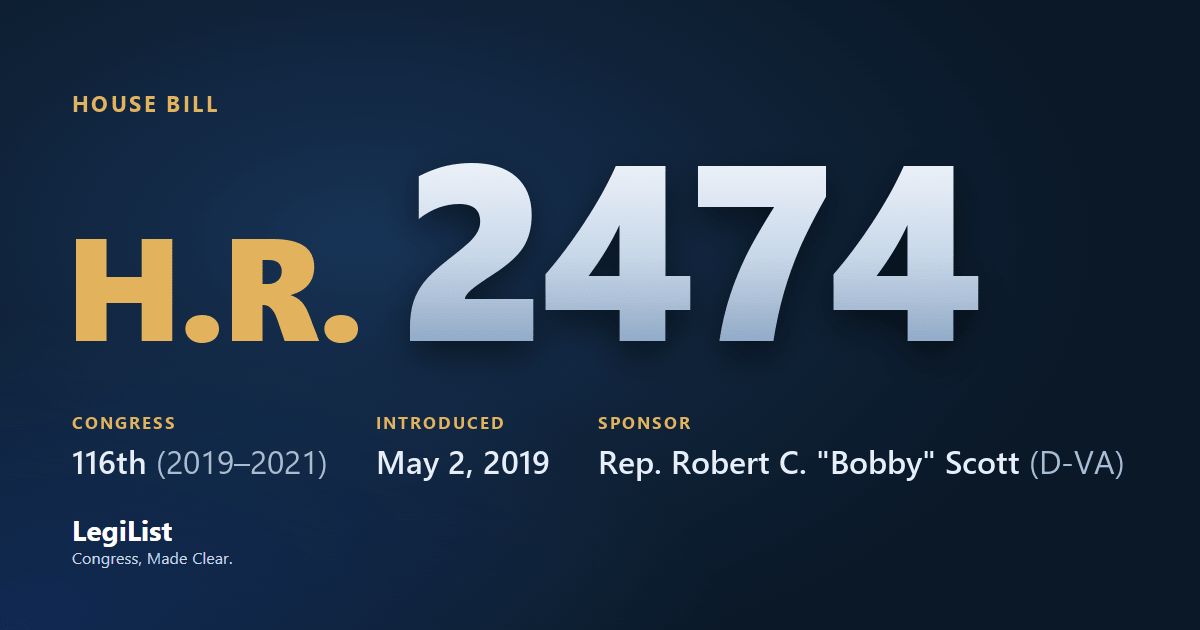
Protecting the Right to Organize Act of 2019
Latest action · Feb 10, 2020 Received in the Senate and Read twice and referred to the Committee on Health, Education, Labor, and Pensions.
Progress
Where this bill reached, and when. A stage with no date was not reached; one that failed a vote and later carried shows the date it carried.
- IntroducedMay 2, 2019
- Passed HouseFeb 6, 2020
- Passed SenateNot reached
- To the PresidentNot reached
- Became lawNot reached
Summary
Protecting the Right to Organize Act of 2019
This bill expands various labor protections related to employees' rights to organize and collectively bargain in the workplace. Specifically, it
- revises the definition of employee, supervisor, and employer to broaden the scope of individuals covered by the fair labor standards;
- permits a labor organization to encourage participation of union members in strikes initiated by employees represented by a different labor organization (i.e., secondary strikes);
- terminates the right of employers to bring claims against unions that conduct such secondary strikes;
- permits the National Labor Relations Board (NLRB) to conduct economic analysis;
- allows collective-bargaining agreements to require all employees represented by the bargaining unit to contribute fees to the labor organization for the cost of such representation, notwithstanding a state law to the contrary;
- expands unfair labor practices to include prohibitions against replacement of, or discrimination against, workers who participate in strikes;
- makes it an unfair labor practice to require or coerce employees to attend employer meetings designed to discourage union membership;
- prohibits employers from entering into agreements with employees under which employees waive the right to pursue or a join collective or class-action litigation; and
- requires the NLRB to promulgate rules requiring employers to post notices of employees' labor rights and protections and establishes penalties for failing to comply with such requirement.
The bill also addresses the procedures for union representation elections. Among other changes, the bill
- prohibits employers from participating in any NLRB representation proceedings,
- requires employers to provide a list of voters to the labor organization seeking to represent the bargaining unit in an NLRB-directed election,
- compels employers to bargain with a labor organization that has received a majority of valid votes for representation in an NLRB-directed election, and
- provides statutory authority for the requirement that the NLRB must set preelection hearings to begin not later than 8 days after notifying the labor organization of such a petition and set postelection hearings to begin not later than 14 days after an objection to a decision has been filed.
The bill modifies the protections against unfair labor practices that result in serious economic harm such as the discharge of an employee. Specifically, the bill
- removes current limits on a court's ability to provide temporary injunctive relief upon a petition by the NLRB;
- expands the available remedies for employees subject to such harms to include two times the amount of actual damages (e.g., back pay), consequential damages; and punitive damages; and
- establishes a civil penalty in addition to any damage awards.
The bill further prohibits employers from taking adverse actions against an employee, including employees with management responsibilities, in response to that employee participating in protected activities related to the enforcement of the prohibitions against unfair labor practices (i.e., whistleblower protections). Such protected activities include
- providing information about a potential violation to an enforcement agency,
- participating in an enforcement proceeding,
- initiating a proceeding concerning an alleged violation or assisting in such a proceeding, or
- refusing to participate in an activity the employee reasonably believes is a violation of labor laws.
The bill also specifies procedures for adjudicating complaints, including, filing requirements, criteria for making determinations of violations, types of available relief, evidentiary guidelines, and judicial review of NLRB determinations.
The bill generally establishes penalties and permits injunctive relief against entities that fail to comply with NLRB orders and creates a private right of action for employees to bring claims against employers interfering with employees' rights to organize or join a labor organization.
Additionally, the bill modifies the reporting requirements for employers engaged in arrangements with third-parties to persuade employees not to organize. Specifically, the bill narrows the scope of the exemption for arrangements that are considered legal advice or representation.
The Government Accountability Office must analyze and report on comparative collective-bargaining practices in countries outside the United States.
Recorded votes 10
Newest first. Open one to see how every member voted.
Cosponsors 218
Members who signed on, in the order they did. Signatures ran from May 2, 2019 to Dec 5, 2019; 99 are original cosponsors, there from the day it was introduced.
| Seat | Cosponsor | Signed on | |
|---|---|---|---|
| D-WA | Adam Smith | Original | May 2, 2019 |
| D-NY | Adriano Espaillat | Original | May 2, 2019 |
| D-TX | Al Green | Original | May 2, 2019 |
| D-CA | Alan S. Lowenthal | Original | May 2, 2019 |
| D-NJ | Albio Sires | Original | May 2, 2019 |
| D-NC | Alma S. Adams | Original | May 2, 2019 |
| D-IN | André Carson | Original | May 2, 2019 |
| D-MI | Andy Levin | Original | May 2, 2019 |
| D-MN | Angie Craig | Original | May 2, 2019 |
| D-CA | Anna G. Eshoo | Original | May 2, 2019 |
| D-NY | Antonio Delgado | Original | May 2, 2019 |
| D-MA | Ayanna Pressley | Original | May 2, 2019 |
| D-CA | Barbara Lee | Original | May 2, 2019 |
| D-NM | Ben Ray Luján | Original | May 2, 2019 |
| D-MS | Bennie G. Thompson | Original | May 2, 2019 |
Committees 2
Where it was sent and what each committee and subcommittee did with it, in order.
| Chamber | Committee | What it did |
|---|---|---|
| House | Education and Workforce Committee | Referred May 2, 2019Markup Sep 25, 2019Reported Dec 16, 2019 |
| Senate | Health, Education, Labor, and Pensions Committee | Referred Feb 10, 2020 |
Actions 46
Everything that happened, newest first.
- Feb 10, 2020Received in the Senate and Read twice and referred to the Committee on Health, Education, Labor, and Pensions.
- Feb 6, 2020Considered under the provisions of rule H. Res. 833. (consideration: CR H879-928; text: CR H895-898)
- Feb 6, 2020Rule provides for consideration of H. Res. 826, H.R. 2474 and H.R. 5687. The resolution provides for consideration of H.Res. 826 under a closed rule with one hour of debate. Also, the resolution provides for consideration of H.R. 2474, under a structured rule and consideration of H.R. 5687, under a structured rule. Each bill shall be debated for one hour.
- Feb 6, 2020House resolved itself into the Committee of the Whole House on the state of the Union pursuant to H. Res. 833 and Rule XVIII.
- Feb 6, 2020The Speaker designated the Honorable Earl Blumenauer to act as Chairman of the Committee.
In the Congressional Record 5
Days the Record’s own index lists this bill, newest first, with the pages and the members it names. Pages starting H are the House, S the Senate, E Extensions of Remarks.
| Where | In the Record | Members | Date |
|---|---|---|---|
| House | Debate and remarks H857, H859–H868, H879–H928, H929Text printed H859, H895–H898Amendments H868, H898, H899, H900, H902, H903, H904, H905, H907, H908, H910, H913, H914, H916, H917, H918Motions H925Recorded votes H869, H920, H921, H922, H923, H924, H926, H927Wild amendment (protect privacy of employees relative to voter lists provided to labor organizations by employers prior to a union representation election)consideration (H. Res. 833), previous questionenactStevens amendment (clarify definition of employer and employee does not preempt any State laws governing wages, work hours, workers’ compensation, or unemployment insurance)Hern motion to recommit (require labor unions verify members are eligible to work in the U.S.)Rouda amendment (clarify that nothing shall be construed to affect the jurisdictional standards of the NLRB with respect to small businesses)Meadows amendment (protect authority for States to enact laws prohibiting agreements requiring membership in a labor organization as a condition of employment)Roe amendment (require unions win a secret-ballot election in order to be certified) | Andy Levin D-MI, Barbara Lee D-CA, Ben Cline R-VA, Brad Sherman D-CA, Bradley Byrne R-AL, Brenda L. Lawrence D-MI (amendment), Carolyn B. Maloney D-NY, Daniel Lipinski D-IL, David P. Roe R-TN (amendment), Denver Riggleman R-VA, Donald Norcross D-NJ (amendment), Dusty Johnson R-SD, Eddie Bernice Johnson D-TX, Francis Rooney R-FL (amendment), Fred Keller R-PA (amendment), Frederica S. Wilson D-FL, Gerald E. Connolly D-VA, Glenn Grothman R-WI, Haley M. Stevens D-MI (amendment), Harley Rouda D-CA (amendment), Jahana Hayes D-CT (amendment), James Comer R-KY, Jamie Raskin D-MD, Janice D. Schakowsky D-IL, Joe Courtney D-CT, Juan Vargas D-CA (amendment), Judy Chu D-CA, Kevin Hern R-OK (motion), Lloyd Smucker R-PA, Lois Frankel D-FL, Lori Trahan D-MA, Marcy Kaptur D-OH, Mark DeSaulnier D-CA, Mark Meadows R-NC (amendment), Mark Pocan D-WI, Mark Takano D-CA, Mark Walker R-NC, Mary Gay Scanlon D-PA, Matt Cartwright D-PA, Max Rose D-NY, Michael C. Burgess R-TX (amendment), Nancy Pelosi D-CA, Paul A. Gosar R-AZ, Pramila Jayapal D-WA, Randy K. Weber, Sr. R-TX, Rashida Tlaib D-MI (amendment), Raul Ruiz D-CA, Rick W. Allen R-GA (amendment), Robert C. "Bobby" Scott D-VA, Rodney Davis R-IL, Ron Wright R-TX, Rosa L. DeLauro D-CT, Scott Perry R-PA, Sheila Jackson Lee D-TX (amendment), Steny H. Hoyer D-MD, Stephen F. Lynch D-MA, Steven Horsford D-NV, Susan Wild D-PA (amendment), Suzanne Bonamici D-OR, Tim Ryan D-OH, Tim Walberg R-MI, Virginia Foxx R-NC (amendment), William R. Timmons IV R-SC | Feb 6, 2020 |
| House | Debate and remarks H770, H839–H844Declaratory Statements H849 | Andy Levin D-MI, Ayanna Pressley D-MA, Ilhan Omar D-MN, Janice D. Schakowsky D-IL, Ted Budd R-NC | Feb 5, 2020 |
| House | Debate and remarks H578 | Fred Keller R-PA | Jan 28, 2020 |
| House | Debate and remarks H9112–H9116 | Andy Levin D-MI, Bonnie Watson Coleman D-NJ, Donald Norcross D-NJ, Jesús G. "Chuy" García D-IL, Mark Pocan D-WI, Mark Takano D-CA, Robert C. "Bobby" Scott D-VA | Nov 20, 2019 |
| House | Debate and remarks H5089 | Denver Riggleman R-VA | Jun 25, 2019 |
Research
What has been written about this bill: committee reports, cost estimates, the sponsor’s authority statement, printed hearings and the Congressional Research Service’s work.
Committee report
Congressional Budget Office cost estimate
- Dec 5, 2019H.R. 2474, Protecting the Right to Organize Act of 2019As ordered reported by the House Committee on Education and Labor on September 25, 2019
Constitutional authority
The sponsor’s statement, as printed in the Congressional Record, vol. 165, no. 72, May 2, 2019, page H3441.
Printed hearings 5
Hearings whose printed record names this bill, newest first: hearings on it, and wider hearings where it came up.
| Number | Hearing | Committee | Held |
|---|---|---|---|
| Serial No. 116-50 | THE FUTURE OF WORK: PROTECTING WORKERS' CIVIL RIGHTS IN THE DIGITAL AGE76 pages | Education and Workforce Committee | Feb 5, 2020 |
| Serial No. 116-45 | FUTURE OF WORK: PRESERVING WORKER PROTECTIONS IN THE MODERN ECONOMY115 pages | Education and Workforce Committee | Oct 23, 2019 |
| Serial No. 116-37 | PROTECTING THE RIGHT TO ORGANIZE ACT: MODERNIZING AMERICA'S LABOR LAWS278 pages | Education and Workforce Committee | Jul 25, 2019 |
| Serial No. 116-32 | STANDING WITH PUBLIC SERVANTS: PROTECTING THE RIGHT TO ORGANIZE121 pages | Education and Workforce Committee | Jun 26, 2019 |
| Serial No. 116-21 | THE PROTECTING THE RIGHT TO ORGANIZE ACT: DETERRING UNFAIR LABOR PRACTICES157 pages | Education and Workforce Committee | May 8, 2019 |
Amendments 16
Amendments offered to this bill.
Related bills 3
Companion bills and other measures the record links to this one.
Titles 5
Every title it has carried, official and short, at each stage.
- Official Title as Introduced
- To amend the National Labor Relations Act, the Labor Management Relations Act, 1947, and the Labor-Management Reporting and Disclosure Act of 1959, and for other purposes.
- Short Title(s) as Introduced
- Protecting the Right to Organize Act of 2019
- Short Title(s) as Reported to House
- Protecting the Right to Organize Act of 2019
- Short Title(s) as Passed House
- Protecting the Right to Organize Act of 2019
- Short Titles from RFS (Referred to Senate) bill text
- Protecting the Right to Organize Act of 2019
Subjects
Assigned by the Library of Congress. Policy area: Labor and Employment.
Text 4
Each version as it was printed, newest first.
- Feb 10, 2020Referred in Senate
- Feb 6, 2020Engrossed in House
- Dec 16, 2019Reported in House
- May 2, 2019Introduced in House
Everything here is as published by Congress: the summary is the Congressional Research Service's, the action wording is the clerks', and the subjects are the Library of Congress's. How far it got is read from the actions themselves, taking the most recent one of each kind, so a bill that failed a vote and later passed is shown as having passed. Records come from this bill on Congress.gov and govinfo.gov; cost estimates are the Congressional Budget Office's, and the hearings are the printed hearings GovInfo publishes, which can appear months after the hearing.