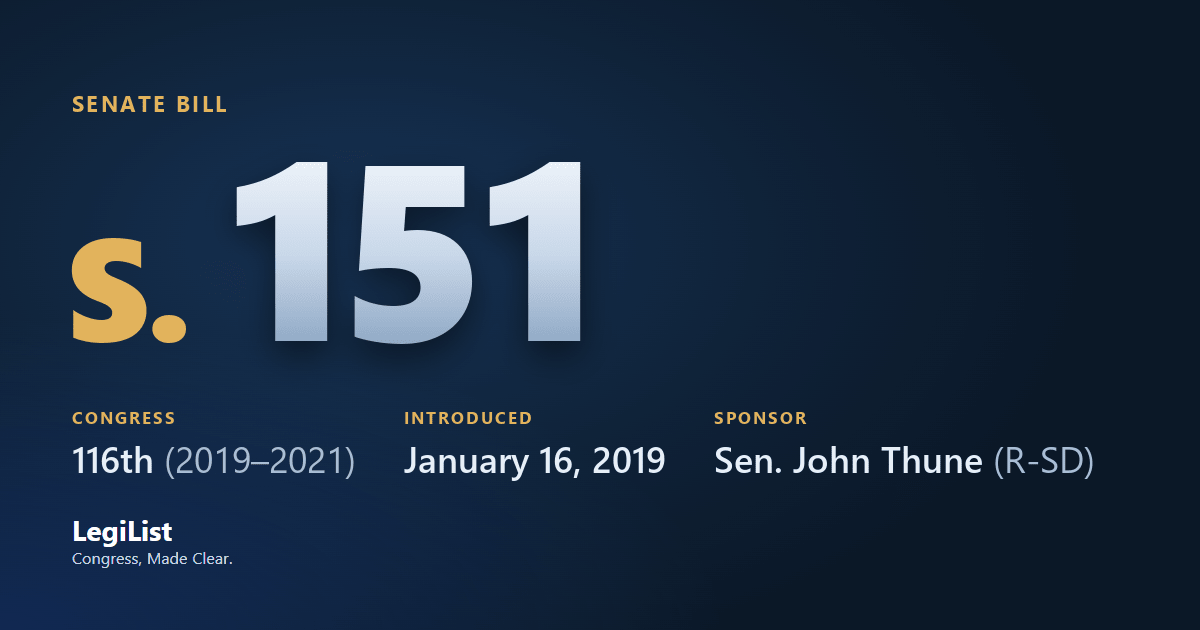
Pallone-Thune TRACED Act
Latest action · Dec 30, 2019 Became Public Law No: 116-105.
Progress
Where this bill reached, and when. A stage with no date was not reached; one that failed a vote and later carried shows the date it carried.
- IntroducedJan 16, 2019
- Passed SenateMay 23, 2019
- Passed HouseDec 4, 2019
- To the PresidentDec 20, 2019
- Became lawDec 30, 2019Public Law 116-105
Summary
Pallone-Thune Telephone Robocall Abuse Criminal Enforcement and Deterrence Act or the Pallone-Thune TRACED Act
This bill establishes rules and requirements to deter criminal robocall violations.
Specifically, the Federal Communications Commission (FCC) must
- require voice service providers to develop call authentication technologies;
- initiate a rulemaking to protect a subscriber from receiving unwanted calls or texts from a caller using an unauthenticated number;
- establish when a provider may block a voice call based on information provided by the call authentication framework, but also establish a process to permit a calling party adversely affected by the framework to verify the authenticity of their calls;
- streamline the ways in which a private entity may voluntarily share information with the FCC relating to a call or text message that violates robocall restrictions;
- determine whether its policies regarding access to number resources could be modified to help reduce access to numbers by potential robocall violators;
- report on the implementation of the reassigned number database;
- implement consumer protections for exempted classes of robocalls;
- ensure opt-out/opt-in robocall blocking services provide transparency and redress options for consumers and callers with no additional line item charge to consumers or additional charge to callers for resolving complaints related to erroneously blocked calls;
- study whether to require a provider of a Voice over Internet Protocol (VoIP) service to give the FCC its contact information and retain a record of each call transmitted over the VoIP service that is sufficient to trace a call back to its source;
- provide the Department of Justice with any evidence obtained suggesting a robocall violation made with an intent to defraud or cause harm;
- protect called parties from one-ring scams (where a caller allows the call to ring for a short duration to prompt the called party to return the call and incur charges);
- establish a registration process for a single consortium that conducts private-led efforts to trace back the origin of suspected unlawful robocalls; and
- establish the Hospital Robocall Protection Group to issue best practices for combating unlawful robocalls made to hospitals, helping hospitals protect themselves, and assisting federal and state governments to combat such calls.
The bill also implements a forfeiture penalty for violations (with or without intent) of the prohibitions on certain robocalls.
Recorded votes 2
Newest first. Open one to see how every member voted.
Cosponsors 84
Members who signed on, in the order they did. Signatures ran from Jan 16, 2019 to May 21, 2019; 1 is an original cosponsor, there from the day it was introduced.
| Seat | Cosponsor | Signed on | |
|---|---|---|---|
| D-MA | Edward J. Markey | Original | Jan 16, 2019 |
| D-MN | Amy Klobuchar | Mar 7, 2019 | |
| R-CO | Cory Gardner | Mar 7, 2019 | |
| R-KS | Jerry Moran | Mar 7, 2019 | |
| R-ND | John Hoeven | Mar 7, 2019 | |
| R-FL | Marco Rubio | Mar 7, 2019 | |
| D-CT | Richard Blumenthal | Mar 7, 2019 | |
| D-IL | Richard J. Durbin | Mar 7, 2019 | |
| D-RI | Sheldon Whitehouse | Mar 7, 2019 | |
| R-WV | Shelley Moore Capito | Mar 7, 2019 | |
| D-IL | Tammy Duckworth | Mar 7, 2019 | |
| R-NE | Deb Fischer | Mar 14, 2019 | |
| I-AZ | Kyrsten Sinema | Mar 14, 2019 | |
| I-ME | Angus S. King Jr. | Mar 26, 2019 | |
| D-MA | Elizabeth Warren | Mar 26, 2019 |
Committees 2
Where it was sent and what each committee and subcommittee did with it, in order.
| Chamber | Committee | What it did |
|---|---|---|
| Senate | Commerce, Science, and Transportation Committee | Referred Jan 16, 2019Markup Apr 3, 2019Reported May 21, 2019 |
| House | Energy and Commerce Committee | Referred May 24, 2019 |
| Communications and Technology Subcommittee | Referred May 25, 2019 |
Actions 27
Everything that happened, newest first.
- Dec 30, 2019Signed by President.
- Dec 30, 2019Became Public Law No: 116-105.
- Dec 20, 2019Presented to President.
- Dec 19, 2019Measure laid before Senate by unanimous consent. (consideration: CR S7177)
- Dec 19, 2019Resolving differences -- Senate actions: Senate agreed to the House amendment to S. 151 by Voice Vote.
In the Congressional Record 10
Days the Record’s own index lists this bill, newest first, with the pages and the members it names. Pages starting H are the House, S the Senate, E Extensions of Remarks.
| Where | In the Record | Members | Date |
|---|---|---|---|
| Senate | Debate and remarks S7513 | John Thune R-SD | Dec 16, 2020 |
| Senate | Debate and remarks S102 | John Thune R-SD | Jan 9, 2020 |
| Senate | Debate and remarks S7176, S7177Motions S7177 | Edward J. Markey D-MA, John Thune R-SD (motion) | Dec 19, 2019 |
| Senate | Debate and remarks S7126 | John Thune R-SD | Dec 18, 2019 |
| Senate | Debate and remarks S7015 | John Thune R-SD | Dec 12, 2019 |
Research
What has been written about this bill: committee reports, cost estimates, the sponsor’s authority statement, printed hearings and the Congressional Research Service’s work.
Committee report
Congressional Budget Office cost estimate
- May 9, 2019S. 151, TRACED ActAs ordered reported by the Senate Committee on Commerce, Science, and Transportation on April 3, 2019
Printed hearings 1
Hearings whose printed record names this bill, newest first: hearings on it, and wider hearings where it came up.
| Number | Hearing | Committee | Held |
|---|---|---|---|
| S. Hrg. 116-355 | ILLEGAL ROBOCALLS: CALLING ALL TO STOP THE SCOURGE62 pages | Commerce, Science, and Transportation Committee | Apr 11, 2019 |
CRS reports 6
Congressional Research Service work that CRS links to this bill or the law it became, newest first.
Cite it 6
Products on other subjects that cite it, usually among other measures.
| Product | Title | Kind | Published |
|---|---|---|---|
| R48941 | Combating Robocalls and Robotexts: Background, Selected FCC Activity, and Legislative Activity in the 119th Congress | Report | May 12, 2026 |
| RL34619 | Use of the Capitol Rotunda, Capitol Grounds, and Emancipation Hall: Concurrent Resolutions, 101st to 119th Congresses | Report | Feb 6, 2026 |
| IN11510 | Lying in State or Honor in the U.S. Capitol by Non-Members of Congress | Insight | Jan 15, 2025 |
| R45724 | House Select Committee on the Modernization of Congress: Structure and Procedures Archived | Report | Apr 15, 2020 |
| R46311 | Federal Communications Commission: Progress Protecting Consumers from Illegal Robocalls Archived | Report | Apr 10, 2020 |
Related bills 8
Companion bills and other measures the record links to this one.
| Bill | Title | Relationship | Latest action |
|---|---|---|---|
| HR 721 | Spam Calls Task Force Act of 2019 | Related bill | Apr 30, 2019 |
| S 819 | Federal Communications Commission Reporting Modernization Act of 2019 | Related bill | Mar 14, 2019 |
| HR 1602 | TRACED Act | Identical bill | Mar 8, 2019 |
| HR 2015 | TRACED Act | Identical bill | Apr 2, 2019 |
| HR 3264 | Ending One-Ring Scams Act of 2019 | Related bill | Jun 14, 2019 |
Titles 19
Every title it has carried, official and short, at each stage.
- Official Title as Introduced
- A bill to deter criminal robocall violations and improve enforcement of section 227(b) of the Communications Act of 1934, and for other purposes.
- Short Titles as Passed House
- Pallone-Thune Telephone Robocall Abuse Criminal Enforcement and Deterrence Act
- Pallone-Thune TRACED Act
- Short Titles as Enacted
- Pallone-Thune TRACED Act
- Pallone-Thune Telephone Robocall Abuse Criminal Enforcement and Deterrence Act
- Other Short Titles
- Pallone-Thune Telephone Robocall Abuse Criminal Enforcement and Deterrence Act
- Pallone-Thune TRACED Act
- Short Title(s) as Introduced
- Telephone Robocall Abuse Criminal Enforcement and Deterrence Act
- TRACED Act
- Short Title(s) as Reported to Senate
- Telephone Robocall Abuse Criminal Enforcement and Deterrence Act
- TRACED Act
- Short Title(s) as Passed Senate
- TRACED Act
- Telephone Robocall Abuse Criminal Enforcement and Deterrence Act
- Short Titles from ENR (Enrolled) bill text
- Pallone-Thune Telephone Robocall Abuse Criminal Enforcement and Deterrence Act
- Pallone-Thune TRACED Act
- Short Title(s) from Engrossed Amendment House bill text
- Pallone-Thune TRACED Act
- Pallone-Thune Telephone Robocall Abuse Criminal Enforcement and Deterrence Act
- Short Titles from RFH (Referred to House) bill text
- Telephone Robocall Abuse Criminal Enforcement and Deterrence Act
- TRACED Act
Subjects
Assigned by the Library of Congress. Policy area: Science, Technology, Communications.
- Administrative law and regulatory procedures
- Civil actions and liability
- Congressional oversight
- Department of Justice
- Executive agency funding and structure
- Federal Communications Commission (FCC)
- Fraud offenses and financial crimes
- Government studies and investigations
- Internet and video services
- Internet, web applications, social media
- Marketing and advertising
- Right of privacy
- Science, Technology, Communications
- Telephone and wireless communication
Text 6
Each version as it was printed, newest first.
- —Enrolled Bill
- Dec 4, 2019Engrossed Amendment House
- May 24, 2019Referred in House
- May 23, 2019Engrossed in Senate
- May 21, 2019Reported to Senate
- Jan 16, 2019Introduced in Senate
Everything here is as published by Congress: the summary is the Congressional Research Service's, the action wording is the clerks', and the subjects are the Library of Congress's. How far it got is read from the actions themselves, taking the most recent one of each kind, so a bill that failed a vote and later passed is shown as having passed. Records come from this bill on Congress.gov and govinfo.gov; cost estimates are the Congressional Budget Office's, and the hearings are the printed hearings GovInfo publishes, which can appear months after the hearing.