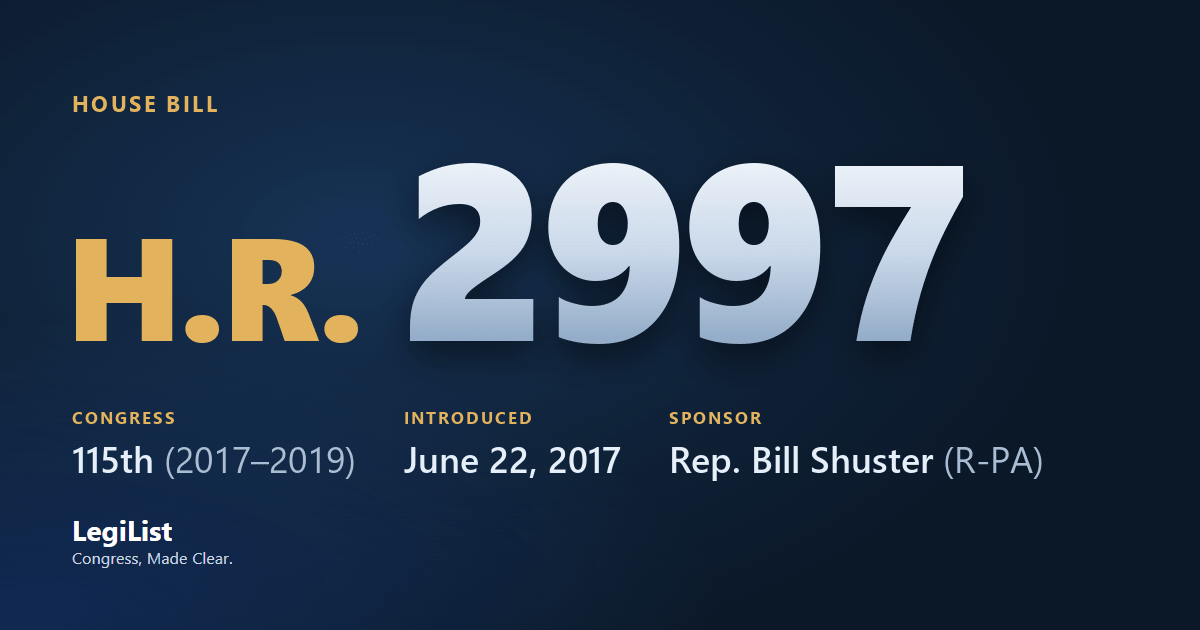
21st Century AIRR Act
Latest action · Sep 6, 2017 Placed on the Union Calendar, Calendar No. 213.
Progress
Where this bill reached, and when. A stage with no date was not reached; one that failed a vote and later carried shows the date it carried.
- IntroducedJun 22, 2017
- Passed HouseNot reached
- Passed SenateNot reached
- To the PresidentNot reached
- Became lawNot reached
Summary
21st Century Aviation Innovation, Reform, and Reauthorization Act or the 21st Century AIRR Act
This bill reauthorizes and modifies Federal Aviation Administration (FAA) programs. It also establishes the American Air Navigation Services Corporation as a federally chartered, not-for-profit corporation to assume operational control of FAA air traffic services on October 1, 2020.
The bill revises requirements for the pilot program for passenger facility charges at nonhub airports and the airport improvement program.
The bill extends the authorization for airport development at Midway Island Airport.
The Department of Transportation (DOT):
- shall carry out an environmental mitigation pilot grant program for sponsors of public-use airports; and
- may make grants to such sponsors for environmental mitigation projects to reduce or mitigate aviation impacts on noise, air quality, or water quality at the airport or within five miles of the airport.
DOT shall establish a Safety Oversight and Certification Advisory Committee.
The FAA must establish:
- the FAA Task Force on Flight Standards Reform,
- a Regulatory Consistency Communications Board,
- a safety workforce training strategy, and
- minimum dimensions for passenger seats on aircraft operated by air carriers.
The FAA must also issue an order requiring the installation of a secondary cockpit barrier on aircraft manufactured for delivery to a passenger air carrier in the United States.
DOT shall take appropriate actions to promote U.S. aerospace standards, products, and services abroad.
DOT shall modify regulations regarding flight duty limitations and rest requirements to ensure that: (1) a flight attendant scheduled for a duty period of 14 hours or less is given a scheduled rest period of at least 10 consecutive hours, and (2) the rest period is not reduced under any circumstances.
The bill prescribes certain requirements for improving passenger air service.
The bill also reauthorizes the essential air service program and the small community air service development program.
DOT shall:
- develop a comprehensive plan to accelerate the integration of civil unmanned aircraft systems (drones) into the national airspace system,
- establish a regional air transportation pilot program to provide operating assistance and grants to provide and maintain air service to communities not receiving sufficient air service,
- require each air carrier to submit for approval a one-page document that accurately describes the rights of passengers in air transportation,
- require large ticket agents to adopt minimum customer service standards, and
- establish a remote air traffic control tower pilot program for rural or small communities.
Each air carrier must submit to the FAA an Employee Assault Prevention and Response Plan related to the customer service agents of the air carrier.
The FAA shall review its strategic aviation cybersecurity plan.
Cosponsors 22
Members who signed on, in the order they did. Signatures ran from Jun 22, 2017 to Sep 5, 2017; 5 are original cosponsors, there from the day it was introduced.
| Seat | Cosponsor | Signed on | |
|---|---|---|---|
| D-HI | Colleen Hanabusa | Original | Jun 22, 2017 |
| R-NJ | Frank A. LoBiondo | Original | Jun 22, 2017 |
| I-AZ | Kyrsten Sinema | Original | Jun 22, 2017 |
| I-MI | Paul Mitchell | Original | Jun 22, 2017 |
| R-MO | Sam Graves | Original | Jun 22, 2017 |
| R-AZ | Andy Biggs | Jun 29, 2017 | |
| R-TX | Blake Farenthold | Jun 29, 2017 | |
| R-FL | Brian J. Mast | Jun 29, 2017 | |
| R-AR | Bruce Westerman | Jun 29, 2017 | |
| R-CA | Doug LaMalfa | Jun 29, 2017 | |
| R-AR | Eric A. "Rick" Crawford | Jun 29, 2017 | |
| R-MN | Jason Lewis | Jun 29, 2017 | |
| R-CA | Jeff Denham | Jun 29, 2017 | |
| R-TN | John J. Duncan, Jr. | Jun 29, 2017 | |
| R-NY | John J. Faso | Jun 29, 2017 | |
| R-PA | Lloyd Smucker | Jun 29, 2017 | |
| R-SC | Mark Sanford | Jun 29, 2017 | |
| R-GA | Rob Woodall | Jun 29, 2017 | |
| R-IL | Rodney Davis | Jun 29, 2017 | |
| R-IN | Luke Messer | Jul 24, 2017 | |
| R-NE | Don Bacon | Aug 18, 2017 | |
| D-TX | Vicente Gonzalez | Sep 5, 2017 |
Committees 1
Where it was sent and what each committee and subcommittee did with it, in order.
| Chamber | Committee | What it did |
|---|---|---|
| House | Transportation and Infrastructure Committee | Referred Jun 22, 2017Markup Jun 27, 2017Reported Sep 6, 2017 |
| Aviation Subcommittee | Referred Jun 23, 2017 |
Actions 7
Everything that happened, newest first.
- Sep 6, 2017Reported (Amended) by the Committee on Transportation and Infrastructure. H. Rept. 115-296.
- Sep 6, 2017Placed on the Union Calendar, Calendar No. 213.
- Jun 27, 2017Committee Consideration and Mark-up Session Held.
- Jun 27, 2017Ordered to be Reported (Amended) by the Yeas and Nays: 32 - 25.
- Jun 23, 2017Referred to the Subcommittee on Aviation.
In the Congressional Record 9
Days the Record’s own index lists this bill, newest first, with the pages and the members it names. Pages starting H are the House, S the Senate, E Extensions of Remarks.
| Where | In the Record | Members | Date |
|---|---|---|---|
| House | Debate and remarks H8303 | Ralph Lee Abraham R-LA | Nov 1, 2017 |
| House | Debate and remarks H8148 | Jeff Denham R-CA | Oct 25, 2017 |
| House | Debate and remarks H7905 | John J. Faso R-NY | Oct 10, 2017 |
| House | Debate and remarks H7755, H7756, H7761 | Garret Graves R-LA, John Katko R-NY, Paul Mitchell I-MI, Rob Woodall R-GA | Oct 4, 2017 |
| House | Debate and remarks H7675, H7680, H7684 | Bill Shuster R-PA, Bruce Westerman R-AR, Paul Mitchell I-MI | Oct 3, 2017 |
Research
What has been written about this bill: committee reports, cost estimates, the sponsor’s authority statement, printed hearings and the Congressional Research Service’s work.
Committee report
Congressional Budget Office cost estimates 3
- Sep 25, 2017H.R. 2997, 21st Century Aviation Innovation, Reform, and Reauthorization ActAs posted on the website of the House Committee on Rules on July 11, 2017
- Aug 15, 2017H.R. 2997, 21st Century Aviation Innovation, Reform, and Reauthorization ActAs posted by the House Committee on Rules on July 11, 2017 (g:\VHLC\071117\071117.335.xml)
- Jul 11, 2017H.R. 2997, 21st Century Aviation Innovation, Reform, and Reauthorization ActAs ordered reported by the House Committee on Transportation and Infrastructure on June 27, 2017
Constitutional authority
The sponsor’s statement, as printed in the Congressional Record, vol. 163, no. 107, June 22, 2017, page H5110.
CRS reports 4
Congressional Research Service work that CRS links to this bill or the law it became, newest first.
Cite it 4
Products on other subjects that cite it, usually among other measures.
| Product | Title | Kind | Published |
|---|---|---|---|
| R45207 | Federal Aviation Administration (FAA) Reauthorization Issues and Debate in the 115th Congress Archived | Report | May 29, 2018 |
| IN10863 | Congressional Debate on FAA Reauthorization Charts New Legislative Path Archived | Insight | May 3, 2018 |
| R45082 | Security of Air Cargo Shipments, Operations, and Facilities Archived | Report | Jan 24, 2018 |
| R44965 | Privatization and the Constitution: Selected Legal Issues | Report | Sep 25, 2017 |
Related bills 15
Companion bills and other measures the record links to this one.
| Bill | Title | Relationship | Latest action |
|---|---|---|---|
| HR 276 | To amend title 49, United States Code, to ensure reliable air service in American Samoa. | Related bill | Feb 1, 2017 |
| S 1167 | Airplane KITS Act | Related bill | May 17, 2017 |
| HR 1386 | To direct the Secretary of Transportation to establish a pilot program to assess the operational benefits of remote air traffic control towers, and for other purposes. | Related bill | Mar 8, 2017 |
| S 1424 | Federal Aviation Administration Veterans' Preference Protection Act | Related bill | Jun 22, 2017 |
| S 1450 | Commercial Flight Courtesy Act of 2017 | Related bill | Jun 28, 2017 |
Titles 5
Every title it has carried, official and short, at each stage.
- Official Title as Introduced
- To transfer operation of air traffic services currently provided by the Federal Aviation Administration to a separate not-for-profit corporate entity, to reauthorize programs of the Federal Aviation Administration, and for other purposes.
- Short Titles as Introduced
- 21st Century AIRR Act
- 21st Century Aviation Innovation, Reform, and Reauthorization Act
- Short Titles as Reported to House
- 21st Century AIRR Act
- 21st Century Aviation Innovation, Reform, and Reauthorization Act
Subjects
Assigned by the Library of Congress. Policy area: Transportation and Public Works.
- Administrative law and regulatory procedures
- Advisory bodies
- American Samoa
- Aviation and airports
- Civil actions and liability
- Congressional oversight
- Consumer affairs
- Department of Transportation
- Disability and paralysis
- Emergency medical services and trauma care
- Endangered and threatened species
- Energy storage, supplies, demand
- Environmental assessment, monitoring, research
- Executive agency funding and structure
- Government information and archives
- Government studies and investigations
- Hazardous wastes and toxic substances
- Health technology, devices, supplies
- International organizations and cooperation
- Labor standards
- Land transfers
- Land use and conservation
- Licensing and registrations
- Marketing and advertising
- Marshall Islands
- Micronesia
- Minority and disadvantaged businesses
- Motor fuels
- Museums, exhibitions, cultural centers
- Noise pollution
- Palau
- Performance measurement
- Presidents and presidential powers, Vice Presidents
- Public contracts and procurement
- Right of privacy
- Roads and highways
- Rural conditions and development
- Science and engineering education
- Solid waste and recycling
- Telephone and wireless communication
- Transportation and Public Works
- Transportation employees
- Transportation programs funding
- Transportation safety and security
- User charges and fees
- Veterans' education, employment, rehabilitation
- Virginia
- War and emergency powers
- Wildlife conservation and habitat protection
- Women's education
- Women's employment
- Women's health
- Worker safety and health
Text 2
Each version as it was printed, newest first.
- Sep 6, 2017Reported in House
- Jun 22, 2017Introduced in House
Everything here is as published by Congress: the summary is the Congressional Research Service's, the action wording is the clerks', and the subjects are the Library of Congress's. How far it got is read from the actions themselves, taking the most recent one of each kind, so a bill that failed a vote and later passed is shown as having passed. Records come from this bill on Congress.gov and govinfo.gov; cost estimates are the Congressional Budget Office's, and the hearings are the printed hearings GovInfo publishes, which can appear months after the hearing.