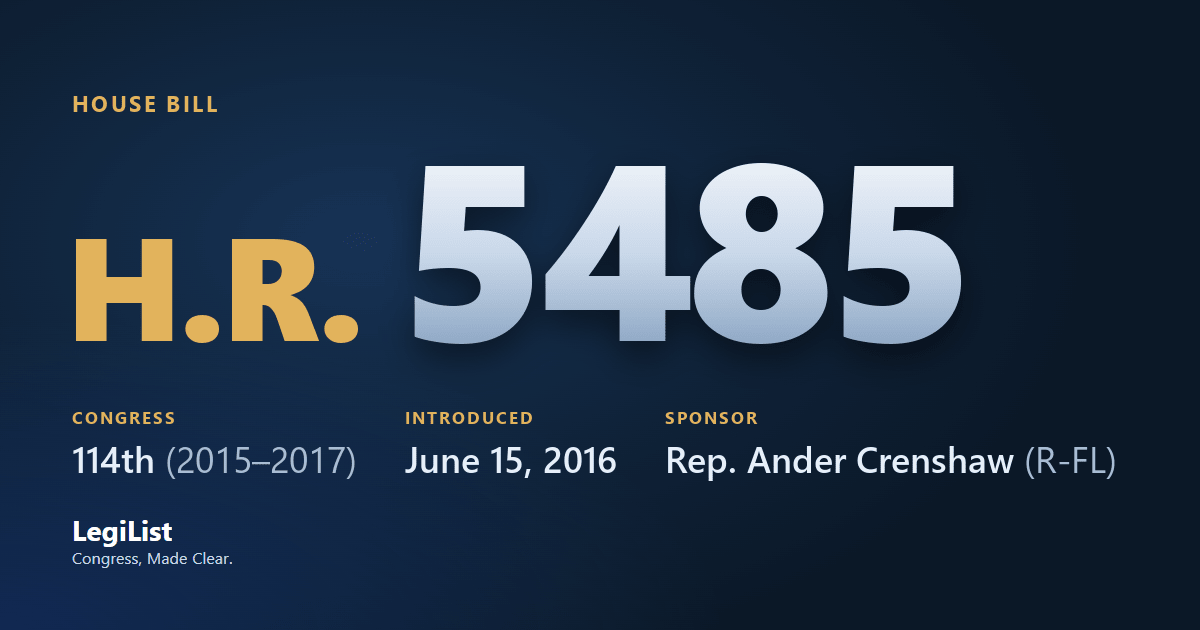
Financial Services and General Government Appropriations Act, 2017
Latest action · Jul 12, 2016 Received in the Senate. Read twice. Placed on Senate Legislative Calendar under General Orders. Calendar No. 557.
Progress
Where this bill reached, and when. A stage with no date was not reached; one that failed a vote and later carried shows the date it carried.
- IntroducedJun 15, 2016
- Passed HouseJul 7, 2016
- Passed SenateNot reached
- To the PresidentNot reached
- Became lawNot reached
Summary
Highlights:
This bill provides FY2017 appropriations to agencies responsible for:
- regulating the financial, telecommunications, and consumer products industries;
- collecting taxes and assisting taxpayers;
- managing federal buildings and the federal workforce; and
- operating the Executive Office of the President, the judiciary, and the District of Columbia.
The bill decreases overall Financial Services and General Government discretionary funding below FY2016 levels.
Compared to FY2016 levels, the bill increases funding for the judiciary, while decreasing funding for the Department of the Treasury, the District of Columbia, and the General Services Administration.
Within the Treasury budget, the bill decreases funding for the Internal Revenue Service (IRS) below FY2016 levels.The bill also includes authorizing legislation to:
- reauthorize and amend the Scholarships for Opportunity and Results Act, which authorizes education funding for the District of Columbia, including the Opportunity Scholarship Program, public schools, and public charter schools;
- establish the Office of the Advocate for Small Business Capital Formation and the Small Business Capital Formation Advisory Committee within the Securities and Exchange Commission; and
- establish a new bankruptcy process for certain financial institutions.
Other provisions included in the bill restrict funds or affect policy in areas such as:
- the implementation of the Patient Protection and Affordable Care Act;
- the implementation of the Dodd-Frank Wall Street Reform and Consumer Protection Act;
- the funding source for the Consumer Financial Protection Bureau;
- IRS determinations of tax-exempt status;
- the Federal Communications Commission's regulations regarding net neutrality and set-top boxes;
- travel to and trade with Cuba; and
- local District of Columbia policy on issues such as marijuana legalization, abortions, and needle exchange programs.
Full Summary:
Financial Services and General Government Appropriations Act, 2017
Provides FY2017 appropriations for financial services and general government, including programs within the Department of the Treasury, the Executive Office of the President, the federal judiciary, the District of Columbia, and several independent agencies.
Department of the Treasury Appropriations Act, 2017
TITLE I--DEPARTMENT OF THE TREASURY
Provides appropriations to the Department of the Treasury for Departmental Offices, including:
- Salaries and Expenses,
- the Office of Terrorism and Financial Intelligence,
- the Office of Inspector General,
- the Treasury Inspector General for Tax Administration, and
- the Special Inspector General for the Troubled Asset Relief Program.
Provides appropriations to Treasury for:
- the Financial Crimes Enforcement Network,
- the Bureau of the Fiscal Service,
- the Alcohol and Tobacco Tax and Trade Bureau,
- the U.S. Mint, and
- the Community Development Financial Institutions Fund Program Account.
Rescinds specified unobligated balances from the Treasury Forfeiture Fund.
Provides appropriations to the Internal Revenue Service (IRS) for:
- Taxpayer Services,
- Enforcement,
- Operations Support, and
- Business Systems Modernization.
(Sec. 101) Permits up to 5% of any IRS appropriation provided by this bill to be transferred to any other IRS appropriation upon advance approval of Congress.
(Sec. 102) Requires the IRS to maintain an employee training program that includes taxpayers' rights, dealing courteously with taxpayers, cross-cultural relations, ethics, and the impartial application of tax law.
(Sec. 103) Requires the IRS to institute and enforce policies and procedures to safeguard the confidentiality of taxpayers' information and protect taxpayers against identity theft.
(Sec. 104) Permits the IRS to use funds for improved facilities and increased staffing to provide sufficient and effective 1-800 help line service for taxpayers.
(Sec. 105) Bars the IRS from using funds to make a video unless it is approved in advance by the Service-Wide Video Editorial Board.
(Sec. 106) Requires the IRS to: (1) issue a notice of confirmation of any address changes relating to an employer making employment tax payments, and (2) give special consideration to an offer-in-compromise from a taxpayer who has been the victim of fraud by a third party payroll tax preparer.
(Sec. 107) Prohibits the IRS from using funds to target U.S. citizens for exercising any rights guaranteed under the First Amendment to the U.S. Constitution.
(Sec. 108) Prohibits the IRS from using funds to target groups for regulatory scrutiny based on their ideological beliefs.
(Sec. 109) Requires the IRS to comply with certain procedures and policies for conference spending that were recommended by the Treasury Inspector General for Tax Administration.
(Sec. 110) Prohibits funds from being transferred to the IRS to implement PPACA.
(Sec. 111) Prohibits the IRS from using funds to implement the requirement under PPACA that individuals maintain minimum essential health care coverage.
(Sec. 112) Prohibits the IRS from using funds for providing employee bonuses or hiring former employees without considering conduct and federal tax compliance.
(Sec. 113) Prohibits the IRS from using funds to violate the confidentiality of tax returns and return information.
(Sec. 114) Prohibits the IRS from using funds for pre-populated returns.
(Sec. 115) Provides additional funds to the IRS for measurable improvements in the customer service representative level of service rate, to improve the identification and prevention of refund fraud and identity theft, and to enhance cybersecurity to safeguard taxpayer data. Prohibits the funds from being used to support PPACA.
(Sec. 116) Permits Treasury to use funds provided by this bill for uniforms; maintenance, repairs, and cleaning; insurance for official motor vehicles operated in foreign countries; contracts with the Department of State for health and medical services to employees and their dependents serving in foreign countries; and experts or consultants.
(Sec. 117) Permits certain transfers between Treasury accounts, subject to congressional approval and specified requirements.
(Sec. 118) Permits the IRS to transfer certain funds to the Treasury Inspector General for Tax Administration, subject to congressional approval and specified requirements.
(Sec. 119) Bars Treasury or the Bureau of Engraving and Printing from using funds to redesign the $1 Federal Reserve note.
(Sec. 120) Permits Treasury to transfer funds from Bureau of Fiscal Services--Salaries and Expenses to the Debt Collection Fund to cover the costs of debt collection. Requires the transferred amounts to be reimbursed from debt collections received in the fund.
(Sec. 121) Prohibits the U.S. Mint from using funds to construct or operate any museum without congressional approval.
(Sec. 122) Prohibits the use of funds to merge the U.S. Mint and the Bureau of Engraving and Printing without congressional approval.
(Sec. 123) Deems funds provided for Treasury's intelligence-related activities as authorized for FY2017 until the enactment of the Intelligence Authorization Act for FY2017.
(Sec. 124) Permits up to $5,000 to be made available from the Bureau of Engraving and Printing's Industrial Revolving Fund for official reception and representation expenses.
(Sec. 125) Requires Treasury to submit a capital investment plan to Congress.
(Sec. 126) Requires Treasury to report to Congress on the Franchise Fund.
(Sec. 127) Prohibits Treasury from using funds for certain regulations, revenue rulings, or other guidance related to the standards used to determine the tax-exempt status of a 501(c)(4) organization.
(Sec. 128) Requires the Office of Financial Stability and the Office of Financial Research to report quarterly to Congress on their activities.
(Sec. 129) Requires the Office of Financial Research to provide public notice of at least 90 days before issuing a proposed rule, report, or regulation.
(Sec. 130) Amends the Dodd-Frank Wall Street Reform and Consumer Protection Act (Dodd-Frank) to limit the fees available for obligation by the Office of Financial Research to the amount provided in appropriations acts beginning in FY2018.
(Sec. 131) Prohibits Treasury from using funds provided by this bill to enforce specified guidance for U.S. positions on multilateral development banks which engage with developing countries on coal-fired power generation.
(Sec. 132) Prohibits funds provided by this bill from being used to approve, license, facilitate, authorize, or otherwise allow certain categories of travel to Cuba incident to non-academic educational exchanges.
(Sec. 133) Prohibits funds provided by this bill from being used to approve, license, facilitate, authorize, or otherwise allow the importation of property confiscated by the Cuban government.
(Sec. 134) Prohibits funds provided by this bill from being used to approve, license, facilitate, authorize, or otherwise allow any financial transactions with the Cuban military or intelligence service. Includes exceptions for: (1) exports permitted under the Trade Sanctions Reform and Export Enhancement Act of 2000, and (2) financial transactions necessary for the maintenance and improvement of the military base at Guantanamo Bay, Cuba.
(Sec. 135) Prohibits funds provided by this bill from being used to approve or otherwise allow the licensing of a mark, trade name, or commercial name that is substantially similar to one that was used in connection with a business or assets that were confiscated by the Cuban government, unless the original owner consents.
(Sec. 136) Prohibits the IRS from using funds provided by this bill to determine that a church, an integrated auxiliary of a church, or a convention or association of churches is not exempt from taxation for participating in, or intervening in, any political campaign unless: the IRS Commissioner consents, Congress is notified, and the determination is effective no earlier than 90 days after congressional notification.
Executive Office of the President Appropriations Act, 2017
TITLE II--EXECUTIVE OFFICE OF THE PRESIDENT AND FUNDS APPROPRIATED TO THE PRESIDENT
Provides FY2017 appropriations to the Executive Office of the President and designated accounts, including:
- the White House,
- the Executive Residence at the White House,
- White House Repair and Restoration,
- the Council of Economic Advisers,
- the National Security Council and the Homeland Security Council,
- the Office of Administration,
- Presidential Transition Administrative Support,
- the Office of Management and Budget (OMB),
- the Office of National Drug Control Policy,
- Information Technology Oversight and Reform,
- Special Assistance to the President, and
- the Official Residence of the Vice President.
(Sec. 201) Permits certain transfers of funds between accounts within the Executive Office of the President, subject to congressional approval and specified requirements.
(Sec. 202) Requires the OMB to report to Congress on the costs of implementing Dodd-Frank.
(Sec. 203) Requires the OMB to include a statement of budgetary impact with any executive order or Presidential memorandum issued during FY2017.
(Sec. 204) Prohibits funds provided by this bill from being used for statements abrogating legislation passed by Congress and signed by the President.
(Sec. 205) Prohibits funds provided by this bill from being used for an executive order or Presidential memorandum that contravenes existing law.
Judiciary Appropriations Act, 2017
TITLE III--THE JUDICIARY
Provides FY2017 appropriations to the judiciary for:
- the Supreme Court of the United States;
- the U.S. Court of Appeals for the Federal Circuit;
- the U.S. Court of International Trade;
- Courts of Appeals, District Courts, and Other Judicial Services;
- the Administrative Office of the U.S. Courts;
- the Federal Judicial Center; and
- the U.S. Sentencing Commission.
(Sec. 301) Permits funds provided by this title for salaries and expenses to be used for the employment of temporary or intermittent experts and consultants.
(Sec. 302) Permits certain transfers of funds between judiciary accounts, subject to congressional notification and specified requirements.
(Sec. 303) Permits up to $11,000 of appropriations provided for salaries and expenses for Courts of Appeals, District Courts, and Other Judicial Services to be used for official reception and representation expenses of the Judicial Conference of the United States.
(Sec. 304) Permits the delegation of authority to the judiciary for contracts for repairs that are under $100,000.
(Sec. 305) Continues a pilot program for the U.S. Marshals Service to provide perimeter security services at selected courthouses.
(Sec. 306) Amends the Judicial Improvements Act of 1990; the Transportation, Treasury, Housing and Urban Development, the Judiciary, the District of Columbia, and Independent Agencies Appropriations Act, 2006; and the 21st Century Department of Justice Appropriations Authorization Act to extend several temporary judgeships.
(Sec. 307) Increases from $40 to $50 the daily attendance fee paid to jurors.
(Sec. 308) Extends for one year the authorization of several temporary bankruptcy judgeships.
District of Columbia Appropriations Act, 2017
TITLE IV--DISTRICT OF COLUMBIA
Provides FY2017 appropriations to the District of Columbia, including federal payments for:
- Resident Tuition Support;
- Emergency Planning and Security Costs in the District of Columbia;
- District of Columbia Courts;
- Defender Services in the District of Columbia Courts;
- the Court Services and Offender Supervision Agency for the District of Columbia;
- the District of Columbia Public Defender Service;
- the Criminal Justice Coordinating Council;
- Judicial Commissions;
- School Improvement;
- the District of Columbia National Guard; and
- Testing and Treatment of HIV/AIDS.
Provides local funds for the operation of the District of Columbia out of the General Fund of the District of Columbia.
TITLE V--INDEPENDENT AGENCIES
Provides appropriations for independent agencies, including:
- the Administrative Conference of the United States,
- the Consumer Product Safety Commission,
- the Election Assistance Commission,
- the Federal Communications Commission (FCC),
- the Federal Deposit Insurance Corporation,
- the Federal Election Commission,
- the Federal Labor Relations Authority,
- the Federal Trade Commission (FTC),
- the General Services Administration (GSA),
- the Merit Systems Protection Board,
- the National Archives and Records Administration,
- the National Credit Union Administration,
- the Office of Government Ethics,
- the Office of Personnel Management (OPM),
- the Office of Special Counsel,
- the Postal Regulatory Commission,
- the Privacy and Civil Liberties Oversight Board,
- the Securities and Exchange Commission (SEC),
- the Selective Service System,
- the Small Business Administration (SBA),
- the U.S. Postal Service, and
- the U.S. Tax Court.
Requires the U.S. Postal Service to continue six day delivery and rural delivery of the mail at not less than the 1983 level.
(Sec. 501) Amends Dodd-Frank to permit the congressional appropriations committees to review transfers from the Federal Reserve system to the Consumer Financial Protection Bureau (CFPB).
(Sec. 502) Changes the CFPB's source of funding from transfers from the Federal Reserve System to annual appropriations beginning in FY2018.
(Sec. 503) Requires the CFPB to notify Congress of any request for a transfer of funds from the Board of Governors of the Federal Reserve System.
(Sec. 504) Requires the CFPB to submit to Congress quarterly reports on its activities.
(Sec. 505) Amends the Consumer Financial Protection Act of 2010 and several other laws to change the management structure of the CFPB to a five-member Board of Directors, to be appointed by the President and approved by the Senate.
(Sec. 506) Prohibits the CFPB from implementing a rule regarding the use of arbitration until specified requirements are addressed.
(Sec. 510) Prohibits the Consumer Product Safety Commission from using funds provided by this bill to finalize, implement, or enforce the proposed Safety Standard for Recreational Off-Highway Vehicles until the National Academy of Sciences completes a specified study.
(Sec. 520) Permits the GSA to use funds to hire passenger motor vehicles.
(Sec. 521) Permits funds in the Federal Buildings Fund made available for FY2017 to be transferred between activities if necessary to meet program requirements, subject to congressional approval.
(Sec. 522) Requires budget requests for courthouse construction funds to meet specified standards.
(Sec. 523) Prohibits funds provided by this bill from being used to increase square footage, provide cleaning services or security enhancements, or provide any other service usually provided through the Federal Buildings Fund to any agency that does not pay the assessed rent.
(Sec. 524) Permits the GSA to use specified funds to pay claims against the federal government that are under $250,000 and arise from direct construction projects and building acquisitions if Congress is notified in advance.
(Sec. 525) Requires the GSA, if specified congressional committees adopt a resolution granting lease authority pursuant to a prospectus, to ensure that the delineated area of procurement matches the prospectus.
(Sec. 526) Requires the GSA to submit a spending plan and explanation to Congress for each project funded with the Major Repairs and Alterations and Judiciary Capital Security Program accounts, and E-Government projects funded with the Federal Citizens Services Fund.
(Sec. 527) Eliminates the GSA's authority to transfer certain unobligated balances to the Working Capital Fund for agency-wide acquisition of capital equipment, automated data processing systems and financial management and management information systems.
(Sec. 530) Permits the SBA to transfer specified funds between appropriations accounts.
(Sec. 531) Waives loan guarantee fees for certain small business loans made to veterans and their spouses.
(Sec. 532) Rescinds specified unobligated balances from the Certified Development Company Program.
TITLE VI--GENERAL PROVISIONS--THIS ACT
Sets forth permissible, restricted, and prohibited uses for funds provided by this bill.
(Sec. 601) Prohibits funds provided by this bill from being used to pay expenses or otherwise compensate non-federal parties intervening in regulatory or adjudicatory proceedings funded in this bill.
(Sec. 602) Prohibits funds provided by this bill from being obligated beyond the current fiscal year or transferred to other appropriations unless authority is expressly provided by this bill.
(Sec. 603) Limits expenditures for consulting services to contracts where expenditures are a matter of public record, except where otherwise permitted under existing law.
(Sec. 604) Prohibits funds provided by this bill from being transferred to any department, agency, or instrumentality of the U.S. government, except pursuant to transfer authority provided by an appropriations Act.
(Sec. 605) Requires enforcement of a Tariff Act of 1930 provision barring the importation of goods manufactured using convict labor.
(Sec. 606) Requires entities receiving funds provided by this bill to comply with the Buy American Act.
(Sec. 607) Prohibits the use of funds provided by this bill by any person or entity convicted of violating the Buy American Act.
(Sec. 608) Provides authority, restrictions, and requirements for reprogramming. Requires agencies funded in this bill to submit to Congress a report establishing a baseline for the application of reprogramming and transfer authorities.
(Sec. 609) Permits up to 50% of unobligated balances remaining at the end of FY2017 for salaries and expenses to remain available through FY2018, subject to reprogramming guidelines and congressional approval.
(Sec. 610) Prohibits the Executive Office of the President from using funds provided by this bill to request either a Federal Bureau of Investigation background investigation or an IRS determination of tax-exempt status under section 501(a) of the Internal Revenue Code, except with the consent of the individual involved in an investigation or in extraordinary circumstances involving national security.
(Sec. 611) Makes certain cost accounting standards inapplicable to contracts under the Federal Employees Health Benefits Program.
(Sec. 612) Permits the OPM to accept and utilize funds made available for resolving litigation and implementing any settlement agreements regarding the nonforeign area cost-of-living allowance program.
(Sec. 613) Prohibits funds provided by this bill from being used to pay for an abortion, or the administrative expenses in connection with any health plan under the Federal Employees Health Benefits Program that provides any benefits or coverage for abortions.
(Sec. 614) Provides exceptions to the prohibition in section 613 if the life of the mother would be endangered if the fetus were carried to term, or the pregnancy is the result of an act of rape or incest.
(Sec. 615) Waives Buy American Act restrictions for commercial information technology acquired by the federal government.
(Sec. 616) Prohibits an officer or employee of any regulatory agency or commission funded by this bill from accepting payments or reimbursements for travel, subsistence, or related expenses from a person or entity regulated by the agency or commission, subject to an exception for nonprofit tax-exempt organizations.
(Sec. 617) Permits the Commodity Futures Trading Commission and the SEC to use funds for the interagency funding and sponsorship of a joint advisory committee to advise on emerging regulatory issues.
(Sec. 618) Requires agencies covered by this bill to consult with the GSA before seeking new office space or making alterations to existing office space. Permits any agency with authority to enter into an emergency lease to do so during any period declared by the President to require emergency leasing authority.
(Sec. 619) Provides funds required under current law for:
- compensation of the President;
- payments to the Judicial Officers' Retirement Fund, the Judicial Survivors' Annuities Fund, and the U.S. Court of Federal Claims Judges' Retirement Fund;
- payment of government contributions for health and life insurance benefits of federal retired employees;
- payments to finance the unfunded liability of annuity benefits under the Civil Service Retirement and Disability Fund; and
- payments of annuities authorized to be paid from the Civil Service Retirement and Disability Fund.
(Sec. 620) Prohibits the FTC from using funds provided by this bill to complete the draft report entitled "Interagency Working Group on Food Marketed to Children: Preliminary Proposed Nutrition Principles to Guide Industry Self-Regulatory Efforts" unless the Working Group complies with Executive Order 13563 (Improving Regulation and Regulatory Review).
(Sec. 621) Bars the use of funds provided by this bill for the following positions:
- Director, White House Office of Health Reform;
- Assistant to the President for Energy and Climate Change;
- Senior Advisor to the Secretary of the Treasury assigned to the Presidential Task Force on the Auto Industry and Senior Counselor for Manufacturing Policy; and
- White House Director of Urban Affairs.
(Sec. 622) Prohibits funds provided by this bill from being used in contravention of the Federal Records Act.
(Sec. 623) Requires specified regulatory agencies to report to Congress on increasing public participation in rulemaking, improving coordination among federal agencies, and identifying ineffective or excessively burdensome regulations.
(Sec. 624) Rescinds unobligated funds from the Securities and Exchange Commission Reserve Fund established by Dodd-Frank.
(Sec. 625) Prohibits the SEC from using funds provided by this bill to require the disclosure of political contributions, contributions to tax-exempt organizations, or dues paid to trade associations.
(Sec. 626) Prohibits the Financial Stability Oversight Council from designating nonbanks as systemically important financial institutions subject to certain regulations and supervision by the Federal Reserve Board of Governors until it: (1) identifies the risks to financial stability presented by the nonbank; and (2) allows the nonbank to present a plan to modify its business, structure, or operation to mitigate the identified risk prior to final designation.
(Sec. 627) Prohibits funds provided by this bill from being used to require Internet Service Providers to disclose electronic communications information in a manner that violates the Fourth Amendment of the U.S. Constitution.
(Sec. 628) Prohibits implementation from FY2017-FY2025 of an FCC rule related to joint sales agreements. (Joint sales agreements permit the sales staff of one broadcast station to sell advertising time on a separately owned station within the same local market, with the two stations dividing the revenue.)
Specifies that, in the case of a joint sales agreement to which this section applies, while the section is in effect, the FCC:
- may not require the termination or modification of a television joint sales agreement as a condition of the transfer or assignment of a station license or the transfer of station ownership or control; and
- must, upon request of the transferee or assignee of the station license, eliminate any such condition that was imposed after March 31, 2014, and permit the licensees of the stations whose advertising was jointly sold pursuant to the agreement to enter into a new joint sales agreement on substantially similar terms and conditions as the prior agreement.
(Sec. 629) Prohibits the FCC from making modifications to Universal Service Fund rules related to Mobility Fund Phase II.
(Sec. 630) Prohibits the FCC from implementing, administering, or enforcing any rule unless the FCC publishes the text of the rule 21 days before a vote on the rule.
(Sec. 631) Prohibits the FCC from regulating rates for either broadband or wireless Internet providers.
(Sec. 632) Prohibits the FCC from implementing a specified order regarding protecting and promoting the open Internet (commonly known as net neutrality) until specified court challenges have been resolved.
(Sec. 633) Requires the President's budget to include specified details regarding cybersecurity spending.
(Sec. 634) Terminates the status of the Christopher Columbus Fellowship Foundation as a federal agency within one year of enactment of this bill.
(Sec. 635) Prohibits the use of funds to maintain or establish a computer network unless the network blocks pornography. Includes an exception for a law enforcement agency or other entity carrying out criminal investigations, prosecution, adjudication activities, or other law enforcement- or victim assistance-related activity.
(Sec. 636) Prohibits the FCC from using funds provided by this bill for proposed rules related to the commercial availability of set-top boxes until: (1) the Government Accountability Office (GAO) has completed a specified study, (2) the FCC has sought public comment on the study and addressed concerned raised in the comments in a report adopted by a majority vote of the FCC.
(Sec. 637) Revises the definition of a mortgage originator with respect to manufactured housing.
(Sec. 638) Revises the definition of a high-cost mortgage with respect to manufactured housing.(Sec. 639) Prohibits the CFPB from using funds to issue or enforce any rule with respect to payday loans, vehicle title loans, or similar loans until it submits a specified report to Congress.
(Sec. 640) Prohibits funds provided by this bill from being used for Executive Order 13673 (Fair Pay and Safe Workplaces) until the GAO completes a specified study, and the Department of Labor reviews the study.
(Sec. 641) Prohibits funds provided by this bill from being used to pay for an abortion or the administrative expenses in connection with a multi-state qualified health plan offered under PPACA which provides any benefits or coverage for abortions. Includes exceptions if the life of the mother would be endangered if the fetus were carried to term, or the pregnancy is the result of rape or incest.
TITLE VII--GENERAL PROVISIONS--GOVERNMENT-WIDE
Sets forth permissible, restricted, and prohibited uses for funds provided by this and other appropriations Acts.
(Sec. 701) Requires agencies to administer a policy designed to ensure that all workplaces are free from the illegal use, possession, or distribution of controlled substances.
(Sec. 702) Establishes price limitations on vehicles purchased by the federal government and specifies exceptions.
(Sec. 703) Permits appropriations for the current fiscal year to be used for quarters and cost-of-living allowances.
(Sec. 704) Prohibits the employment of noncitizens whose posts of duty would be in the continental United States, subject to specified exceptions.
(Sec. 705) Permits appropriations provided to any department or agency for necessary expenses such as maintenance and operating expenses to be used for payments to the GSA for space and services.
(Sec. 706) Permits agencies to use receipts from the sale of materials through recycling or waste prevention programs for: (1) acquisition, waste reduction and prevention, and recycling programs; (2) other federal agency environmental management programs; and (3) other employee programs as authorized by law or as deemed appropriate by the agency.
(Sec. 707) Permits funds provided to certain corporations and agencies for administrative expenses to be used to pay rent and other service costs in the District of Columbia.
(Sec. 708) Prohibits interagency financing of boards, commissions, councils, committees, or similar groups absent prior statutory approval.
(Sec. 709) Prohibits funds from being used to implement, administer, or enforce any regulation which has been disapproved pursuant to a joint resolution.
(Sec. 710) Prohibits spending more than $5000 to redecorate or furnish the office of the head of a department or agency in specified circumstances unless Congress is notified in advance.
(Sec. 711) Permits interagency funding of national security and emergency preparedness telecommunications initiatives.
(Sec. 712) Requires agencies to certify that certain appointments were not created solely or primarily to detail an individual to the White House.
(Sec. 713) Prohibits the use of funds to prevent federal employees from communicating with Congress or to take disciplinary or personnel actions against employees for communicating with Congress.
(Sec. 714) Prohibits funds from being used for training that is not directly related to the performance of official duties.
(Sec. 715) Prohibits an agency of the executive branch from using funds for publicity or propaganda purposes and for the preparation or distribution of materials designed to support or defeat legislation pending before Congress.
(Sec. 716) Prohibits an agency from providing a federal employee's home address to any labor organization absent employee authorization or a court order.
(Sec. 717) Prohibits funds from being used to provide any non-public information such as mailing, telephone, or electronic mailing lists to any organization outside the federal government without approval of Congress.
(Sec. 718) Prohibits funds from being used for propaganda and publicity purposes not authorized by Congress.
(Sec. 719) Directs agency employees to use official time in an honest effort to perform official duties.
(Sec. 720) Allows the use of funds to finance an appropriate share of the Federal Accounting Standards Advisory Board administrative costs.
(Sec. 721) Permits agencies to transfer funds to the GSA to support specified government-wide and multiagency activities that meet certain requirements and are approved by the OMB.
(Sec. 722) Permits breastfeeding at any location in a federal building or on federal property if the woman and child are authorized to be there.
(Sec. 723) Permits interagency funding of the National Science and Technology Council, and requires the OMB to provide a report describing the budget and resources connected with the council.
(Sec. 724) Requires documents involving the distribution of federal funds to indicate the agency providing the funds and the amount provided.
(Sec. 725) Prohibits the use of funds to monitor personal information relating to the use of federal Internet sites, subject to specified exceptions.
(Sec. 726) Prohibits the use of funds provided by this bill for health plans with prescription drug coverage unless contraceptive coverage is included. Includes exemptions for certain religious plans. Prohibits plans from discriminating against individuals who refuse to provide contraceptives due to religious beliefs or moral convictions.
(Sec. 727) Specifies that the United States is committed to ensuring the health of its Olympic, Pan American, and Paralympic athletes, and supports the strict adherence to anti-doping in sports through testing, adjudication, education, and research.
(Sec. 728) Permits federal agencies and departments to use funds appropriated for official travel to participate in the fractional aircraft ownership pilot program, if consistent with OMB Circular A-126 regarding official travel for government personnel.
(Sec. 729) Prohibits funds from being used to implement OPM regulations limiting executive branch detailees to the legislative branch or to implement limitations on the Coast Guard Congressional Fellowship Program.
(Sec. 730) Prohibits agencies from using funds for additional law enforcement training facilities that are not within or contiguous to existing locations without the approval of Congress. Permits the Federal Law Enforcement Training Center to obtain the temporary use of additional facilities for training which cannot be accommodated in existing facilities.
(Sec. 731) Prohibits agencies from using funds to produce any prepackaged news story intended for broadcast or distribution in the United States, unless the story includes a notification that it was prepared or funded by the agency.
(Sec. 732) Prohibits the use of funds in contravention of the Privacy Act or associated regulations.
(Sec. 733) Prohibits the use of funds for contracts with any foreign incorporated entity which is an inverted domestic corporation. Requires a waiver if necessary for national security. Exempts contracts entered into prior to enactment of this bill.
(Sec. 734) Requires agencies to pay a fee to the OPM for processing retirements of employees who separate under Voluntary Early Retirement Authority or receive Voluntary Separation Incentive Payments.
(Sec. 735) Bars the use of funds to recommend or require any entity submitting an offer for a federal contract to disclose specified political contributions as a condition of submitting the offer.
(Sec. 736) Bars the use of funds for portraits of a federal officer or employee, including the President, the Vice President, a Member of Congress, or the head of an executive branch agency or legislative branch office.
(Sec. 737) Limits pay increases for certain categories of prevailing rate employees.
(Sec. 738) Eliminates automatic pay increases for the Vice President and certain categories of political appointees.
(Sec. 739) Requires agencies to submit annual reports to Inspectors General or senior ethics officials regarding the costs and contracting procedures for conferences that cost more than $100,000.
(Sec. 740) Prohibits the use of funds to increase, eliminate, or reduce funding for a program, project, or activity, unless the changes have been enacted into law or made using transfer or reprogramming authority provided in an appropriations Act.
(Sec. 741) Prohibits funds from being used to require contractors or employees to sign confidentiality agreements or statements restricting or prohibiting the reporting of waste, fraud, or abuse to investigative or law enforcement representatives.
(Sec. 742) Prohibits the use of funds to implement or enforce a nondisclosure agreement unless it meets specified criteria.
(Sec. 743) Prohibits the use of funds for specified transactions with any corporation with certain unpaid federal tax liabilities, unless an agency has considered suspension or debarment of the corporation and decided that further action is not necessary to protect the interests of the government.
(Sec. 744) Prohibits the use of funds for specified transactions with any corporation that was convicted of a felony within the preceding 24 months, unless an agency has considered suspension or debarment of the corporation and decided that further action is not necessary to protect the interests of the government.
(Sec. 745) Prohibits funds provided by this bill from being used for Executive Order 13690, entitled "Establishing a Federal Flood Risk Management Standard and a Process for Further Soliciting and Considering Stakeholder Input," unless specified requirements and conditions for the implementation of the executive order are satisfied.
(Sec. 746) Provides that references to "this Act" shall not apply to titles IV (District of Columbia) or VIII (General Provisions--District of Columbia) unless it is included in those titles or expressly provided for in this bill.
TITLE VIII--GENERAL PROVISIONS--DISTRICT OF COLUMBIA
Sets forth permitted, restricted, and prohibited uses of funds appropriated by this bill for the District of Columbia.
(Sec. 801) Appropriates District of Columbia funds for making refunds and paying settlements or judgments against the District of Columbia government.
(Sec. 802) Prohibits the use of federal funds provided by this bill for publicity or propaganda purposes or implementation of any policy including boycott designed to support or defeat legislation pending before Congress or any state legislature.
(Sec. 803) Establishes reprogramming procedures for federal funds.
(Sec. 804) Prohibits the use of federal funds for the salaries and expenses of shadow U.S. Representatives or Senators.
(Sec. 805) Requires official vehicles provided to any officer or employee of the District of Columbia to be used only for official duties.
(Sec. 806) Prohibits the use of federal funds for a petition drive or civil action seeking voting representation in Congress for the District of Columbia.
(Sec. 807) Bars the use of federal funds provided by this bill to distribute needles or syringes for the hypodermic injection of any illegal drug.
(Sec. 808) Specifies that nothing in this bill prevents the Council or the Mayor from addressing contraceptive coverage by health insurance plans. Expresses the intent of Congress that legislation enacted on the issue should include a conscience clause providing exceptions for religious beliefs and moral convictions.
(Sec. 809) Prohibits the use of federal funds provided by this bill to legalize or otherwise reduce penalties for the possession, use, or distribution of any schedule I substance under the Controlled Substances Act or any tetrahydrocannabinols derivative (THC, the psychoactive component of marijuana).
Prohibits the use of funds available for any officer or employee of the District of Columbia from being used to legalize or reduce penalties for possession, use, or distribution of any schedule I substance under the Controlled Substance Act or any tetrahydrocannabinols derivative (THC, the psychoactive component of marijuana) for recreational purposes.
(Sec. 810) Prohibits funds available to any officer or employee of the District of Columbia government from being used for any abortion except where the life of the mother would be endangered if the fetus were carried to term or where the pregnancy is the result of rape or incest.
(Sec. 811) Requires the Chief Financial Officer (CFO) of the District of Columbia to submit to Congress, the Mayor, and the Council a revised operating budget for agencies requiring a reallocation to address unanticipated changes in program requirements.
(Sec. 812) Requires the CFO of the District of Columbia to submit to Congress, the Mayor, and the Council a revised operating budget for the District of Columbia Public Schools that aligns the school budget to actual enrollment.
(Sec. 813) Permits the District of Columbia to reprogram or transfer funds between operating funds and capital and enterprise funds. Prohibits the transfer of any funds derived from bonds, notes, or other obligations issued for capital projects.
(Sec. 814) Prohibits federal funds from being obligated beyond the current fiscal year or transferred unless expressly permitted in this bill.
(Sec. 815) Permits up to 50% of unobligated balances available at the end of FY2017 from federal appropriations for salaries and expenses to remain available through FY2018, subject to congressional approval and reprogramming guidelines.
(Sec. 816) Appropriates local funds to the District of Columbia for FY2018 if no continuing resolution or regular appropriation for the District of Columbia is in effect. Provides the funds under the same authorities, conditions, and manner as provided for FY2017.
(Sec. 817) Repeals the Local Budget Autonomy Amendment Act of 2012 (D.C. Law 19-321).
Amends the District of Columbia Home Rule Act to specify that:
- nothing in the Act may be construed to create a continuing appropriation of the general fund of the District of Columbia;
- all funds provided for the District of Columbia must be appropriated on an annual fiscal year basis through the federal appropriations process; and
- the District of Columbia is subject to the requirements of the Anti-Deficiency Act, the Budget and Accounting Act of 1921, and all other requirements and restrictions that apply to appropriations for the fiscal year.
(Sec. 818) Provides that references to "this Act" in this title or title IV (District of Columbia) refer only to those titles, unless this Act expressly provides otherwise.
Scholarships for Opportunity and Results Reauthorization Act or the SOAR Reauthorization Act
TITLE IX--SOAR REAUTHORIZATION ACT
(Sec. 902) Repeals the D.C. Opportunity Scholarship Program School Certification Requirements Act, as contained in the Consolidated Appropriations Act, 2016.
(Sec. 903) Amends the Scholarships for Opportunity and Results Act (SOAR) to specify that the purpose is to provide educational opportunities to students in the lowest-performing Washington, DC, elementary and secondary schools.
(Sec. 904) Specifies that the Department of Education (ED) may not limit the number of eligible students receiving Opportunity Scholarship Program (OSP) scholarships, or prevent otherwise eligible students from participating in the OSP because of:
- the type of school the student previously attended;
- whether or not the individual previously received the scholarship or participated in OSP, including one previously awarded a scholarship who did not use it; or
- whether or not the student was a member of the control group used by the Institute of Education Sciences to carry out previous OSP evaluations.
(Sec. 905) Prohibits a participating school from being required to submit to more than one site visit per school year.
Requires an eligible nonprofit organization's application for an OSP grant to include a detailed description of how it will ensure:
- the financial viability of participating schools in which 85% or more of enrolled students receive and use an opportunity scholarship, and
- the utilization of internal fiscal and quality controls and compliance with financial reporting requirements.
(Sec. 906) Modifies the priorities for scholarships to give priority to:
- students who in the preceding school year attended an elementary school or secondary school identified as one of the lowest-performing schools under the District of Columbia's accountability system, and
- certain students regardless of whether they have attended a private school in the past.
(Sec. 907) Requires OSP-participating schools to:
- ensure that participating students are taught core subject matter by a teacher with a baccalaureate or equivalent degree,
- conduct criminal background checks on school employees who have direct and unsupervised interactions with students, and
- comply with all requests for data and information regarding certain reporting requirements.
Requires participating private schools to be provisionally or fully accredited or in the process of seeking accreditation.
Specifies that students who were previously awarded an opportunity scholarship in any previous year are to be treated as renewal students and not new applicants.
Requires ED to make any remaining appropriations for the OSP available to the entity administering the OSP. Permits the entity to use the funds to award new scholarships to students. Prohibits more than 5% of the unexpended funds from being used for administrative costs, parental assistance, and tutoring.
Authorizes appropriations to carry out administrative functions and to provide parental education and assistance.
(Sec. 908) Revises current OSP evaluation procedures. Requires DC and ED to:
- jointly enter into an agreement with the Institute of Education Sciences (IES) within ED to annually evaluate the OSP,
- jointly agree to monitor and evaluate D.C. public schools and public charter schools' use of funds, and
- make the evaluations public.
Requires ED to: (1) ensure that the annual OSP evaluation uses a quasi-experimental research design that does not require a control group that would prohibit eligible students from entering the OSP, and (2) disseminate information on the impact of the program.
Requires the IES to:
- assess participating students in grades 3-8 and one grade in high school,
- measure the academic achievement of all participating eligible students who use an opportunity scholarship in the specified grade years, and
- work with eligible entities receiving grants to ensure that the parents of each student agrees to permit their child to participate in the evaluations and assessments carried out by the IES.
Requires the following issues be evaluated by IES:
- a comparison of academic achievement of OSP participating students with similar backgrounds in DC public schools;
- the success of expanding choice options for parents and increasing satisfaction of parents and students with their choice;
- reasons for participating in the program;
- a comparison of retention, graduation, college admission, college persistence, and college graduation rates of OSP participating students with those in the D.C. public school comparison group;
- school safety;
- an assessment of student achievement at OSP participating schools with 85% or greater enrollment of OSP participating students; and
- other issues ED deems appropriate.
Specifies requirements for protecting the personally identifiable information of students.
(Sec. 909) Permits ED to withhold funds from DC if it fails to comply with any of the requirements, reasonable notice is given, and an opportunity for a hearing is provided.
Permits ED to direct funds to the Office of the State Superintendent of Education of the District of Columbia (OSSE). Permits the OSSE to transfer funds to subgrantees that are DC public charter schools, public charter school networks, nonprofits that support DC public charter schools, or networks of schools. Requires DC to make all necessary DC public and public charter school information available to IES for the purposes of the evaluation.
(Sec. 910) Requires ED and DC to revise their memorandum of understanding to reflect the amendments within this bill, the need to ensure that participating schools meet fire code standards and maintain certificates of occupancy, and to ensure that DC public and public charter schools meet the requirements to provide information necessary to carry out evaluations.
(Sec. 911) Defines ''core subject matter'' and redesignates certain paragraphs.
(Sec. 912) Reauthorizes the OSP through FY2021.
(Sec. 913) Specifies that the amendments in the Act apply for the 2017-2018 school year and each succeeding school year.
SEC Small Business Advocate Act of 2016
TITLE X--SEC SMALL BUSINESS ADVOCATE ACT
(Sec. 1002) Amends the Securities Exchange Act of 1934 to establish within the Securities and Exchange Commission (SEC) an Office of the Advocate for Small Business Capital Formation.
Requires the Advocate for Small Business Capital Formation to :
- assist small businesses and small business investors in resolving significant problems they may have with the SEC or with self-regulatory organizations;
- identify areas in which such businesses and investors would benefit from changes in SEC regulations or the rules of such organizations;
- identify problems that small businesses have with securing access to capital;
- analyze the potential impact on such businesses and investors of proposed SEC regulations and proposed rules that are likely to have a significant economic impact on small businesses and small business capital formation;
- conduct outreach to solicit views on relevant capital formation issues;
- propose to the SEC changes in its regulations or orders, and propose to Congress legislative, administrative, or personnel changes, to mitigate problems identified and to promote the interests of such businesses and investors;
- consult with the Investor Advocate on such proposals and advise the Investor Advocate on small business-related issues;
- submit annual reports on its activities to specified congressional committees; and
- plan, organize, and execute the annual Government-Business Forum on Small Business Capital Formation.
Establishes the Small Business Capital Formation Advisory Committee to advise the SEC on rules, regulations, and policies regarding its mission of protecting investors, maintaining fair, orderly, and efficient markets, and facilitating capital formation, as they relate to:
- capital raising by emerging, privately held small businesses and publicly traded companies with less than $250 million in public market capitalization through securities offerings;
- trading in the securities of such businesses and companies; and
- public reporting and corporate governance requirements of such businesses and companies.
Requires the SEC to assess the committee's recommendations and disclose any action it intends to take with respect to the recommendations.
Financial Institution Bankruptcy Act of 2016
TITLE XI--FINANCIAL INSTITUTION BANKRUPTCY ACT
(Sec. 1102) Amends federal bankruptcy law with respect to "covered financial corporations." Specifies that a "covered financial corporation" is an entity (other than a stockbroker, a commodity broker, or a domestic or foreign insurance company or financial institution meeting certain criteria) that is: (1) a bank holding company; or (2) a corporation that exists for the primary purpose of owning, controlling, and financing its subsidiaries, has total consolidated assets of $50 billion or greater, and whose annual gross revenues or consolidated assets meet specified tests.
(Sec. 1103) Adds "Subchapter V - Liquidation, Reorganization, or Recapitalization of a Covered Financial Corporation," to address a bankruptcy of a covered financial corporation.
Sets forth requirements and procedures regarding:
- commencement of a case concerning a covered financial corporation;
- a special trustee and bridge company;
- special transfer of the property of the estate in bankruptcy;
- treatment of qualified financial contracts and affiliate contracts;
- licenses, permits, and registrations;
- exemption from securities laws; and
- inapplicability of certain avoiding powers.
Permits a debtor holding company to transfer the assets (including executory contracts and unexpired leases) of a covered financial corporation, including the equity in all of its operating subsidiaries, to a newly-formed bridge company over a single weekend, during which a 48-hour stay of debt-collection proceedings (except payment and delivery obligations) shall apply.
Permits conversion to chapter 7 (Liquidation) of a case under subchapter V if certain conditions are met.
Prohibits a Bankruptcy Court from ordering an assets transfer unless it determines by a preponderance of the evidence that a transfer is necessary to prevent serious adverse effects on financial stability in the United States.
(Sec. 1104) Amends the judicial code to require the Chief Justice of the United States to designate at least 10 bankruptcy judges to be available to hear a Subchapter V case in bankruptcy. Permits bankruptcy judges to request to be considered for the designation.
TITLE XII--ADDITIONAL GENERAL PROVISIONS
(Sec. 1201) Establishes a spending reduction account for the amount by which spending proposed in this bill exceeds the subcommittee's allocation under the Congressional Budget Act of 1974. Specifies that the amount is $0. (Under the Rules of the House of Representatives, any savings included in the spending reduction account are not available for further appropriation during consideration of the bill.)
(Sec. 1202) Prohibits funds provided by this bill from being used to enforce provisions of the Federal Election Campaign Act of 1971 that: (1) require a member corporation to approve a trade association's solicitation of contributions from the corporation's stockholders and executive or administrative personnel, and the families of the stockholders or personnel, prior to the solicitation; and (2) prohibit a corporation from approving a solicitation by more than one trade association per year.
(Sec. 1203) Prohibits the FCC from using funds provided by this bill for any of the rules proposed pursuant to provisions of the Communications Act of 1934 regarding the privacy of customer information and other statutory provisions in the Notice of Proposed Rulemaking that was adopted by the FCC on March 31, 2016.
(Sec. 1204) Prohibits funds provided by this bill from being used to implement, administer, or enforce a new regulatory action for which the aggregate costs of state, local, and tribal government compliance or private sector compliance will be $100 million or more.
(Sec. 1205) Prohibits funds provided by this bill from being used with respect to Rainey v. Merit Systems Protection Board, which was decided by the U.S. Court of Appeals for the Federal Circuit on June 7, 2016. (The decision addressed provisions of the Whistleblower Protection Act that protect employees from retaliation for refusing to obey an order that would require the violation of a law.)
(Sec. 1206) Prohibits funds provided by this bill from being used to enforce requirements under current law for the General Services Administration to sell property associated with the Department of Homeland Security's Plum Island Animal Disease Center in Orient Point, New York.
(Sec. 1207) Prohibits funds provided by this bill from being used to relocate the Social Security Administration's Office of Disability Adjudication and Review that is located in Brooklyn, New York.
(Sec. 1208) Prohibits funds provided by this bill from being used to lease or purchase new light duty vehicles except in accordance with a specified Presidential Memorandum related to federal fleet performance.
(Sec. 1209) Prohibits funds provided by this bill from being used for a contract with companies convicted, indicted, or charged with certain crimes or that have more than $3,000 in delinquent taxes within a three-year period surrounding the contract.
(Sec. 1210) Prohibits funds provided by this bill from being used to pay certain performance awards to any career appointee within the Senior Executive Service.
(Sec. 1211) Prohibits funds provided by this bill from being used to propose or finalize a regulatory action until January 21, 2017.
(Sec. 1212) Prohibits funds provided by this bill from being used in contravention of, or to implement changes to, specified regulations regarding the transfer of funds regarding Iran.
(Sec. 1213) Prohibits funds provided by this bill from being used to carry out Operation Choke Point. (Operation Choke Point is a Department of Justice initiative to investigate and prosecute bank-related fraud involving businesses that debit customer bank accounts without proper authorization.)
(Sec. 1214) Prohibits funds provided by this bill from being used to change Selective Service System registration requirements in contravention of the Military Selective Service Act.
(Sec. 1215) Prohibits the SEC from using funds provided by this bill to require that a solicitation of a proxy, consent, or authorization to vote a security of an issuer in an election of members of the board of directors of the issuer be made using a single ballot or card that lists both individuals nominated by (or on behalf of) the issuer and individuals nominated by (or on behalf of) other proponents and permits the person granting the proxy, consent, or authorization to select from among individuals in both groups.
(Sec. 1216) Prohibits funds provided by this bill from being used to: (1) designate any nonbank financial company as "too big to fail;" (2) designate any nonbank financial company as a "systemically important financial institution;" or (3) determine that material financial distress at a nonbank financial company, or the nature, scope, size, scale, concentration, interconnectedness, or mix of the activities of the company, could pose a threat to U.S. financial stability.
(Sec. 1217) Prohibits funds provided by this bill from being used in contravention of provisions of the Illegal Immigration Reform and Immigrant Responsibility Act of 1996 regarding unrestricted communications between government agencies and the Immigration and Naturalization Service, with respect to the citizenship or immigration status of any individual.
(Sec. 1218) Prohibits the CFPB from using funds provided by this bill to implement, administer, or enforce any guidance with respect to indirect auto lending.
(Sec. 1219) Prohibits funds provided by this bill from being used to implement, administer, or enforce a rule issued pursuant to provisions of the Securities Exchange Act of 1934 requiring disclosures relating to conflict minerals originating in the Democratic Republic of the Congo or an adjoining country.
(Sec. 1220) Prohibits the SEC from using funds provided by this for pay ratio disclosure rules.
(Sec. 1221) Prohibits Treasury from using funds provided by this bill to issue a license pursuant to any Office of Foreign Assets Control (OFAC) memo regarding section 5.1.1 of Annex II to the Joint Comprehensive Plan of Action (JCPOA), including the memo entitled "Statement of Licensing Policy For Activities Related to the Export Or Re-Export to Iran of Commercial Passenger Aircraft and Related Parts and Services" and any other OFAC memo of the same substance.
(The JCPOA is the agreement reached on July 14, 2015, between Iran, the United States, the United Kingdom, France, Russia, China, and Germany regarding Iran's nuclear program. Section 5.1.1 of Annex II to the JCPOA includes the U.S. commitment to allow the sale of certain commercial passenger aircraft and related parts and services to Iran by licensing.)
(Sec. 1222) Prohibits funds provided by this bill from being used to authorize a transaction by a U.S. financial institution that is ordinarily incident to the export or re-export of a commercial passenger aircraft to the Islamic Republic of Iran.
(Sec. 1223) Prohibits funds provided by this bill from being used to pay final judgments, awards, compromise settlements, or interest and costs specified in judgments to Iran using funds appropriated from the Judgment Fund authorized under current law, or interest from amounts appropriated from the Judgment Fund.
(Sec. 1224) Prohibits Treasury from using funds provided by this bill to modify regulations that prohibit, or impose strict conditions on, the opening or maintaining in the United States of a correspondent account or a payable-through account by a foreign financial institution that the Treasury finds knowingly engages in any activity described in specified provisions of the Comprehensive Iran Sanctions, Accountability, and Divestment Act of 2010.
(Sec. 1225) Prohibits the CFPB from using funds provided by this bill to commence certain administrative adjudications or civil actions under the Consumer Financial Protection Act of 2010 more than three years after the date of discovery of the violation to which the adjudication or action relates.
(Sec. 1226) Prohibits funds provided by this bill from being used to carry out the Reproductive Health Non-Discrimination Amendment Act of 2014 (DC Law 20-261) or to implement any rule or regulation promulgated to carry out the Act.
(Sec. 1227) Prohibits the Consumer Product Safety Commission from using funds provided by this bill for the proposed rule entitled "Voluntary Remedial Actions and Guidelines for Voluntary Recall Notices."
(Sec. 1228) Prohibits the SEC from using funds provided by this bill to implement, administer, enforce, or codify into regulation, specified guidance for public companies regarding disclosures related to climate change.
(Sec. 1229) Prohibits funds provided by this bill from being used to revise any policy or directive relating to hiring preferences for veterans.
(Sec. 1230) Prohibits the CFPB from using funds provided by this bill for a contract for consumer awareness and engagement tools and resources communication.
Recorded votes 37
Newest first. Open one to see how every member voted.
| Roll call | Question | Result | Date |
|---|---|---|---|
| House 398 | On Passage | Passed239–185 | Jul 7, 2016 |
| House 397 | On Motion to Recommit with Instructions | Failed183–241 | Jul 7, 2016 |
| House 396 | On Agreeing to the Amendment | Agreed to242–179 | Jul 7, 2016 |
| House 395 | On Agreeing to the Amendment | Agreed to409–14 | Jul 7, 2016 |
| House 394 | On Agreeing to the Amendment | Failed189–232 | Jul 7, 2016 |
Cosponsors
Members who signed on, in the order they did.
Committees 2
Where it was sent and what each committee and subcommittee did with it, in order.
| Chamber | Committee | What it did |
|---|---|---|
| Senate | Appropriations Committee | |
| Financial Services and General Government Subcommittee | Hearings Apr 12, 2016 | |
| House | Appropriations Committee | Reported as an original measure Jun 15, 2016 |
Actions 128
Everything that happened, newest first.
- Jul 12, 2016Received in the Senate. Read twice. Placed on Senate Legislative Calendar under General Orders. Calendar No. 557.
- Jul 7, 2016Considered as unfinished business. (consideration: CR 7/6/2016 H4460-4464)
- Jul 7, 2016DEBATE - Pursuant to the provisions of H. Res. 794, the Committee of the Whole proceeded with 10 minutes of debate on the Blackburn amendment No. 22.
- Jul 7, 2016POSTPONED PROCEEDINGS - At the conclusion of debate on the Blackburn amendment, the Chair put the question on adoption of the amendment and by voice vote announced that the ayes had prevailed. Mr. Serrano demanded a recorded vote and the Chair postponed further proceedings on the question of adoption of the amendment until a time to be announced.
- Jul 7, 2016DEBATE - Pursuant to the provisions of H. Res. 794, the Committee of the Whole proceeded with 10 minutes of debate on the Buck amendment No. 23.
In the Congressional Record 6
Days the Record’s own index lists this bill, newest first, with the pages and the members it names. Pages starting H are the House, S the Senate, E Extensions of Remarks.
| Where | In the Record | Members | Date |
|---|---|---|---|
| Extensions | Debate and remarks E1099 | Ruben Hinojosa D-TX | Jul 13, 2016 |
| House · Extensions | Debate and remarks E1056, E1058, E1061, H4497–H4544Amendments H4497, H4498, H4500, H4501, H4502, H4503, H4504, H4506, H4507, H4510, H4512, H4513, H4514, H4524, H4525, H4526, H4527, H4528, H4529, H4530, H4531, H4532, H4533, H4534, H4535Motions H4542Recorded votes H4515, H4516, H4517, H4518, H4519, H4520, H4521, H4537, H4538, H4539, H4540, H4541, H4543, H4544Blackburn amendment (across-the-board funding reduction)Buck amendment (prohibit funding for IRS Commissioner’s salary until appointment of a new Commissioner)Posey amendment (prohibit SEC funding to implement regulation ‘‘Commission Guidance Regarding Disclosure Related to Climate Change’’)Garrett amendment (prohibit SEC from proposing or implementing a rule that mandates the use of universal proxy ballots during proxy contests)Gallego amendment (prohibit funding for related agencies to revise any policy or directive relative to hiring preferences for veterans)Garrett amendment (prohibit designation of any nonbank financial company as ‘‘too big to fail’’)Guinta amendment (prohibit funding to implement, administer, or enforce any guidance by the Consumer Financial Protection Bureau relative to indirect auto lending)King of Iowa amendment (prohibit funding to enforce Executive order providing access to Federal programs and activities for persons with limited English proficiency)Huizenga amendment (prohibit funding to implement, administer, or enforce SEC rule relative to disclosure of certain companies’ use of conflict materials)makingMesser amendment (prohibit Consumer Financial Protection Bureau funding to take administrative adjudication or civil action beyond statute of limitations)Mullin amendment (prohibit funding for CPSC proposed rule on ‘‘Voluntary Remedial Actions and Guidelines for Voluntary Recall Notices’’)Peters motion to recommit (Dept. of the Treasury Office of Terrorism and Financial Intelligence funding)Yarmuth amendment (prohibit FCC funding in contravention of rules to require disclosure of significant donors to persons paying for broadcasts of political matters) | Alan Grayson D-FL (amendment), Alcee L. Hastings D-FL, Ander Crenshaw R-FL, Barbara Comstock R-VA (amendment), Bill Huizenga R-MI (amendment), Bill Posey R-FL (amendment), Blaine Luetkemeyer R-MO (amendment), Brad Sherman D-CA, Diane Black R-TN, Eleanor Holmes Norton D-DC, Eliot L. Engel D-NY (amendment), Evan H. Jenkins R-WV (amendment), Frank C. Guinta R-NH (amendment), Gary J. Palmer R-AL (amendment), Gerald E. Connolly D-VA (amendment), Grace Meng D-NY (amendment), Hakeem S. Jeffries D-NY (amendment), Jackie Speier D-CA (amendment), James A. Himes D-CT (amendment), Jim McDermott D-WA, John A. Yarmuth D-KY (amendment), John C. Carney, Jr. D-DE (amendment), Jose E. Serrano D-NY, Kathleen M. Rice D-NY (amendment), Kevin McCarthy R-CA, Lee M. Zeldin R-NY (amendment), Leonard Lance R-NJ (amendment), Louise McIntosh Slaughter D-NY, Luke Messer R-IN (amendment), Mark Sanford R-SC (amendment), Markwayne Mullin R-OK (amendment), Maxine Waters D-CA, Mike Coffman R-CO, Nydia M. Velázquez D-NY, Paul A. Gosar R-AZ (amendment), Peter J. Roskam R-IL (amendment), Richard Hudson R-NC (amendment), Ruben Gallego D-AZ (amendment), Scott Garrett R-NJ (amendment), Scott H. Peters D-CA (motion), Sean P. Duffy R-WI (amendment), Stephen F. Lynch D-MA (amendment), Steve Chabot R-OH, Steve King R-IA (amendment), Tim Walberg R-MI (amendment), Vicky Hartzler R-MO (amendment) | Jul 7, 2016 |
| House · Extensions | Debate and remarks E1051, H4346–H4392, H4419–H4449, H4460–H4464Amendments H4419, H4420, H4422, H4423, H4424, H4425, H4426, H4427, H4429, H4430, H4431, H4432, H4434, H4435, H4436, H4437, H4460, H4462, H4463Motions H4391Recorded votes H4391, H4439, H4440, H4441, H4442, H4443, H4444, H4445, H4446, H4447, H4448, H4449Amodei amendment (prohibit FEC funding to enforce prior approval requirement for trade association political action committees to solicit member corporation donations)Becerra amendment (clarify IRS regulations designating organizations as 501(c)4 tax-exempt)Blackburn amendment (prohibit funding to implement, administer, or enforce proposed FCC regulations relative to Internet service providers privacy obligations)Grayson amendment (provide benefits and coverage for abortion under the Federal Employees Health Benefit Program)Duffy amendment (Dept. of the Treasury Community Development Financial Institutions Fund funding)Ellison amendment (Consumer Financial Protection Bureau prohibition on manufactured housing retailers from being incentivized to steer buyers to high-cost mortgages)Ellison amendment (grant Consumer Financial Protection Bureau authority to regulate pre-dispute mandatory arbitration clauses in financial contracts)Ellison amendment (require Consumer Financial Protection Bureau protection of buyers of manufactured homes from high-cost financing)Himes amendment (SEC funding)Kaptur appeal of ruling of the Chair relative to Chaffetz point of order (Postal Service standards for mail delivery)Kildee amendment (require SEC disclosure of corporate political spending)Sewell amendment (restore Consumer Financial Protection Bureau ability to enforce regulations relative to payday loans, vehicle title loans, or other similar loans)Rulings of the chair H4391Tables H4349–H4356 | Adam B. Schiff D-CA, Alan Grayson D-FL (amendment), Ander Crenshaw R-FL, Anna G. Eshoo D-CA (amendment), Barbara Lee D-CA, Bruce Poliquin R-ME, Charles J. "Chuck" Fleischmann R-TN, Christopher H. Smith R-NJ, Daniel T. Kildee D-MI (amendment), Diana DeGette D-CO, Don Young R-AK, Earl L. "Buddy" Carter R-GA, Eleanor Holmes Norton D-DC (amendment), Eric A. "Rick" Crawford R-AR, Gwen Moore D-WI (amendment), Harold Rogers R-KY, Henry C. "Hank" Johnson, Jr. D-GA, James A. Himes D-CT (amendment), James B. Renacci R-OH, Jerry McNerney D-CA, Jose E. Serrano D-NY, Keith Ellison D-MN (amendment), Ken Buck R-CO (amendment), Marcy Kaptur D-OH (motion), Mario Diaz-Balart R-FL, Mark E. Amodei R-NV (amendment), Mark Meadows R-NC, Mark Sanford R-SC, Marsha Blackburn R-TN (amendment), Maxine Waters D-CA, Michelle Lujan Grisham D-NM, Mike Coffman R-CO, Nita M. Lowey D-NY, Patrick T. McHenry R-NC, Peter A. DeFazio D-OR (amendment), Sanford D. Bishop, Jr. D-GA, Sean P. Duffy R-WI (amendment), Steny H. Hoyer D-MD, Steve Stivers R-OH, Steve Womack R-AR, Terri A. Sewell D-AL (amendment), Theodore E. Deutch D-FL, Tom Graves R-GA, Warren Davidson R-OH (amendment), Xavier Becerra D-CA (amendment) | Jul 6, 2016 |
| House | Debate and remarks H4220, H4222–H4230Text printed H4222Amendments H4230Recorded votes H4243consideration (H. Res. 794), previous question | Ann M. Kuster D-NH, David N. Cicilline D-RI, Doris O. Matsui D-CA, Eleanor Holmes Norton D-DC, Elizabeth H. Esty D-CT, James P. McGovern D-MA (amendment), Judy Chu D-CA, Katherine M. Clark D-MA, Michael C. Burgess R-TX, Mike Thompson D-CA, Peter Welch D-VT, Rosa L. DeLauro D-CT | Jul 5, 2016 |
| House | Amendments H3975 | — | Jun 20, 2016 |
| House | Debate and remarks H3954 | Kevin McCarthy R-CA, Steny H. Hoyer D-MD | Jun 16, 2016 |
Research
What has been written about this bill: committee reports, cost estimates, the sponsor’s authority statement, printed hearings and the Congressional Research Service’s work.
Committee report
Constitutional authority
The sponsor’s statement, as printed in the Congressional Record, vol. 162, no. 95, June 15, 2016, page H3914.
CRS reports 21
Congressional Research Service work that CRS links to this bill or the law it became, newest first.
Cite it 21
Products on other subjects that cite it, usually among other measures.
| Product | Title | Kind | Published |
|---|---|---|---|
| R45100 | The 10-20-30 Provision: Defining Persistent Poverty Counties | Report | Apr 22, 2026 |
| RL31139 | Cuba: U.S. Restrictions on Travel and Remittances Archived | Report | Dec 15, 2022 |
| RS20871 | Iran Sanctions Archived | Report | Feb 2, 2022 |
| R44452 | The Selective Service System and Draft Registration: Issues for Congress | Report | Aug 18, 2021 |
| R40616 | The Federal Net Neutrality Debate: Access to Broadband Networks Archived | Report | Feb 24, 2021 |
Amendments 46
Amendments offered to this bill.
| Amendment | Description | Offered by | Status |
|---|---|---|---|
| HAmdt 1226 | Amendment sought to reprogram already appropriated funds to create an Office of Good Jobs for the Department of Treasury. | Keith Ellison D-MN | On agreeing to the Ellison amendment (A001) Failed by recorded vote: 173 - 245 (Roll no. 357). |
| HAmdt 1227 | Amendment sought to decrease by $20.7 million, the Community Development Financial Institutions (CDFI) account. | Sean P. Duffy R-WI | On agreeing to the Duffy amendment (A002) Failed by recorded vote: 166 - 254 (Roll no. 358). |
| HAmdt 1228 | Amendment sought to strike section 127, which prevents the IRS from issuing guidance to more clearly define political activity for 501(c)(4) organizations. | Xavier Becerra D-CA | On agreeing to the Becerra amendment (A003) Failed by recorded vote: 183 - 239 (Roll no. 359). |
| HAmdt 1229 | Amendment sought to restrict funds tranferred to the Bureau of Consumer Financial Protection's ability to regulate pre-dispute arbitration agreements. | Keith Ellison D-MN | On agreeing to the Ellison amendment (A004) Failed by recorded vote: 181 - 236 (Roll no. 360). |
| HAmdt 1230 | Amendments en bloc comprised of amendments 5, 6, and 7 printed in House Report 114-639. See page D750 of the Congressional Record of July 6, 2016 for description of en bloc amendments. | Gwen Moore D-WI | On agreeing to the Moore amendments (A005) Failed by recorded vote: 179 - 243 (Roll no. 361). |
Related bills 10
Companion bills and other measures the record links to this one.
| Bill | Title | Relationship | Latest action |
|---|---|---|---|
| HRES 794 | Providing for consideration of the bill (H.R. 5485) making appropriations for financial services and general government for the fiscal year ending September 30, 2017, and for other purposes. | Procedurally related | Jul 5, 2016 |
| S 1840 | Taxpayer Protection and Responsible Resolution Act | Related bill | Jul 29, 2015 |
| S 1841 | Taxpayer Protection and Responsible Resolution Act | Related bill | Jul 22, 2015 |
| S 2867 | SEC Small Business Advocate Act of 2016 | Related bill | Jun 14, 2016 |
| HR 2947 | Financial Institution Bankruptcy Act of 2016 | Related bill | Apr 13, 2016 |
Titles 28
Every title it has carried, official and short, at each stage.
- Official Title as Introduced
- Making appropriations for financial services and general government for the fiscal year ending September 30, 2017, and for other purposes.
- Short Titles as Introduced
- Financial Services and General Government Appropriations Act, 2017
- Short Titles as Reported to House
- Financial Services and General Government Appropriations Act, 2017
- Short Titles as Passed House
- Financial Services and General Government Appropriations Act, 2017
- Short Titles as Introduced for portions of this bill
- SEC Small Business Advocate Act of 2016
- SOAR Reauthorization Act
- Financial Institution Bankruptcy Act of 2016
- Department of the Treasury Appropriations Act, 2017
- Scholarships for Opportunity and Results Reauthorization Act
- Executive Office of the President Appropriations Act, 2017
- Judiciary Appropriations Act, 2017
- District of Columbia Appropriations Act, 2017
- Short Titles as Reported to House for portions of this bill
- Financial Institution Bankruptcy Act of 2016
- SEC Small Business Advocate Act of 2016
- District of Columbia Appropriations Act, 2017
- Judiciary Appropriations Act, 2017
- Scholarships for Opportunity and Results Reauthorization Act
- SOAR Reauthorization Act
- Executive Office of the President Appropriations Act, 2017
- Department of the Treasury Appropriations Act, 2017
- Short Titles as Passed House for portions of this bill
- Financial Institution Bankruptcy Act of 2016
- SEC Small Business Advocate Act of 2016
- Executive Office of the President Appropriations Act, 2017
- Department of the Treasury Appropriations Act, 2017
- SOAR Reauthorization Act
- Scholarships for Opportunity and Results Reauthorization Act
- District of Columbia Appropriations Act, 2017
- Judiciary Appropriations Act, 2017
Subjects
Assigned by the Library of Congress. Policy area: Economics and Public Finance.
- Administrative Conference of the U.S.
- Advisory bodies
- Appropriations
- Banking and financial institutions regulation
- Bankruptcy
- Business investment and capital
- Consumer Product Safety Commission
- Department of the Treasury
- District of Columbia
- Economics and Public Finance
- Education programs funding
- Election Assistance Commission
- Elementary and secondary education
- Executive agency funding and structure
- Executive Office of the President
- Federal appellate courts
- Federal Communications Commission (FCC)
- Federal Deposit Insurance Corporation (FDIC)
- Federal district courts
- Federal Election Commission (FEC)
- Federal Labor Relations Authority
- Federal Trade Commission (FTC)
- General Services Administration
- Internal Revenue Service (IRS)
- Judicial procedure and administration
- Merit Systems Protection Board
- National Archives and Records Administration
- National Credit Union Administration
- Office of Government Ethics
- Office of Personnel Management (OPM)
- Office of Special Counsel
- Postal Regulatory Commission
- Privacy and Civil Liberties Oversight Board
- Securities and Exchange Commission (SEC)
- Selective Service System
- Small business
- Small Business Administration
- Specialized courts
- State and local finance
- Student aid and college costs
- Supreme Court
- Tax administration and collection, taxpayers
- U.S. Postal Service
- U.S. Sentencing Commission
Text 3
Each version as it was printed, newest first.
- Jul 12, 2016Placed on Calendar Senate
- Jul 7, 2016Engrossed in House
- Jun 15, 2016Reported in House
Support LegiList
This page is free, carries no paywall, and is built and maintained by one person. If the record here is useful to you, a few dollars keeps it going.
Everything here is as published by Congress: the summary is the Congressional Research Service's, the action wording is the clerks', and the subjects are the Library of Congress's. How far it got is read from the actions themselves, taking the most recent one of each kind, so a bill that failed a vote and later passed is shown as having passed. Records come from this bill on Congress.gov and govinfo.gov; cost estimates are the Congressional Budget Office's, and the hearings are the printed hearings GovInfo publishes, which can appear months after the hearing.