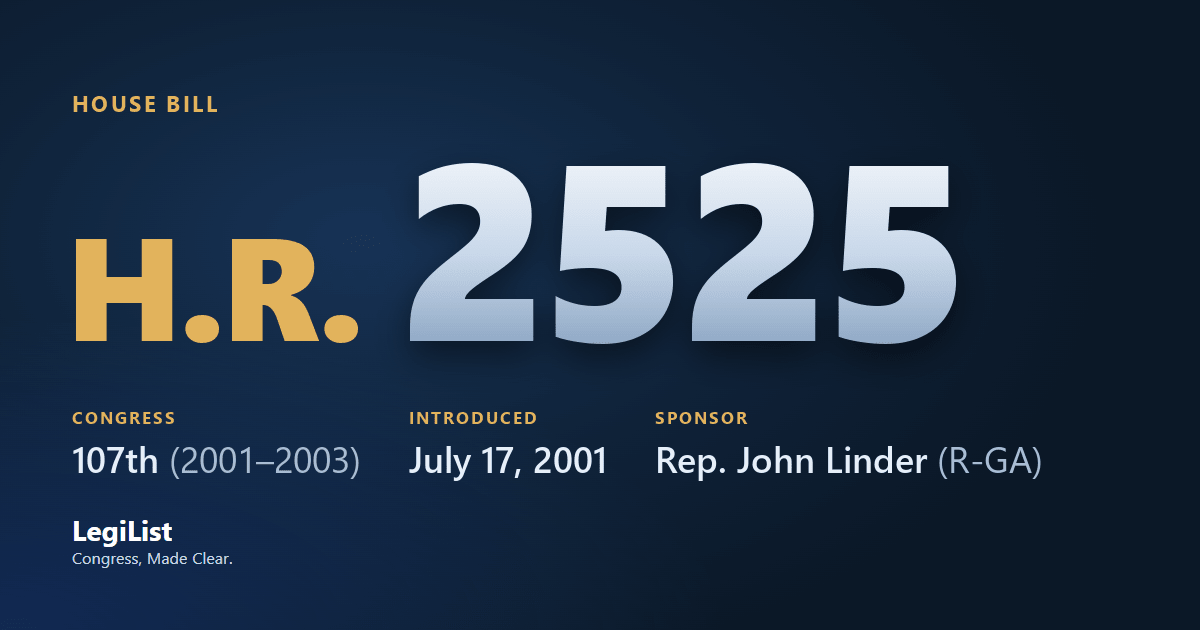
Fair Tax Act of 2001
Latest action · Jul 17, 2001 Referred to the House Committee on Ways and Means.
Progress
Where this bill reached, and when. A stage with no date was not reached; one that failed a vote and later carried shows the date it carried.
- IntroducedJul 17, 2001
- Passed HouseNot reached
- Passed SenateNot reached
- To the PresidentNot reached
- Became lawNot reached
Summary
Imposes a tax on the use or consumption in the United States of taxable property or services. Sets the tax rate at 23 percent for the calendar year 2003. Sets the rate, for years after 2003, at the combined sum of the general revenue rate (14.91 percent), the old-age survivors and disability rate, and the hospital insurance rate.
Sets forth provisions concerning, among other things; (1) imports and exports; (2) definitions; (3) credits and refunds; (4) a "family consumption allowance"; (5) Federal and State cooperative tax administration; (6) administrative matters; (7) collections, appeals, and taxpayer rights; (8) special rules (hobbies, gaming, government purchases, non-profits, and etc.); (9) financial intermediation services; and (10) additional matters.
Sets forth provisions concerning the: (1) phase-out of administration of repealed taxes; (2) administration of other taxes (establishes an Excise Tax Bureau and a Sales Tax Bureau); and (3) sales tax inclusive social security benefits indexation.
Cosponsors 7
Members who signed on, in the order they did. All signed on Jul 17, 2001.
| Seat | Cosponsor | Signed on | |
|---|---|---|---|
| D-MN | Collin C. Peterson | Original | Jul 17, 2001 |
| R-AK | Don Young | Original | Jul 17, 2001 |
| D-CA | Gary A. Condit | Original | Jul 17, 2001 |
| R-TX | Henry Bonilla | Original | Jul 17, 2001 |
| D-MI | James A. Barcia | Original | Jul 17, 2001 |
| R-CA | Jerry Lewis | Original | Jul 17, 2001 |
| R-TX | Ralph M. Hall | Original | Jul 17, 2001 |
Committees 1
Where it was sent and what each committee and subcommittee did with it, in order.
| Chamber | Committee | What it did |
|---|---|---|
| House | Ways and Means Committee | Referred Jul 17, 2001 |
Actions 3
Everything that happened, newest first.
- Jul 17, 2001Introduced in House
- Jul 17, 2001Referred to the House Committee on Ways and Means.
- Jul 4, 2001Sponsor introductory remarks on measure. (CR H1461-1462)
Research
What has been written about this bill: committee reports, cost estimates, the sponsor’s authority statement, printed hearings and the Congressional Research Service’s work.
Printed hearings 3
Hearings whose printed record names this bill, newest first: hearings on it, and wider hearings where it came up.
| Number | Hearing | Committee | Held |
|---|---|---|---|
| Serial No. 107-77 | SECOND IN SERIES ON THE EXTRATERRITORIAL INCOME REGIME92 pages | Ways and Means Committee | May 9, 2002 |
| Serial No. 107-57 | AUTHORIZING SAFETY NET PUBLIC HEALTH PROGRAMS165 pages | Energy and Commerce Committee | Aug 1, 2001 |
| Serial No. 107-40 | FIRST IN SERIES ON TAX CODE SIMPLIFICATION133 pages | Ways and Means Committee | Jul 17, 2001 |
Titles 2
Every title it has carried, official and short, at each stage.
- Official Title as Introduced
- To promote freedom, fairness, and economic opportunity by repealing the income tax and other taxes, abolishing the Internal Revenue Service, and enacting a national sales tax to be administered primarily by the States.
- Short Titles as Introduced
- Fair Tax Act of 2001
Subjects
Assigned by the Library of Congress. Policy area: Taxation.
- Accounting
- Administrative fees
- Administrative procedure
- Administrative remedies
- Affiliated corporations
- Aliens
- Arts, Culture, Religion
- Authorization
- Awards, medals, prizes
- Bank accounts
- Bankruptcy
- Barter
- Business income tax
- Business records
- Civil Rights and Liberties, Minority Issues
- Commemorations
- Commerce
- Conferences
- Confidential communications
- Congress
- Cost of living adjustments
- Crime and Law Enforcement
- Debt
- Department of the Treasury
- Economics and Public Finance
- Education
- Electric power
- Electronic funds transfers
- Elementary and secondary education
- Energy
- Estate tax
- Evidence (Law)
- Excise tax
- Executive reorganization
- Exports
- Families
- Federal preemption
- Federal-state relations
- Fees
- Finance and Financial Sector
- Financial services
- Financial statements
- Fines (Penalties)
- Foreign corporations
- Foreign Trade and International Finance
- Fraud
- Fringe benefits
- Gambling
- Garnishment
- Gift tax
- Government attorneys
- Government corporations
- Government Operations and Politics
- Government paperwork
- Government procurement
- Government publicity
- Government trust funds
- Governmental investigations
- Grievance procedures
- Health
- Higher education
- Hobbies
- Housing and Community Development
- Immigration
- Imports
- Income tax
- Informers
- Injunctions
- Insurance
- Insurance premiums
- Interest
- Interest rates
- Intergovernmental fiscal relations
- Intergovernmental tax relations
- Interstate compacts
- Interstate relations
- Inventories
- Investments
- Judicial review of administrative acts
- Jurisdiction
- Labor and Employment
- Law
- Lease and rental services
- Leases
- Legal fees
- Legislation
- Liability (Law)
- Loan defaults
- Married people
- Medicare
- Motor vehicles
- Nonprofit organizations
- Old age, survivors and disability insurance
- Personal income tax
- Poor
- Prisoners
- Prosecution
- Public records
- Regulatory impact statements
- Rent
- Retail trade
- Right of privacy
- Salaries
- Sales tax
- Science, Technology, Communications
- Self-employed
- Small business
- Smart cards
- Social security taxes
- Social Welfare
- Sound recording and reproducing
- Sports and Recreation
- Students
- Subpoena
- Surety and fidelity
- Tariff
- Tax administration
- Tax auditing
- Tax courts
- Tax credits
- Tax evasion
- Tax exemption
- Tax liens
- Tax penalties
- Tax rates
- Tax rebates
- Tax refunds
- Tax returns
- Taxation
- Taxpayers
- Telephone
- Transportation and Public Works
- Vending machines
- Video tape recording
- Wages
- Wholesale trade
- Withholding tax
Text 1
Each version as it was printed, newest first.
- Jul 17, 2001Introduced in House
Support LegiList
This page is free, carries no paywall, and is built and maintained by one person. If the record here is useful to you, a few dollars keeps it going.
Everything here is as published by Congress: the summary is the Congressional Research Service's, the action wording is the clerks', and the subjects are the Library of Congress's. How far it got is read from the actions themselves, taking the most recent one of each kind, so a bill that failed a vote and later passed is shown as having passed. Records come from this bill on Congress.gov and govinfo.gov; cost estimates are the Congressional Budget Office's, and the hearings are the printed hearings GovInfo publishes, which can appear months after the hearing.