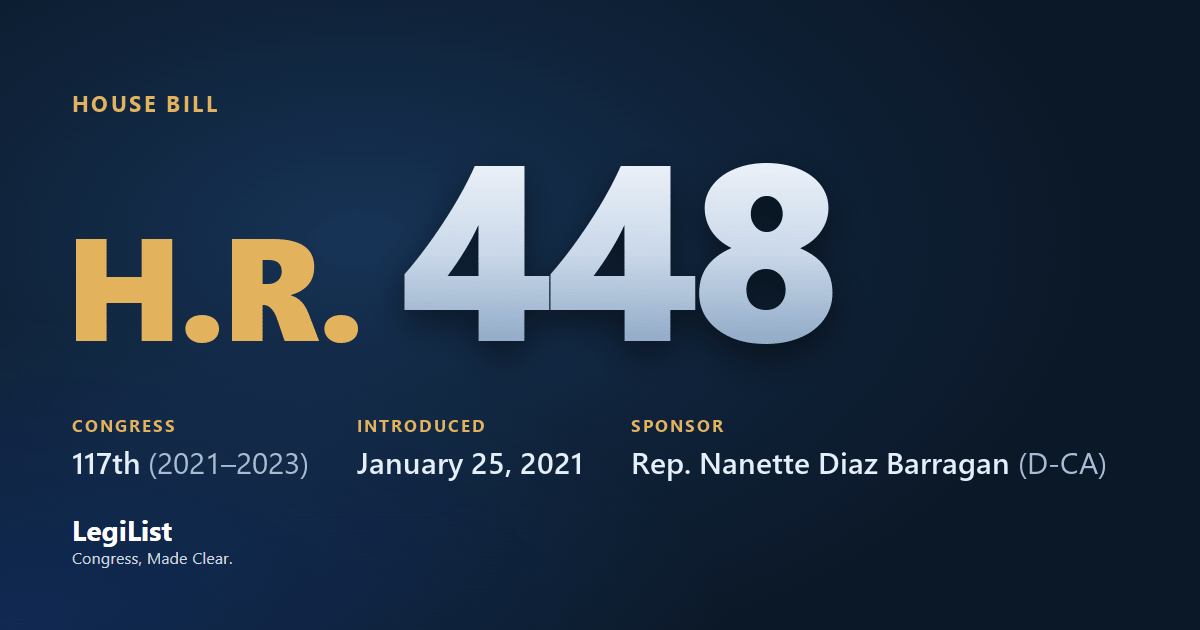
Energy Resilient Communities Act
Latest action · Feb 2, 2021 Referred to the Subcommittee on Energy.
Progress
Where this bill reached, and when. A stage with no date was not reached; one that failed a vote and later carried shows the date it carried.
- IntroducedJan 25, 2021
- Passed HouseNot reached
- Passed SenateNot reached
- To the PresidentNot reached
- Became lawNot reached
Summary
Energy Resilient Communities Act
This bill requires the Department of Energy to establish a program that awards grants to make critical energy infrastructure more resilient to climate change hazards, such as grants for developing clean energy microgrids that support critical community infrastructure or customers of electric utilities with special energy needs due to medical conditions.
Cosponsors 50
Members who signed on, in the order they did. Signatures ran from Jan 25, 2021 to Dec 8, 2021; 39 are original cosponsors, there from the day it was introduced.
| Seat | Cosponsor | Signed on | |
|---|---|---|---|
| D-WA | Adam Smith | Original | Jan 25, 2021 |
| D-NY | Adriano Espaillat | Original | Jan 25, 2021 |
| D-FL | Al Lawson, Jr. | Original | Jan 25, 2021 |
| D-NJ | Albio Sires | Original | Jan 25, 2021 |
| D-FL | Alcee L. Hastings | Original | Jan 25, 2021 |
| D-NY | Alexandria Ocasio-Cortez | Original | Jan 25, 2021 |
| D-IN | André Carson | Original | Jan 25, 2021 |
| D-NJ | Andy Kim | Original | Jan 25, 2021 |
| D-MS | Bennie G. Thompson | Original | Jan 25, 2021 |
| D-IL | Bill Foster | Original | Jan 25, 2021 |
| D-NJ | Bonnie Watson Coleman | Original | Jan 25, 2021 |
| D-NY | Carolyn B. Maloney | Original | Jan 25, 2021 |
| D-ME | Chellie Pingree | Original | Jan 25, 2021 |
| D-PA | Chrissy Houlahan | Original | Jan 25, 2021 |
| D-MO | Cori Bush | Original | Jan 25, 2021 |
Committees 2
Where it was sent and what each committee and subcommittee did with it, in order.
| Chamber | Committee | What it did |
|---|---|---|
| House | Energy and Commerce Committee | Referred Jan 25, 2021 |
| Energy Subcommittee | Referred Feb 2, 2021 | |
| House | Science, Space, and Technology Committee | Referred Jan 25, 2021 |
| Energy Subcommittee | Referred Jan 25, 2021 |
Actions 4
Everything that happened, newest first.
- Feb 2, 2021Referred to the Subcommittee on Energy.
- Jan 25, 2021Introduced in House
- Jan 25, 2021Referred to the Committee on Energy and Commerce, and in addition to the Committee on Science, Space, and Technology, for a period to be subsequently determined by the Speaker, in each case for consideration of such provisions as fall within the jurisdiction of the committee concerned.
- Jan 25, 2021Referred to the Subcommittee on Energy.
Research
What has been written about this bill: committee reports, cost estimates, the sponsor’s authority statement, printed hearings and the Congressional Research Service’s work.
Constitutional authority
The sponsor’s statement, as printed in the Congressional Record, vol. 167, no. 14, January 25, 2021, page H232.
Related bills 4
Companion bills and other measures the record links to this one.
| Bill | Title | Relationship | Latest action |
|---|---|---|---|
| HR 891 | Energy Resilient Communities Act | Reintroduced Bill | Feb 17, 2023 |
| HR 1449 | Energy Resilient Communities Act | Cross-Congress related bill | Feb 21, 2025 |
| HR 1512 | CLEAN Future Act | Related bill | Jun 30, 2022 |
| HR 8626 | Energy Resilient Communities Act | Reintroduction of | Oct 20, 2020 |
Titles 2
Every title it has carried, official and short, at each stage.
- Official Title as Introduced
- To direct the Secretary of Energy to carry out a grant program to improve the energy resilience, energy democracy, and security of communities, prioritizing environmental justice communities, and for other purposes.
- Short Title(s) as Introduced
- Energy Resilient Communities Act
Subjects
Assigned by the Library of Congress. Policy area: Energy.
- Air quality
- Alternative and renewable resources
- Building construction
- Buy American requirements
- Climate change and greenhouse gases
- Community life and organization
- Congressional oversight
- Electric power generation and transmission
- Employment and training programs
- Energy
- Energy prices
- Energy storage, supplies, demand
- Government information and archives
- Government studies and investigations
- Inflation and prices
- Infrastructure development
- Manufacturing
- Metals
- Public contracts and procurement
- Public-private cooperation
- Racial and ethnic relations
- Small business
- Wages and earnings
- Women in business
Text 1
Each version as it was printed, newest first.
- Jan 25, 2021Introduced in House
Support LegiList
This page is free, carries no paywall, and is built and maintained by one person. If the record here is useful to you, a few dollars keeps it going.
Everything here is as published by Congress: the summary is the Congressional Research Service's, the action wording is the clerks', and the subjects are the Library of Congress's. How far it got is read from the actions themselves, taking the most recent one of each kind, so a bill that failed a vote and later passed is shown as having passed. Records come from this bill on Congress.gov and govinfo.gov; cost estimates are the Congressional Budget Office's, and the hearings are the printed hearings GovInfo publishes, which can appear months after the hearing.