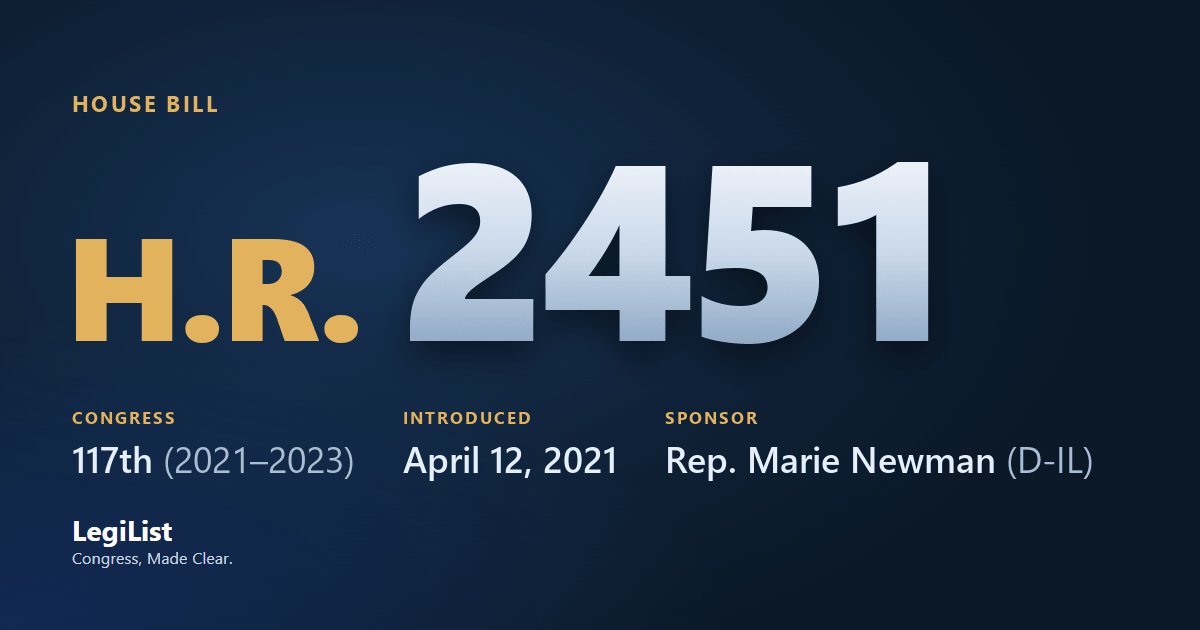
America's Clean Future Fund Act
Latest action · Apr 13, 2021 Referred to the Subcommittee on Energy.
Progress
Where this bill reached, and when. A stage with no date was not reached; one that failed a vote and later carried shows the date it carried.
- IntroducedApr 12, 2021
- Passed HouseNot reached
- Passed SenateNot reached
- To the PresidentNot reached
- Became lawNot reached
Summary
America's Clean Future Fund Act
This bill establishes requirements and incentives to reduce greenhouse gas emissions and assist industries, communities, and workers transition to a low-carbon economy, including by establishing (1) the Climate Change Finance Corporation (C2FC); (2) the America's Clean Future Fund; and (3) a carbon fee on the use, sale, or transfer of certain fuels by covered entities.
The bill provides appropriations to the C2FC, an independent agency, which must finance clean energy and climate change resiliency activities in order to meet the goal of eliminating greenhouse gas emissions by 2050.
The bill also provides appropriations for the America's Clean Future Fund. Amounts in the fund may be used for the C2FC, stimulus payments (i.e., tax rebates) to individuals whose gross incomes do not exceed specified thresholds, decarbonization transition payments to the agricultural sector, and grants to help certain communities and workers transition to a low-carbon economy.
Revenues generated from the carbon fee must also be deposited into the America's Clean Future Fund. Beginning in 2023, covered entities (e.g., entities that use, sell, or transfer fossil fuels) must pay a carbon fee of $25 per metric ton of carbon dioxide or carbon dioxide equivalent. The fee increases by $10 each year, multiplied by the cost-of-living adjustment. The fees further increase if the entities miss cumulative greenhouse gas emission targets established by the bill. Refund payments may be provided for carbon capture, sequestration, and utilization.
Cosponsors 9
Members who signed on, in the order they did. Signatures ran from Apr 12, 2021 to Jul 16, 2021; 4 are original cosponsors, there from the day it was introduced.
| Seat | Cosponsor | Signed on | |
|---|---|---|---|
| D-CT | Jahana Hayes | Original | Apr 12, 2021 |
| D-CA | Juan Vargas | Original | Apr 12, 2021 |
| D-GA | Nikema Williams | Original | Apr 12, 2021 |
| D-CA | Salud O. Carbajal | Original | Apr 12, 2021 |
| D-NJ | Albio Sires | Apr 16, 2021 | |
| D-NY | Ritchie Torres | Jun 15, 2021 | |
| D-IL | Mike Quigley | Jun 25, 2021 | |
| D-CA | Jared Huffman | Jul 16, 2021 | |
| D-CA | Pete Aguilar | Jul 16, 2021 |
Committees 8
Where it was sent and what each committee and subcommittee did with it, in order.
| Chamber | Committee | What it did |
|---|---|---|
| House | Science, Space, and Technology Committee | Referred Apr 12, 2021 |
| Energy Subcommittee | Referred Apr 12, 2021 | |
| House | Energy and Commerce Committee | Referred Apr 12, 2021 |
| Energy Subcommittee | Referred Apr 13, 2021 | |
| House | Ways and Means Committee | Referred Apr 12, 2021 |
| House | Agriculture Committee | Referred Apr 12, 2021 |
| House | Education and Workforce Committee | Referred Apr 12, 2021 |
| House | Transportation and Infrastructure Committee | Referred Apr 12, 2021 |
| Highways and Transit Subcommittee | Referred Apr 13, 2021 | |
| Aviation Subcommittee | Referred Apr 13, 2021 | |
| Water Resources and Environment Subcommittee | Referred Apr 13, 2021 | |
| House | Financial Services Committee | Referred Apr 12, 2021 |
| House | Natural Resources Committee | Referred Apr 12, 2021 |
Actions 7
Everything that happened, newest first.
- Apr 13, 2021Referred to the Subcommittee on Highways and Transit.
- Apr 13, 2021Referred to the Subcommittee on Aviation.
- Apr 13, 2021Referred to the Subcommittee on Water Resources and Environment.
- Apr 13, 2021Referred to the Subcommittee on Energy.
- Apr 12, 2021Introduced in House
- Apr 12, 2021Referred to the Subcommittee on Energy.
- Apr 12, 2021Referred to the Committee on Energy and Commerce, and in addition to the Committees on Ways and Means, Agriculture, Education and Labor, Transportation and Infrastructure, Financial Services, Science, Space, and Technology, and Natural Resources, for a period to be subsequently determined by the Speaker, in each case for consideration of such provisions as fall within the jurisdiction of the committee concerned.
Research
What has been written about this bill: committee reports, cost estimates, the sponsor’s authority statement, printed hearings and the Congressional Research Service’s work.
Constitutional authority
The sponsor’s statement, as printed in the Congressional Record, vol. 167, no. 62, April 12, 2021, page H1727.
CRS reports 3
Congressional Research Service work that CRS links to this bill or the law it became, newest first.
Cite it 3
Products on other subjects that cite it, usually among other measures.
| Product | Title | Kind | Published |
|---|---|---|---|
| R45472 | Market-Based Greenhouse Gas Emission Reduction Legislation: 108th Through 118th Congresses Archived | Report | Dec 4, 2024 |
| R48247 | Border Carbon Adjustments: Policy Considerations, Legislation, and Developments in the European Union | Report | Oct 28, 2024 |
| IF11608 | National Infrastructure Bank: Proposals in the 117th Congress Archived | Resource | Sep 20, 2021 |
Related bills 1
Companion bills and other measures the record links to this one.
| Bill | Title | Relationship | Latest action |
|---|---|---|---|
| S 685 | America's Clean Future Fund Act | Identical bill | Mar 10, 2021 |
Titles 2
Every title it has carried, official and short, at each stage.
- Official Title as Introduced
- To amend the Internal Revenue Code of 1986 to establish a carbon fee to reduce greenhouse gas emissions, and for other purposes.
- Short Title(s) as Introduced
- America's Clean Future Fund Act
Subjects
Assigned by the Library of Congress. Policy area: Environmental Protection.
- Administrative law and regulatory procedures
- Agricultural conservation and pollution
- Agricultural practices and innovations
- Air quality
- Alternative and renewable resources
- Appropriations
- Atmospheric science and weather
- Buy American requirements
- Climate change and greenhouse gases
- Coal
- Community life and organization
- Congressional oversight
- Ecology
- Economic performance and conditions
- Employment and training programs
- Energy efficiency and conservation
- Environmental assessment, monitoring, research
- Environmental Protection
- Environmental Protection Agency (EPA)
- Environmental regulatory procedures
- Executive agency funding and structure
- Farmland
- Floods and storm protection
- Forests, forestry, trees
- Government lending and loan guarantees
- Government studies and investigations
- Hybrid, electric, and advanced technology vehicles
- Inflation and prices
- Land use and conservation
- Livestock
- Marine and coastal resources, fisheries
- Metals
- Mining
- Minority and disadvantaged businesses
- Oil and gas
- Poverty and welfare assistance
- Public contracts and procurement
- Sales and excise taxes
- User charges and fees
- Water quality
- Wetlands
Text 1
Each version as it was printed, newest first.
- Apr 12, 2021Introduced in House
Support LegiList
This page is free, carries no paywall, and is built and maintained by one person. If the record here is useful to you, a few dollars keeps it going.
Everything here is as published by Congress: the summary is the Congressional Research Service's, the action wording is the clerks', and the subjects are the Library of Congress's. How far it got is read from the actions themselves, taking the most recent one of each kind, so a bill that failed a vote and later passed is shown as having passed. Records come from this bill on Congress.gov and govinfo.gov; cost estimates are the Congressional Budget Office's, and the hearings are the printed hearings GovInfo publishes, which can appear months after the hearing.