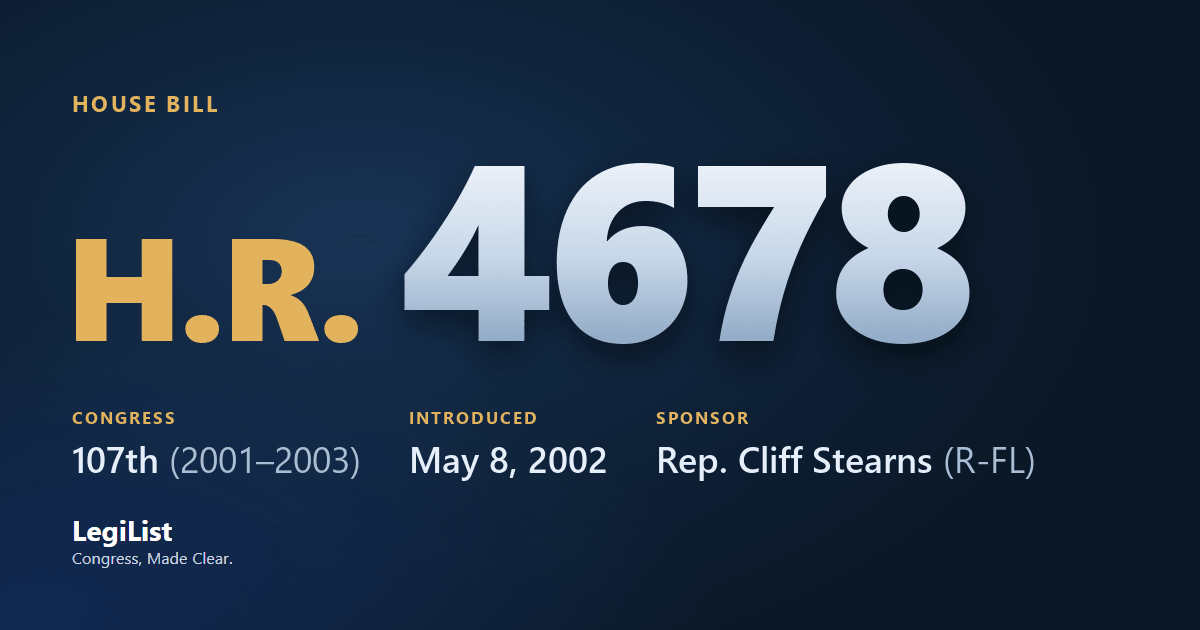
Consumer Privacy Protection Act of 2002
Latest action · Sep 24, 2002 Subcommittee Hearings Held.
Progress
Where this bill reached, and when. A stage with no date was not reached; one that failed a vote and later carried shows the date it carried.
- IntroducedMay 8, 2002
- Passed HouseNot reached
- Passed SenateNot reached
- To the PresidentNot reached
- Became lawNot reached
Summary
Requires the organizations to establish a privacy policy with respect to the collection, sale, disclosure for consideration, or use of the consumer's information.
Requires an organization to provide consumers, without charge, the opportunity to preclude the sale or disclosure of their information to any organization that is not an information-sharing partner. Allows a consumer an opportunity to limit other information practices of the organization.
Directs an organization to prepare and implement an information security policy that prevents the unauthorized disclosure or release of a consumer's information.
Requires the Federal Trade Commission (FTC) to presume that an organization is in compliance with this Act if it participates in an approved self-regulatory program for an eight-year period.
Directs the FTC to: (1) facilitate electronic and promote the use of common identity theft affidavits; (2) require the timely resolution of identity theft disputes; (3) utilize the Identity Theft Clearinghouse to transmit information to appropriate entities for protective action and to mitigate losses; and (4) provide change of address protection for consumers.
Requires: (1) the Comptroller General to analyze the impact on U.S. interstate and foreign commerce of information privacy laws, regulations, or agreements enacted, promulgated, or adopted by other nations, and whether the enforcement mechanisms or procedures of them result in discriminatory treatment of U.S. entities; and (2) the Secretary of Commerce, based on such results, to take steps to mitigate against such discriminatory impact.
Directs the Secretary to seek harmonization of this Act with other international privacy laws, regulations, and agreements for the advancement of transnational and electronic commerce.
Cosponsors 21
Members who signed on, in the order they did. Signatures ran from May 8, 2002 to Sep 26, 2002; 20 are original cosponsors, there from the day it was introduced.
| Seat | Cosponsor | Signed on | |
|---|---|---|---|
| D-CA | Anna G. Eshoo | Original | May 8, 2002 |
| D-TN | Bart Gordon | Original | May 8, 2002 |
| R-NH | Charles F. Bass | Original | May 8, 2002 |
| R-FL | Dan Miller | Original | May 8, 2002 |
| R-FL | Dave Weldon | Original | May 8, 2002 |
| D-NY | Edolphus Towns | Original | May 8, 2002 |
| R-MI | Fred Upton | Original | May 8, 2002 |
| R-OR | Greg Walden | Original | May 8, 2002 |
| R-GA | Jack Kingston | Original | May 8, 2002 |
| R-PA | James C. Greenwood | Original | May 8, 2002 |
| D-VA | James P. Moran | Original | May 8, 2002 |
| R-IL | Jerry Weller | Original | May 8, 2002 |
| R-NE | Lee Terry | Original | May 8, 2002 |
| R-CA | Mary Bono | Original | May 8, 2002 |
| R-FL | Michael Bilirakis | Original | May 8, 2002 |
Committees 2
Where it was sent and what each committee and subcommittee did with it, in order.
| Chamber | Committee | What it did |
|---|---|---|
| House | Energy and Commerce Committee | Referred May 8, 2002 |
| Commerce, Manufacturing, and Trade Subcommittee | Referred May 17, 2002Hearings Sep 24, 2002 | |
| House | Foreign Affairs Committee | Referred May 8, 2002 |
Actions 4
Everything that happened, newest first.
- Sep 24, 2002Subcommittee Hearings Held.
- May 17, 2002Referred to the Subcommittee on Commerce, Trade and Consumer Protection.
- May 8, 2002Introduced in House
- May 8, 2002Referred to the Committee on Energy and Commerce, and in addition to the Committee on International Relations, for a period to be subsequently determined by the Speaker, in each case for consideration of such provisions as fall within the jurisdiction of the committee concerned.
Research
What has been written about this bill: committee reports, cost estimates, the sponsor’s authority statement, printed hearings and the Congressional Research Service’s work.
Printed hearings 5
Hearings whose printed record names this bill, newest first: hearings on it, and wider hearings where it came up.
| Number | Hearing | Committee | Held |
|---|---|---|---|
| Serial No. 107-131 | THE CONSUMER PRIVACY PROTECTION ACT OF 200264 pages | Energy and Commerce Committee | Sep 24, 2002 |
| Serial No. 107-107 | CHILD SUPPORT AND FATHERHOOD PROPOSALS137 pages | Ways and Means Committee | Jun 28, 2001 |
| Serial No. 107-72 | H.R. 866, A BILL TO PROHIBIT THE PROVISION OF FINANCIAL ASSISTANCE BY THE FEDERAL GOVERNMENT TO ANY PERSON WHO IS MORE THAN 60 DAYS DELINQUENT IN THE PAYMENT OF ANY CHILD SUPPORT OBLIGATION101 pages | Oversight and Government Reform Committee | Jun 6, 2001 |
| Serial No. 107-6 | PRESIDENT'S TAX RELIEF PROPOSALS: TAX PROPOSALS AFFECTING INDIVIDUALS179 pages | Ways and Means Committee | Mar 21, 2001 |
| Serial No. 107-5 | DEPARTMENT OF HEALTH AND HUMAN SERVICES FY 2002 BUDGET PRIORITIES132 pages | Budget Committee | Mar 7, 2001 |
Titles 2
Every title it has carried, official and short, at each stage.
- Official Title as Introduced
- To protect and enhance consumer privacy, and for other purposes.
- Short Titles as Introduced
- Consumer Privacy Protection Act of 2002
Subjects
Assigned by the Library of Congress. Policy area: Commerce.
- Administrative procedure
- Administrative remedies
- Civil Rights and Liberties, Minority Issues
- Commerce
- Computer networks
- Computer security measures
- Computer software
- Congress
- Congressional investigations
- Congressional reporting requirements
- Consumer complaints
- Consumer education
- Consumer protection
- Crime and Law Enforcement
- Criminal statistics
- Data banks
- Electronic commerce
- Federal preemption
- Federal Trade Commission
- Fines (Penalties)
- Foreign Trade and International Finance
- Fraud
- Government Operations and Politics
- Government paperwork
- Government statistics
- Grievance arbitration
- Grievance procedures
- Identification devices
- Independent regulatory commissions
- Information networks
- Information services
- Injunctions
- International Affairs
- International agencies
- International competitiveness
- Internet
- Larceny
- Law
- Liability (Law)
- Restrictive trade practices
- Right of privacy
- Science, Technology, Communications
- Security measures
- Signs and symbols
- Telephone
- Trade negotiations
- Treaties
- Victims of crimes
- Web sites
Text 1
Each version as it was printed, newest first.
- May 8, 2002Introduced in House
Support LegiList
This page is free, carries no paywall, and is built and maintained by one person. If the record here is useful to you, a few dollars keeps it going.
Everything here is as published by Congress: the summary is the Congressional Research Service's, the action wording is the clerks', and the subjects are the Library of Congress's. How far it got is read from the actions themselves, taking the most recent one of each kind, so a bill that failed a vote and later passed is shown as having passed. Records come from this bill on Congress.gov and govinfo.gov; cost estimates are the Congressional Budget Office's, and the hearings are the printed hearings GovInfo publishes, which can appear months after the hearing.