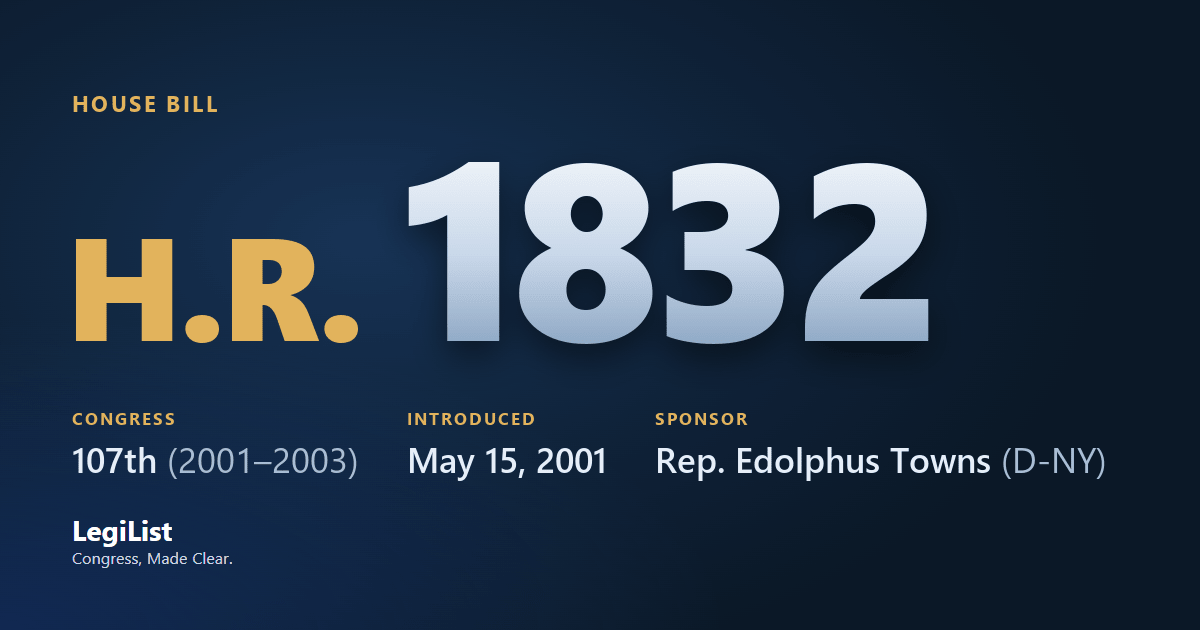
Hydroelectric Licensing and Incentives Act of 2001
Latest action · May 22, 2001 Referred to the Subcommittee on Energy and Air Quality.
Progress
Where this bill reached, and when. A stage with no date was not reached; one that failed a vote and later carried shows the date it carried.
- IntroducedMay 15, 2001
- Passed HouseNot reached
- Passed SenateNot reached
- To the PresidentNot reached
- Became lawNot reached
Summary
Instructs the Secretary of Energy to make incentive payments: (1) for a period of ten fiscal years to the owner or operator of electric energy generated and sold by a qualified hydroelectric facility; and (2) to the owner or operator of hydroelectric facilities at existing dams for capital improvements directly related to specified facility efficiency improvements.
Amends the Public Utility Regulatory Policies Act of 1978 to redefine "an existing dam" for purposes of small hydroelectric power projects as one whose construction was completed on or before May 16, 2001 (currently, on or before April 20, 1977).
Instructs the Secretary of Energy to study and report to certain congressional committees on cost-effective opportunities to increase hydropower generation at existing federally-owned or operated water regulation, storage, and conveyance facilities.
Cosponsors 21
Members who signed on, in the order they did. Signatures ran from May 15, 2001 to Jul 24, 2001; 13 are original cosponsors, there from the day it was introduced.
| Seat | Cosponsor | Signed on | |
|---|---|---|---|
| D-MD | Albert Russell Wynn | Original | May 15, 2001 |
| R-WA | Doc Hastings | Original | May 15, 2001 |
| R-WA | George R. Nethercutt Jr. | Original | May 15, 2001 |
| R-CA | George Radanovich | Original | May 15, 2001 |
| R-SC | Henry E. Brown, Jr. | Original | May 15, 2001 |
| D-SC | James E. Clyburn | Original | May 15, 2001 |
| R-WA | Jennifer Dunn | Original | May 15, 2001 |
| R-SC | Jim DeMint | Original | May 15, 2001 |
| R-AZ | John B. Shadegg | Original | May 15, 2001 |
| D-SC | John M. Spratt, Jr. | Original | May 15, 2001 |
| R-SC | Lindsey Graham | Original | May 15, 2001 |
| R-TX | Ralph M. Hall | Original | May 15, 2001 |
| R-NC | Richard Burr | Original | May 15, 2001 |
| R-SC | Floyd Spence | Jun 12, 2001 | |
| R-ID | C. L. (Butch) Otter | Jun 28, 2001 |
Committees 1
Where it was sent and what each committee and subcommittee did with it, in order.
| Chamber | Committee | What it did |
|---|---|---|
| House | Energy and Commerce Committee | Referred May 15, 2001 |
| Energy Subcommittee | Referred May 22, 2001 |
Actions 3
Everything that happened, newest first.
- May 22, 2001Referred to the Subcommittee on Energy and Air Quality.
- May 15, 2001Introduced in House
- May 15, 2001Referred to the House Committee on Energy and Commerce.
Research
What has been written about this bill: committee reports, cost estimates, the sponsor’s authority statement, printed hearings and the Congressional Research Service’s work.
Printed hearings 1
Hearings whose printed record names this bill, newest first: hearings on it, and wider hearings where it came up.
| Number | Hearing | Committee | Held |
|---|---|---|---|
| Serial No. 107-55 | HYDROELECTRIC RELICENSING AND NUCLEAR ENERGY185 pages | Energy and Commerce Committee | Jun 27, 2001 |
Titles 2
Every title it has carried, official and short, at each stage.
- Official Title as Introduced
- To improve the Federal licensing process for hydroelectric projects.
- Short Titles as Introduced
- Hydroelectric Licensing and Incentives Act of 2001
Subjects
Assigned by the Library of Congress. Policy area: Energy.
- Administrative remedies
- Agriculture and Food
- Boundaries
- Congress
- Congressional reporting requirements
- Cost effectiveness
- Dams
- Department of Energy
- Economic impact statements
- Economics and Public Finance
- Electric power production
- Emergency Management
- Energy
- Energy efficiency
- Environmental assessment
- Environmental Protection
- Federal aid to water resources development
- Federal Energy Regulatory Commission
- Fishery management
- Flood control
- Government Operations and Politics
- Government paperwork
- Governmental investigations
- Hydroelectric power
- Independent regulatory commissions
- Indexing (Economic policy)
- Infrastructure
- International Affairs
- Irrigation
- Law
- Licenses
- Marine and coastal resources, fisheries
- Outdoor recreation
- Public Lands and Natural Resources
- Sports and Recreation
- Transportation and Public Works
- Treaties
- Water Resources Development
- Water storage
- Water supply
Text 1
Each version as it was printed, newest first.
- May 15, 2001Introduced in House
Support LegiList
This page is free, carries no paywall, and is built and maintained by one person. If the record here is useful to you, a few dollars keeps it going.
Everything here is as published by Congress: the summary is the Congressional Research Service's, the action wording is the clerks', and the subjects are the Library of Congress's. How far it got is read from the actions themselves, taking the most recent one of each kind, so a bill that failed a vote and later passed is shown as having passed. Records come from this bill on Congress.gov and govinfo.gov; cost estimates are the Congressional Budget Office's, and the hearings are the printed hearings GovInfo publishes, which can appear months after the hearing.