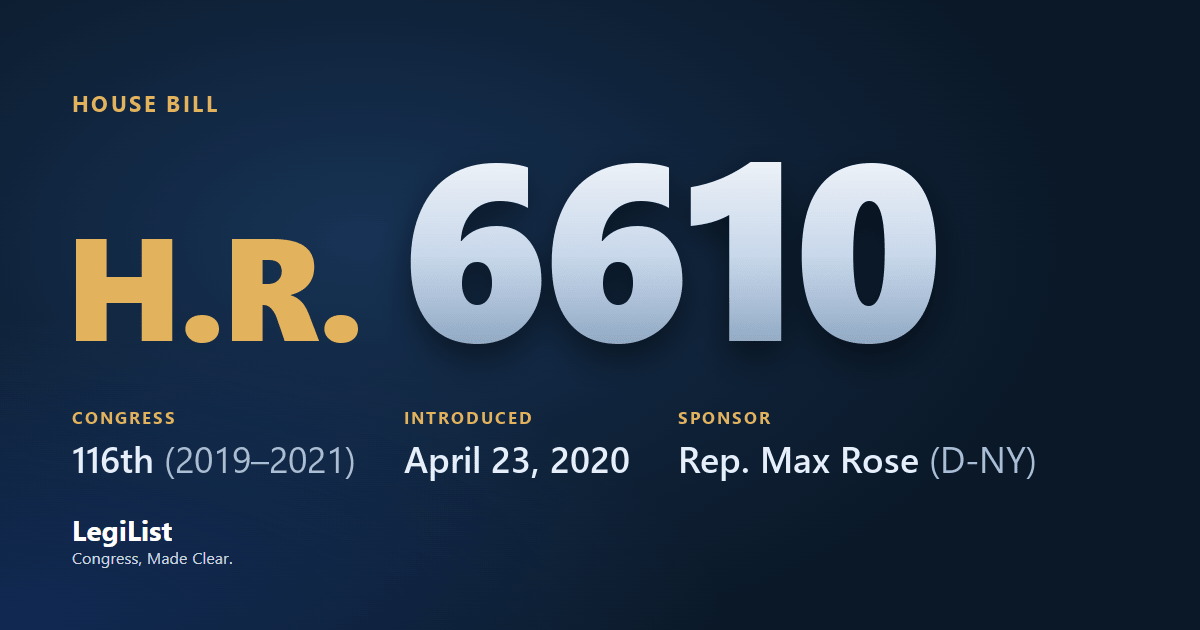
Director of Pandemic and Biodefense Preparedness and Response Act
Latest action · Apr 24, 2020 Referred to the Subcommittee on Economic Development, Public Buildings, and Emergency Management.
Progress
Where this bill reached, and when. A stage with no date was not reached; one that failed a vote and later carried shows the date it carried.
- IntroducedApr 23, 2020
- Passed HouseNot reached
- Passed SenateNot reached
- To the PresidentNot reached
- Became lawNot reached
Summary
Director of Pandemic and Biodefense Preparedness and Response Act
This bill establishes the position of the Director of Pandemic and Biodefense Preparedness and Response in the executive branch and sets forth the qualifications for and responsibilities of the position. Among other tasks, the director shall
- advise the President, relevant councils, and others with respect to pandemics and other health threats;
- oversee the development of a National Pandemic and Biodefense Preparedness and Response Strategy and, in consultation with the Office of Management and Budget, submit biennial reports to Congress on the implementation of the strategy; and
- plan for and coordinate specified preparedness and response activities.
The director must also (1) identify existing federal agencies charged with elements of pandemic and biodefense preparedness and response, and (2) provide recommendations to Congress for reorganizing such agencies under the Office of the Director of Pandemic and Biodefense Preparedness and Response.
The director may not simultaneously serve as the head of any other agency in the federal government and must be a member of the National Security Council.
Cosponsors 4
Members who signed on, in the order they did. Signatures ran from Apr 23, 2020 to May 12, 2020; 3 are original cosponsors, there from the day it was introduced.
| Seat | Cosponsor | Signed on | |
|---|---|---|---|
| D-DC | Eleanor Holmes Norton | Original | Apr 23, 2020 |
| D-PA | Mary Gay Scanlon | Original | Apr 23, 2020 |
| D-TX | Sheila Jackson Lee | Original | Apr 23, 2020 |
| D-IL | Bill Foster | May 12, 2020 |
Committees 5
Where it was sent and what each committee and subcommittee did with it, in order.
| Chamber | Committee | What it did |
|---|---|---|
| House | Energy and Commerce Committee | Referred Apr 23, 2020 |
| House | Transportation and Infrastructure Committee | Referred Apr 23, 2020 |
| Economic Development, Public Buildings, and Emergency Management Subcommittee | Referred Apr 24, 2020 | |
| House | Armed Services Committee | Referred Apr 23, 2020 |
| House | Foreign Affairs Committee | Referred Apr 23, 2020 |
| House | Intelligence (Permanent Select) Committee | Referred Apr 23, 2020 |
Actions 3
Everything that happened, newest first.
- Apr 24, 2020Referred to the Subcommittee on Economic Development, Public Buildings, and Emergency Management.
- Apr 23, 2020Introduced in House
- Apr 23, 2020Referred to the Committee on Energy and Commerce, and in addition to the Committees on Transportation and Infrastructure, Armed Services, Foreign Affairs, and Intelligence (Permanent Select), for a period to be subsequently determined by the Speaker, in each case for consideration of such provisions as fall within the jurisdiction of the committee concerned.
Research
What has been written about this bill: committee reports, cost estimates, the sponsor’s authority statement, printed hearings and the Congressional Research Service’s work.
Constitutional authority
The sponsor’s statement, as printed in the Congressional Record, vol. 166, no. 77, April 23, 2020, page H1957.
CRS reports 1
Congressional Research Service work that CRS links to this bill or the law it became, newest first.
Cite it 1
Products on other subjects that cite it, usually among other measures.
| Product | Title | Kind | Published |
|---|---|---|---|
| R46319 | Novel Coronavirus 2019 (COVID-19): Q&A on Global Implications and Responses Archived | Report | May 14, 2020 |
Titles 2
Every title it has carried, official and short, at each stage.
- Official Title as Introduced
- To establish the Cabinet-level position of Director of Pandemic and Biodefense Preparedness and Response in the executive branch with the responsibility of developing a National Pandemic and Biodefense Preparedness and Response Strategy, to prepare for and coordinate the response to future pandemics, biological attacks, and other major health crises, including coordinating the work of multiple government agencies, and for other purposes.
- Short Title(s) as Introduced
- Director of Pandemic and Biodefense Preparedness and Response Act
Subjects
Assigned by the Library of Congress. Policy area: Health.
- Allied health services
- Cemeteries and funerals
- Chemical and biological weapons
- Congressional oversight
- Drug therapy
- Emergency medical services and trauma care
- Executive agency funding and structure
- Executive Office of the President
- Federal officials
- Fires
- First responders and emergency personnel
- Food supply, safety, and labeling
- Health
- Health care coverage and access
- Health facilities and institutions
- Health personnel
- Health programs administration and funding
- Health promotion and preventive care
- Health technology, devices, supplies
- Immunology and vaccination
- Infectious and parasitic diseases
- International organizations and cooperation
- Law enforcement administration and funding
- Medical education
- Medical research
- Public contracts and procurement
- Public utilities and utility rates
- Research administration and funding
- Social work, volunteer service, charitable organizations
- Solid waste and recycling
- Teaching, teachers, curricula
- Water use and supply
- Worker safety and health
Text 1
Each version as it was printed, newest first.
- Apr 23, 2020Introduced in House
Support LegiList
This page is free, carries no paywall, and is built and maintained by one person. If the record here is useful to you, a few dollars keeps it going.
Everything here is as published by Congress: the summary is the Congressional Research Service's, the action wording is the clerks', and the subjects are the Library of Congress's. How far it got is read from the actions themselves, taking the most recent one of each kind, so a bill that failed a vote and later passed is shown as having passed. Records come from this bill on Congress.gov and govinfo.gov; cost estimates are the Congressional Budget Office's, and the hearings are the printed hearings GovInfo publishes, which can appear months after the hearing.