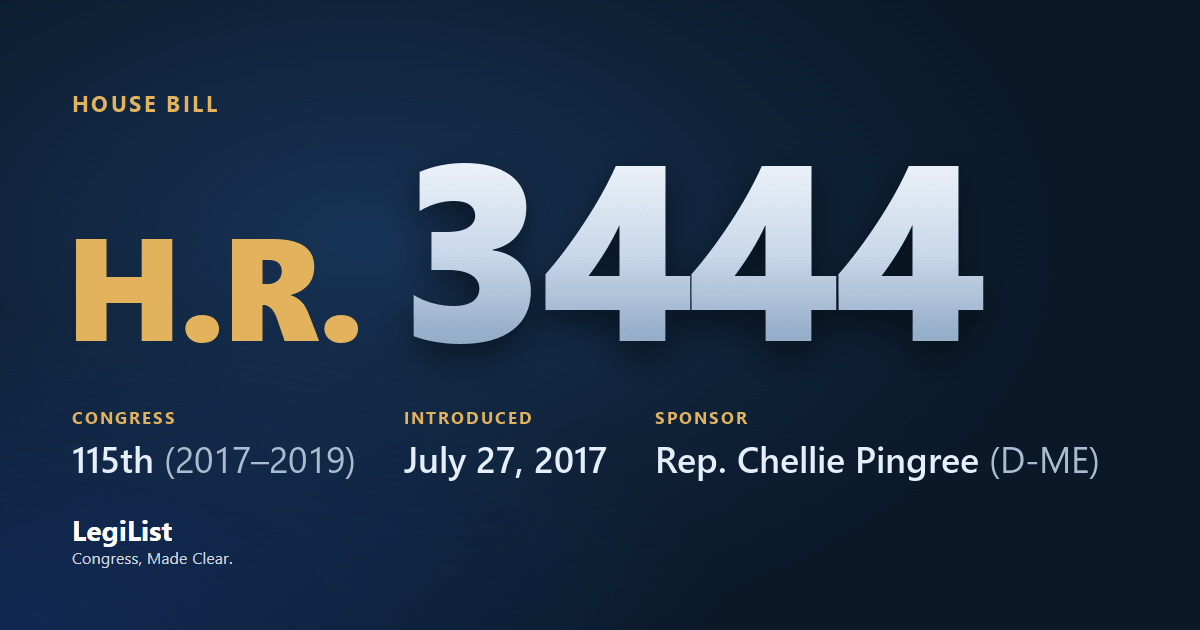
Food Recovery Act of 2017
Latest action · Jul 28, 2017 Referred to the Subcommittee on Health.
Progress
Where this bill reached, and when. A stage with no date was not reached; one that failed a vote and later carried shows the date it carried.
- IntroducedJul 27, 2017
- Passed HouseNot reached
- Passed SenateNot reached
- To the PresidentNot reached
- Became lawNot reached
Summary
Food Recovery Act of 2017
This bill provides funding and establishes requirements to reduce food waste and standardize date labeling on food.
The bill authorizes grants or loans for activities related to:
- raising awareness about wasted food and food recovery efforts to reduce the quantity of wasted food,
- reducing food waste at schools and farms, and
- installing facilities that include composting or anaerobic digesters that use food or crop waste to produce energy.
The bill provides funds for: (1) state storage and distribution costs under the Emergency Food Assistance Program, and (2) national media campaigns to decrease food waste.
The bill also:
- establishes a Food Recovery Liaison within the Department of Agriculture (USDA),
- specifies that composting is eligible for support under USDA's conservation programs,
- expands the tax deduction for charitable contributions to include contributions of food inventory for nonprofit retail sales,
- expands the liability protections for the donation of food, and
- requires companies that receive federal food service contracts to donate surplus food to nonprofit organizations that assist food-insecure people.
The bill requires date labels on food packaging to include the phrases "best if used by" to indicate food quality and "use by" to warn of food that may be unsafe to eat after a specified date.
Labelers may include a quality date on packaging, but must include a safety date on ready-to-eat products. No one may prohibit the sale, donation, or use of a product based on passage of the quality date of the product.
Cosponsors 31
Members who signed on, in the order they did. Signatures ran from Nov 7, 2017 to Sep 10, 2018.
| Seat | Cosponsor | Signed on | |
|---|---|---|---|
| D-NC | Alma S. Adams | Nov 7, 2017 | |
| D-IA | David Loebsack | Nov 7, 2017 | |
| D-PA | Dwight Evans | Nov 7, 2017 | |
| D-OR | Earl Blumenauer | Nov 7, 2017 | |
| D-WI | Gwen Moore | Nov 7, 2017 | |
| D-MA | James P. McGovern | Nov 7, 2017 | |
| D-TX | Marc A. Veasey | Nov 7, 2017 | |
| D-WI | Mark Pocan | Nov 7, 2017 | |
| D-OR | Peter A. DeFazio | Nov 7, 2017 | |
| D-OH | Tim Ryan | Nov 7, 2017 | |
| D-CA | Jared Huffman | Nov 9, 2017 | |
| D-CA | Salud O. Carbajal | Nov 9, 2017 | |
| D-IL | Bobby L. Rush | Nov 14, 2017 | |
| D-NY | Louise McIntosh Slaughter | Nov 14, 2017 | |
| D-IL | Mike Quigley | Nov 14, 2017 |
Committees 6
Where it was sent and what each committee and subcommittee did with it, in order.
| Chamber | Committee | What it did |
|---|---|---|
| House | Agriculture Committee | Referred Jul 27, 2017 |
| House | Ways and Means Committee | Referred Jul 27, 2017 |
| House | Education and Workforce Committee | Referred Jul 27, 2017 |
| House | Energy and Commerce Committee | Referred Jul 27, 2017 |
| Health Subcommittee | Referred Jul 28, 2017 | |
| House | Oversight and Government Reform Committee | Referred Jul 27, 2017 |
| House | Committee on House Administration | Referred Jul 27, 2017 |
Actions 3
Everything that happened, newest first.
- Jul 28, 2017Referred to the Subcommittee on Health.
- Jul 27, 2017Introduced in House
- Jul 27, 2017Referred to the Committee on Agriculture, and in addition to the Committees on Ways and Means, Education and the Workforce, Energy and Commerce, Oversight and Government Reform, and House Administration, for a period to be subsequently determined by the Speaker, in each case for consideration of such provisions as fall within the jurisdiction of the committee concerned.
Research
What has been written about this bill: committee reports, cost estimates, the sponsor’s authority statement, printed hearings and the Congressional Research Service’s work.
Constitutional authority
The sponsor’s statement, as printed in the Congressional Record, vol. 163, no. 127, July 27, 2017, pages H6518, H6517.
Related bills 2
Companion bills and other measures the record links to this one.
| Bill | Title | Relationship | Latest action |
|---|---|---|---|
| HR 952 | Food Donation Act of 2017 | Related bill | Feb 7, 2017 |
| S 1680 | Food Recovery Act of 2017 | Related bill | Jul 31, 2017 |
Titles 2
Every title it has carried, official and short, at each stage.
- Official Title as Introduced
- To decrease the incidence of food waste, and for other purposes.
- Short Titles as Introduced
- Food Recovery Act of 2017
Subjects
Assigned by the Library of Congress. Policy area: Agriculture and Food.
- Accounting and auditing
- Administrative law and regulatory procedures
- Agricultural conservation and pollution
- Agricultural education
- Agricultural prices, subsidies, credit
- Agriculture and Food
- Alternative and renewable resources
- Charitable contributions
- Civil actions and liability
- Congressional operations and organization
- Congressional oversight
- Consumer affairs
- Department of Agriculture
- Education programs funding
- Elementary and secondary education
- Executive agency funding and structure
- Food assistance and relief
- Food industry and services
- Food supply, safety, and labeling
- Government information and archives
- Government lending and loan guarantees
- Government studies and investigations
- Income tax deductions
- Livestock
- Marketing and advertising
- Meat
- Public contracts and procurement
- Retail and wholesale trades
- Social work, volunteer service, charitable organizations
- Solid waste and recycling
- State and local government operations
Text 1
Each version as it was printed, newest first.
- Jul 27, 2017Introduced in House
Support LegiList
This page is free, carries no paywall, and is built and maintained by one person. If the record here is useful to you, a few dollars keeps it going.
Everything here is as published by Congress: the summary is the Congressional Research Service's, the action wording is the clerks', and the subjects are the Library of Congress's. How far it got is read from the actions themselves, taking the most recent one of each kind, so a bill that failed a vote and later passed is shown as having passed. Records come from this bill on Congress.gov and govinfo.gov; cost estimates are the Congressional Budget Office's, and the hearings are the printed hearings GovInfo publishes, which can appear months after the hearing.