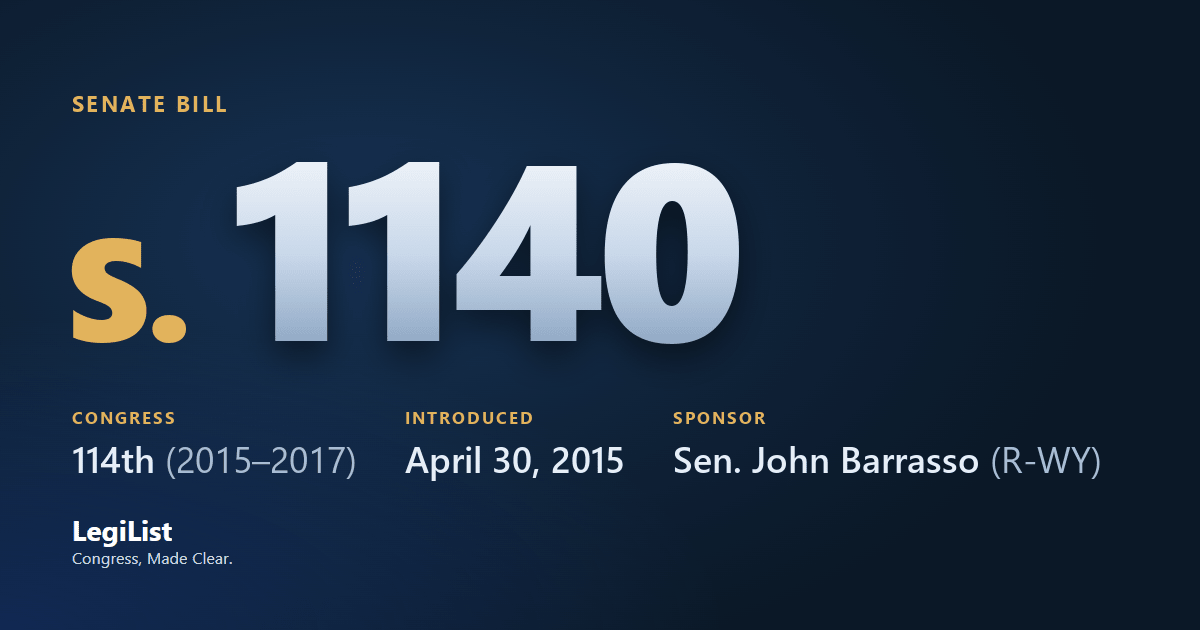
Federal Water Quality Protection Act
Latest action · Nov 3, 2015 Motion to proceed to consideration of measure withdrawn in Senate. (consideration: CR S7697)
Progress
Where this bill reached, and when. A stage with no date was not reached; one that failed a vote and later carried shows the date it carried.
- IntroducedApr 30, 2015
- Passed SenateNot reached
- Passed HouseNot reached
- To the PresidentNot reached
- Became lawNot reached
Summary
Federal Water Quality Protection Act
(Sec. 2) This bill states as the policy of the Federal Water Pollution Control Act (commonly known as the Clean Water Act) cooperative federalism and consultation with states in the protection of water resources.
(Sec. 3) The bill defines new terms used in this bill, including "body of water," "interstate waters," "traditional navigable water," and "wetlands".
(Sec. 4) The bill nullifies a revision to or guidance on a regulatory definition of the term "navigable waters" or "waters of the United States" promulgated or issued pursuant to the Clean Water Act after February 4, 2015: (1) unless the revision adheres to the principles in this bill, and (2) until after the U.S. Army Corps of Engineers (Corps of Engineers) and the Environmental Protection Agency (EPA) carry out the requirements of this bill.
In promulgating a revised regulatory definition, the Corps of Engineers and the EPA must adhere to three principles. First, the Clean Water Act is an Act to protect traditional navigable waters from water pollution.
Second, the definition of "waters of the United States" should identify bodies of water subject to federal jurisdiction and should include:
- traditional navigable waters and interstate waters;
- certain lengths of streams that are drinking water source protection areas;
- certain lengths of streams with surface flow in a normal year of sufficient volume, duration, and frequency that pollutants in that length of stream would degrade the water quality of a connected traditional navigable water, based on a quantifiable and statistically valid measure of flow; and
- wetlands situated next to a water of the United States that, in a normal year, prevent the movement of pollutants to a navigable water.
Third, the definition should not include the following:
- water located below the surface of the land;
- water not located within a body of water;
- natural or man-made isolated ponds;
- water management systems used for collecting, conveying, holding or treating stormwater, wastewater, water supplies, agricultural water, or silvicultural water;
- lengths of streams that do not have enough surface flow of volume, duration, and frequency in a normal year to degrade the water quality of a traditional navigable water;
- prior converted cropland; and
- water removed from the waters of the United States pursuant to a permit for construction of structures in or over any navigable water of the United States or a permit for the discharge of dredged or fill material into the navigable waters at specified disposal sites.
The bill outlines the circumstances in which some water management systems may still be considered to be waters of the United States.
In promulgating a revised definition of waters of the United States, the Corps of Engineers and the EPA must consider that a basis for establishing federal jurisdiction under the Clean Water Act is not created by:
- the use of a body of water by an organism, including a migratory bird;
- the supply of water to a groundwater aquifer and the storage of water in an isolated body of water; and
- the connection of all water through the water cycle.
The Corps of Engineers and the EPA should identify waters of the United States on maps to promote certainty and transparency in jurisdictional determinations.
The bill outlines the process that the EPA and the Corps of Engineers must follow in proposing or promulgating a rule revising a definition.
The Corps of Engineers and the EPA must ensure compliance with the federalism policy making criteria and consultation requirements in accordance with Executive Order 13132, regardless of whether they determine that the rule would have any substantial and direct effect on states, the relationship between the federal government and the states, or the distribution of power and responsibilities among the various levels of government.
Before publishing a rule with a revised regulatory definition, the Corps of Engineers and the EPA must consult on alternative approaches to the proposal by seeking input from Governors, state departments with authority over water supply and quality, state departments of agriculture, and local governments. The topics of consultation must include: categories of waters that should be subject to federal jurisdiction, role of the states, and whether channels in which water is present only during or for a short time after a precipitation event are correctly categorized as geomorphological features rather than hydrologic features.
In proposing and promulgating such rule, the Corps of Engineers and the EPA must:
- conduct a regulatory flexibility analyses and gather comments from small entities as required under the Regulatory Flexibility Act, regardless of whether the rule would significantly impact a substantial number of small entities;
- evaluate the intergovernmental and private sector impacts of the rule under title II of the Unfunded Mandates Reform Act of 1995, regardless of whether they consider the impacts of the rule to be direct or indirect, or whether they determine the expenditures resulting from the rules would meet the monetary thresholds established under that Act;
- follow Executive Orders 12866 and 13563 with respect to improving regulation and regulatory review, regardless of whether they consider the rule to be a significant regulatory action or whether the rule will have a significant effect on state, local and tribal governments; and
- consider Executive Order 13604 with respect to federal permitting and review of infrastructure projects.
The Corps of Engineers and the EPA must report on compliance with those regulatory review and process requirements 30 days before issuing proposed regulations.
(Sec. 5) After providing public notice and an opportunity for comment, the Corps of Engineers must establish quantifiable and statistically valid measures of the volume, duration, and frequency of flow in streams in different geographic areas that would, in a normal year, allow pollutants in lengths of streams in those geographic areas to flow to and degrade the water quality of a traditional navigable water.
(Sec. 6) The Government Accountability Office must issue a report on jurisdictional determinations every three years, including descriptions of the interpretations of the regulation by the districts of the Corps of Engineers and the EPA's regional offices, measures to reduce any inconsistent interpretations, and the impacts of those interpretations on federal permitting and review of infrastructure projects.
(Sec. 7) Nothing in this Act:
- limits the authority of the Corps of Engineers or the EPA to require a permit for any discharge of pollutants to a navigable water under the Clean Water Act, or to take any enforcement action with respect to an unpermitted discharge under that Act;
- affects a determination of whether the transfer of water from one body of water to another requires a permit under the national pollutant discharge elimination system; and
- limits the scope of water subject to state jurisdiction under state law.
Recorded votes 1
Newest first. Open one to see how every member voted.
| Roll call | Question | Result | Date |
|---|---|---|---|
| Senate 295 | On Cloture on the Motion to Proceed S. 1140 | Cloture on the Motion to Proceed Rejected57–41 | Nov 3, 2015 |
Cosponsors 47
Members who signed on, in the order they did. Signatures ran from Apr 30, 2015 to Nov 3, 2015; 12 are original cosponsors, there from the day it was introduced.
| Seat | Cosponsor | Signed on | |
|---|---|---|---|
| R-AK | Dan Sullivan | Original | Apr 30, 2015 |
| R-NE | Deb Fischer | Original | Apr 30, 2015 |
| D-ND | Heidi Heitkamp | Original | Apr 30, 2015 |
| R-OK | James M. Inhofe | Original | Apr 30, 2015 |
| D-IN | Joe Donnelly | Original | Apr 30, 2015 |
| D-WV | Joe Manchin III | Original | Apr 30, 2015 |
| R-ND | John Hoeven | Original | Apr 30, 2015 |
| R-SD | Mike Rounds | Original | Apr 30, 2015 |
| R-KY | Mitch McConnell | Original | Apr 30, 2015 |
| R-KS | Pat Roberts | Original | Apr 30, 2015 |
| R-MO | Roy Blunt | Original | Apr 30, 2015 |
| R-WV | Shelley Moore Capito | Original | Apr 30, 2015 |
| R-GA | David Perdue | May 5, 2015 | |
| R-LA | David Vitter | May 5, 2015 | |
| R-AZ | Jeff Flake | May 5, 2015 | |
| R-AR | John Boozman | May 5, 2015 | |
| R-AK | Lisa Murkowski | May 5, 2015 | |
| R-ID | Mike Crapo | May 5, 2015 | |
| R-AR | Tom Cotton | May 5, 2015 | |
| R-KS | Jerry Moran | May 11, 2015 | |
| R-SD | John Thune | May 11, 2015 | |
| R-UT | Orrin G. Hatch | May 11, 2015 | |
| R-MS | Roger F. Wicker | May 11, 2015 | |
| R-MS | Thad Cochran | May 11, 2015 | |
| R-SC | Tim Scott | May 11, 2015 | |
| R-ID | James E. Risch | May 13, 2015 | |
| R-IA | Chuck Grassley | May 19, 2015 | |
| R-AZ | John McCain | May 19, 2015 | |
| R-GA | Johnny Isakson | May 21, 2015 | |
| R-IN | Daniel Coats | Jun 2, 2015 | |
| R-NV | Dean Heller | Jun 2, 2015 | |
| R-TX | John Cornyn | Jun 2, 2015 | |
| R-TN | Lamar Alexander | Jun 2, 2015 | |
| R-MT | Steve Daines | Jun 2, 2015 | |
| R-NC | Thom Tillis | Jun 2, 2015 | |
| R-UT | Mike Lee | Jun 3, 2015 | |
| R-LA | Bill Cassidy | Jun 8, 2015 | |
| R-IA | Joni Ernst | Jun 9, 2015 | |
| R-NE | Ben Sasse | Jun 11, 2015 | |
| R-AL | Richard C. Shelby | Jun 11, 2015 | |
| R-WI | Ron Johnson | Jun 11, 2015 | |
| R-WY | Michael B. Enzi | Jun 25, 2015 | |
| R-SC | Lindsey Graham | Jul 21, 2015 | |
| R-IL | Mark Kirk | Sep 9, 2015 | |
| R-TN | Bob Corker | Sep 22, 2015 | |
| R-OK | James Lankford | Sep 28, 2015 | |
| D-MO | Claire McCaskill | Nov 3, 2015 |
Withdrew 1 Ted Cruz R-TX Jun 4, 2015
Committees 1
Where it was sent and what each committee and subcommittee did with it, in order.
| Chamber | Committee | What it did |
|---|---|---|
| Senate | Environment and Public Works Committee | Referred Apr 30, 2015Markup Jun 10, 2015Reported Jul 16, 2015 |
| Fisheries, Water, and Wildlife Subcommittee | Hearings May 19, 2015 |
Actions 11
Everything that happened, newest first.
- Nov 3, 2015Motion to proceed to measure considered in Senate. (consideration: CR S7679-7695, S7695-7697)
- Nov 3, 2015Cloture on the motion to proceed to the measure not invoked in Senate by Yea-Nay Vote. 57 - 41. Record Vote Number: 295. (consideration: CR S7697; text: CR S7697)
- Nov 3, 2015Motion to proceed to consideration of measure withdrawn in Senate. (consideration: CR S7697)
- Oct 30, 2015Motion to proceed to consideration of measure made in Senate. (consideration: CR S7675)
- Oct 30, 2015Cloture motion on the motion to proceed to the measure presented in Senate. (consideration: CR S7675; text: CR S7675)
In the Congressional Record 8
Days the Record’s own index lists this bill, newest first, with the pages and the members it names. Pages starting H are the House, S the Senate, E Extensions of Remarks.
| Where | In the Record | Members | Date |
|---|---|---|---|
| Senate | Debate and remarks S7733–S7743, S7754, S7758–S7761, S7769 | Benjamin L. Cardin D-MD, Dean Heller R-NV, Harry Reid D-NV, James M. Inhofe R-OK, Jerry Moran R-KS, John McCain R-AZ, Joni Ernst R-IA, Lisa Murkowski R-AK, Michael B. Enzi R-WY, Mitch McConnell R-KY, Roy Blunt R-MO, Thom Tillis R-NC | Nov 4, 2015 |
| House · Senate | Debate and remarks H7397, S7677, S7679, S7682–S7697, S7702, S7703, S7704–S7707, S7711Amendments S7726Motions S7679Cloture motions S7697Recorded votes S7697cloture motion on motion to proceedLists S7683–S7685California organizations supporting S. 1140, Federal Water Quality Protection ActOrganizations supporting S. 1140, Federal Water Quality Protection Act | Barbara A. Mikulski D-MD, Barbara Boxer D-CA, Ben Sasse R-NE (cloture motion), Benjamin L. Cardin D-MD, Cory Gardner R-CO (cloture motion), Daniel Coats R-IN (cloture motion), David Perdue R-GA (cloture motion), Dean Heller R-NV (cloture motion), Deb Fischer R-NE, Doug LaMalfa R-CA, Edward J. Markey D-MA, Harry Reid D-NV, Heidi Heitkamp D-ND, Jack Reed D-RI, James M. Inhofe R-OK, Jeff Flake R-AZ (amendment, cloture motion), Joe Donnelly D-IN, Joe Manchin III D-WV, John Barrasso R-WY (cloture motion), John Boozman R-AR (cloture motion), John Cornyn R-TX (cloture motion), John Hoeven R-ND, John Thune R-SD, Johnny Isakson R-GA (cloture motion), Joni Ernst R-IA, Mike Rounds R-SD (cloture motion), Mitch McConnell R-KY (cloture motion), Pat Roberts R-KS, Richard Burr R-NC (cloture motion), Richard C. Shelby R-AL (cloture motion), Roy Blunt R-MO (cloture motion), Sheldon Whitehouse D-RI, Shelley Moore Capito R-WV (cloture motion), Steve Daines R-MT (cloture motion) | Nov 3, 2015 |
| Senate | Motions S7675Cloture motions S7675 | Ben Sasse R-NE (cloture motion), Cory Gardner R-CO (cloture motion), Daniel Coats R-IN (cloture motion), David Perdue R-GA (cloture motion), Dean Heller R-NV (cloture motion), Jeff Flake R-AZ (cloture motion), John Barrasso R-WY (cloture motion), John Boozman R-AR (cloture motion), John Cornyn R-TX (cloture motion), Johnny Isakson R-GA (cloture motion), Mike Rounds R-SD (cloture motion), Mitch McConnell R-KY (cloture motion, motion), Richard Burr R-NC (cloture motion), Richard C. Shelby R-AL (cloture motion), Roy Blunt R-MO (cloture motion), Shelley Moore Capito R-WV (cloture motion), Steve Daines R-MT (cloture motion) | Oct 30, 2015 |
| Senate | Debate and remarks S4629 | Lisa Murkowski R-AK | Jun 25, 2015 |
| Senate | Debate and remarks S4236 | John Boozman R-AR | Jun 17, 2015 |
Research
What has been written about this bill: committee reports, cost estimates, the sponsor’s authority statement, printed hearings and the Congressional Research Service’s work.
Committee report
Congressional Budget Office cost estimate
- Jul 1, 2015S. 1140, Federal Water Quality Protection ActAs ordered reported by the Senate Committee on Environment and Public Works on June 10, 2015
Printed hearings 4
Hearings whose printed record names this bill, newest first: hearings on it, and wider hearings where it came up.
| Number | Hearing | Committee | Held |
|---|---|---|---|
| S. Hrg. 114-292 | EROSION OF EXEMPTIONS AND EXPANSION OF FEDERAL CONTROL--IMPLEMENTATION OF THE DEFINITION OF WATERS OF THE UNITED STATES253 pages | Environment and Public Works Committee | May 24, 2016 |
| S. Hrg. 114-682 | THE ADMINISTRATIVE STATE: AN EXAMINATION OF FEDERAL RULEMAKING286 pages | Homeland Security and Governmental Affairs Committee | Apr 20, 2016 |
| S. Hrg. 114-248 | BUSINESS MEETING105 pages | Environment and Public Works Committee | Jun 10, 2015 |
| S. Hrg. 114-27 | LEGISLATIVE HEARING ON S. 1140, THE FEDERAL WATER QUALITY PROTECTION ACT170 pages | Environment and Public Works Committee | May 19, 2015 |
CRS reports 3
Congressional Research Service work that CRS links to this bill or the law it became, newest first.
Cite it 3
Products on other subjects that cite it, usually among other measures.
| Product | Title | Kind | Published |
|---|---|---|---|
| RL33483 | Wetlands: An Overview of Issues | Report | Jan 5, 2017 |
| R43943 | The “Waters of the United States” Rule: Legislative Options and 114th Congress Responses Archived | Report | Dec 29, 2016 |
| R43867 | Water Quality Issues in the 114th Congress: An Overview Archived | Report | Dec 13, 2016 |
Amendments 1
Amendments offered to this bill.
| Amendment | Description | Offered by | Status |
|---|---|---|---|
| SA 2762 | No description on file | Jeff Flake R-AZ | Senate amendment submitted |
Titles 3
Every title it has carried, official and short, at each stage.
- Official Title as Introduced
- A bill to require the Secretary of the Army and the Administrator of the Environmental Protection Agency to propose a regulation revising the definition of the term "waters of the United States", and for other purposes.
- Short Titles as Introduced
- Federal Water Quality Protection Act
- Short Titles as Reported to Senate
- Federal Water Quality Protection Act
Subjects
Assigned by the Library of Congress. Policy area: Environmental Protection.
- Administrative law and regulatory procedures
- Agricultural practices and innovations
- Army Corps of Engineers
- Congressional oversight
- Department of Defense
- Environmental Protection
- Environmental Protection Agency (EPA)
- Environmental regulatory procedures
- Intergovernmental relations
- Lakes and rivers
- Licensing and registrations
- State and local government operations
- Water quality
- Water use and supply
- Wetlands
Text 2
Each version as it was printed, newest first.
- Jul 16, 2015Reported to Senate
- Apr 30, 2015Introduced in Senate
Everything here is as published by Congress: the summary is the Congressional Research Service's, the action wording is the clerks', and the subjects are the Library of Congress's. How far it got is read from the actions themselves, taking the most recent one of each kind, so a bill that failed a vote and later passed is shown as having passed. Records come from this bill on Congress.gov and govinfo.gov; cost estimates are the Congressional Budget Office's, and the hearings are the printed hearings GovInfo publishes, which can appear months after the hearing.