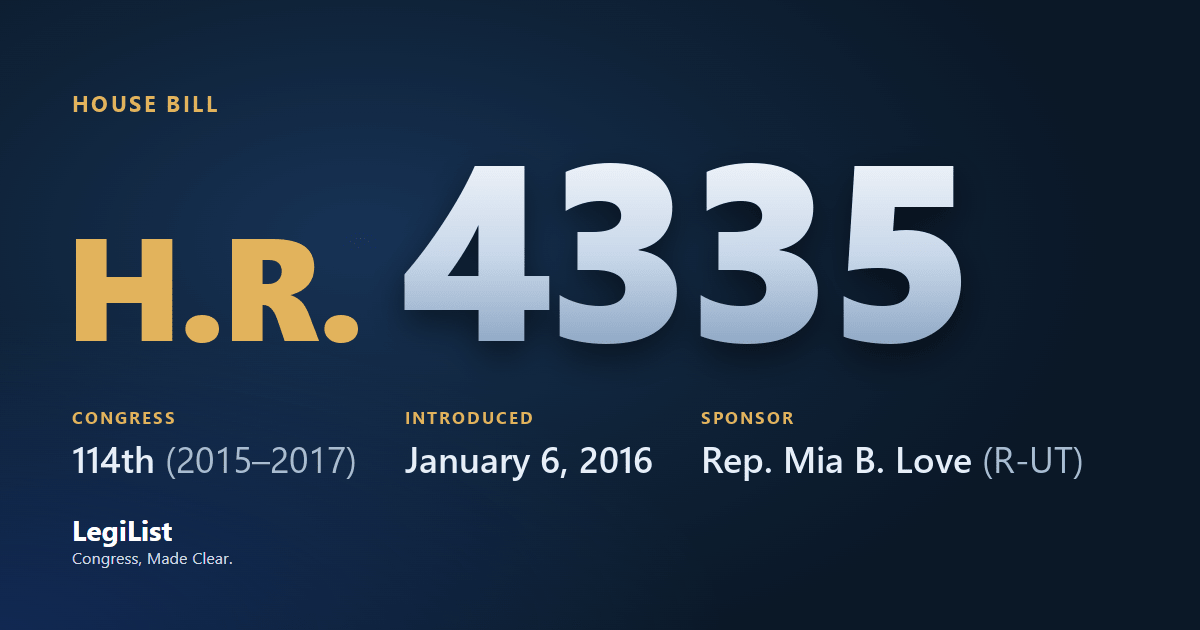
One Subject at a Time Act
Latest action · Feb 3, 2016 Referred to the Subcommittee on the Constitution and Civil Justice.
Progress
Where this bill reached, and when. A stage with no date was not reached; one that failed a vote and later carried shows the date it carried.
- IntroducedJan 6, 2016
- Passed HouseNot reached
- Passed SenateNot reached
- To the PresidentNot reached
- Became lawNot reached
Summary
One Subject at a Time Act
This bill requires: (1) each bill or joint resolution to embrace no more than one subject, and (2) the subject to be clearly and descriptively expressed in the measure's title.
The bill prohibits an appropriations bill from containing any general legislation or change of existing law requirement, if its subject is not germane to the subject of such bill.
The bill also declares void: (1) an entire Act or joint resolution if its title addresses two or more unrelated subjects, (2) provisions in legislation not clearly and descriptively expressed in the measure's title, (3) appropriation provisions in legislation outside the relevant subcommittee's jurisdiction, and (4) provisions of appropriation bills not germane to their subject matter.
Aggrieved persons and Members of Congress shall have the right to bring an action against the United States to seek appropriate relief, including an injunction against the enforcement of any law the passage of which did not conform to this Act.
Cosponsors 18
Members who signed on, in the order they did. Signatures ran from Jan 6, 2016 to Nov 14, 2016; 11 are original cosponsors, there from the day it was introduced.
| Seat | Cosponsor | Signed on | |
|---|---|---|---|
| R-UT | Chris Stewart | Original | Jan 6, 2016 |
| R-VA | Dave Brat | Original | Jan 6, 2016 |
| R-OH | Jim Jordan | Original | Jan 6, 2016 |
| R-TX | John Ratcliffe | Original | Jan 6, 2016 |
| R-KS | Kevin Yoder | Original | Jan 6, 2016 |
| R-NC | Mark Walker | Original | Jan 6, 2016 |
| R-SC | Mick Mulvaney | Original | Jan 6, 2016 |
| R-ID | Raul R. Labrador | Original | Jan 6, 2016 |
| R-IA | Rod Blum | Original | Jan 6, 2016 |
| R-NM | Stevan Pearce | Original | Jan 6, 2016 |
| R-KY | Thomas Massie | Original | Jan 6, 2016 |
| R-GA | Barry Loudermilk | Feb 8, 2016 | |
| R-OK | Jim Bridenstine | Feb 11, 2016 | |
| R-MN | Tom Emmer | Feb 12, 2016 | |
| R-GA | Doug Collins | Feb 29, 2016 | |
| R-MD | Andy Harris | Mar 23, 2016 | |
| R-FL | Dennis A. Ross | Jul 6, 2016 | |
| R-WA | Dan Newhouse | Nov 14, 2016 |
Committees 1
Where it was sent and what each committee and subcommittee did with it, in order.
| Chamber | Committee | What it did |
|---|---|---|
| House | Judiciary Committee | Referred Jan 6, 2016 |
| Constitution and Limited Government Subcommittee | Referred Feb 3, 2016 |
Actions 3
Everything that happened, newest first.
- Feb 3, 2016Referred to the Subcommittee on the Constitution and Civil Justice.
- Jan 6, 2016Introduced in House
- Jan 6, 2016Referred to the House Committee on the Judiciary.
Research
What has been written about this bill: committee reports, cost estimates, the sponsor’s authority statement, printed hearings and the Congressional Research Service’s work.
Constitutional authority
The sponsor’s statement, as printed in the Congressional Record, vol. 162, no. 3, January 6, 2016, page H102.
Related bills 2
Companion bills and other measures the record links to this one.
| Bill | Title | Relationship | Latest action |
|---|---|---|---|
| HR 395 | One Subject at a Time Act | Reintroduced Bill | Feb 6, 2017 |
| S 1572 | One Subject at a Time Act | Identical bill | Jun 15, 2015 |
Titles 2
Every title it has carried, official and short, at each stage.
- Official Title as Introduced
- To end the practice of including more than one subject in a single bill by requiring that each bill enacted by Congress be limited to only one subject, and for other purposes.
- Short Titles as Introduced
- One Subject at a Time Act
Subjects
Assigned by the Library of Congress. Policy area: Congress.
Text 1
Each version as it was printed, newest first.
- Jan 6, 2016Introduced in House
Everything here is as published by Congress: the summary is the Congressional Research Service's, the action wording is the clerks', and the subjects are the Library of Congress's. How far it got is read from the actions themselves, taking the most recent one of each kind, so a bill that failed a vote and later passed is shown as having passed. Records come from this bill on Congress.gov and govinfo.gov; cost estimates are the Congressional Budget Office's, and the hearings are the printed hearings GovInfo publishes, which can appear months after the hearing.