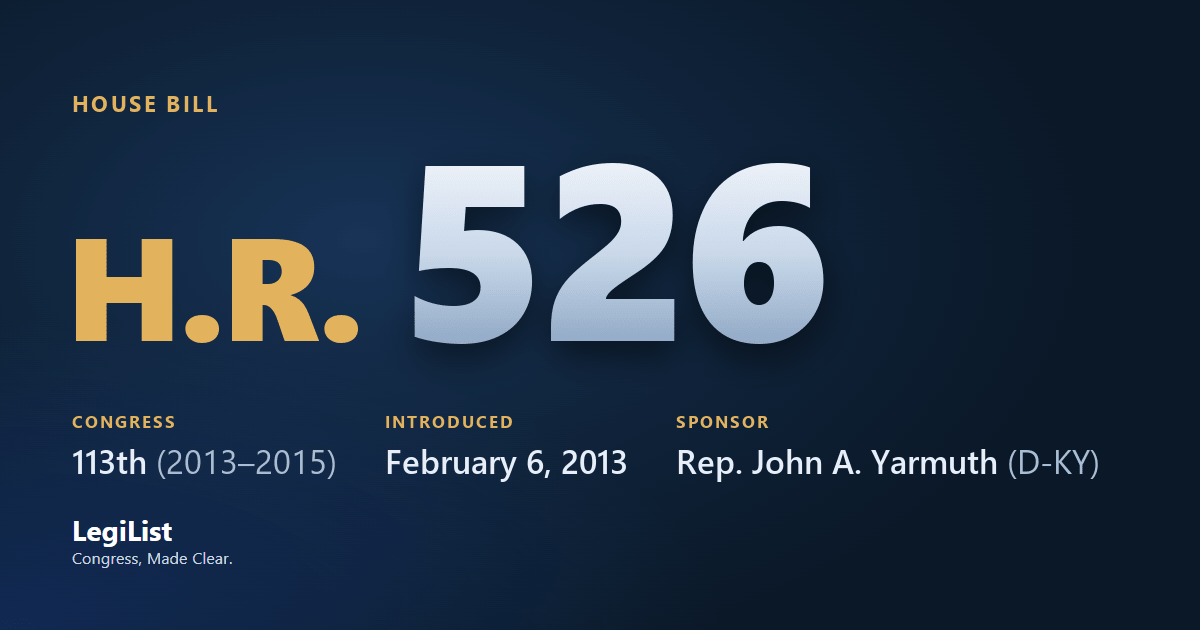
ACHE Act
Latest action · Feb 15, 2013 Referred to the Subcommittee on Energy and Mineral Resources.
Progress
Where this bill reached, and when. A stage with no date was not reached; one that failed a vote and later carried shows the date it carried.
- IntroducedFeb 6, 2013
- Passed HouseNot reached
- Passed SenateNot reached
- To the PresidentNot reached
- Became lawNot reached
Summary
Appalachian Communities Health Emergency Act or ACHE Act - Requires the Director of the National Institute of Environmental Health Sciences to conduct or support comprehensive studies on the health impacts of mountaintop removal coal mining on individuals in the surrounding communities. Directs the Secretary of Health and Human Services (HHS), upon receipt of a report on study results, to publish a determination of whether such mining presents any health risks to individuals in those communities. Defines "mountaintop removal coal mining" as surface coal mining that uses blasting with explosives in the steep slope regions of Kentucky, Tennessee, West Virginia, and Virginia.
Prohibits issuance of an authorization for any mountaintop removal coal mining project (or expansion), under the Federal Water Pollution Control Act (commonly known as the Clean Water Act) or the Surface Mining Control and Reclamation Act of 1977, until and unless the Secretary publishes a determination that such mining does not present any health risk to individuals in the surrounding communities. Imposes requirements for continuous monitoring of air, noise, and water pollution and frequent monitoring of soil until a determination by the Secretary is made.
Directs the President, acting through the Office of Surface Mining Reclamation and Enforcement of the Department of the Interior, to assess a one-time fee upon persons that conduct such mining projects, sufficient to cover the federal cost of the health studies and pollution monitoring required by this Act.
Cosponsors 46
Members who signed on, in the order they did. Signatures ran from Feb 6, 2013 to Apr 3, 2014, with 23 there on the day it was introduced.
| Seat | Cosponsor | Signed on | |
|---|---|---|---|
| D-CA | Barbara Lee | Original | Feb 6, 2013 |
| D-NY | Charles B. Rangel | Original | Feb 6, 2013 |
| D-ME | Chellie Pingree | Original | Feb 6, 2013 |
| D-MD | Donna F. Edwards | Original | Feb 6, 2013 |
| D-OR | Earl Blumenauer | Original | Feb 6, 2013 |
| D-DC | Eleanor Holmes Norton | Original | Feb 6, 2013 |
| D-VA | James P. Moran | Original | Feb 6, 2013 |
| D-IL | Janice D. Schakowsky | Original | Feb 6, 2013 |
| D-CA | Jared Huffman | Original | Feb 6, 2013 |
| D-CO | Jared Polis | Original | Feb 6, 2013 |
| D-WA | Jim McDermott | Original | Feb 6, 2013 |
| D-MI | John Conyers, Jr. | Original | Feb 6, 2013 |
| D-MD | John P. Sarbanes | Original | Feb 6, 2013 |
| D-CA | Judy Chu | Original | Feb 6, 2013 |
| D-MN | Keith Ellison | Original | Feb 6, 2013 |
Actions 5
Everything that happened, newest first.
- Feb 15, 2013Referred to the Subcommittee on Energy and Mineral Resources.
- Feb 8, 2013Referred to the Subcommittee on Environment and the Economy.
- Feb 7, 2013Referred to the Subcommittee on Water Resources and Environment.
- Feb 6, 2013Introduced in House
- Feb 6, 2013Referred to the Committee on Natural Resources, and in addition to the Committees on Transportation and Infrastructure, and Energy and Commerce, for a period to be subsequently determined by the Speaker, in each case for consideration of such provisions as fall within the jurisdiction of the committee concerned.
Subjects
Assigned by the Library of Congress. Policy area: Health.
- Air quality
- Coal
- Environmental assessment, monitoring, research
- Environmental health
- Health
- Health information and medical records
- Health programs administration and funding
- Kentucky
- Licensing and registrations
- Medical research
- Mining
- Noise pollution
- Research administration and funding
- Tennessee
- User charges and fees
- Virginia
- Water quality
- West Virginia
Text 1
Each version as it was printed, newest first.
- Feb 6, 2013Introduced in House
Everything here is as published by Congress: the summary is the Congressional Research Service's, the action wording is the clerks', and the subjects are the Library of Congress's. How far it got is read from the actions themselves, taking the most recent one of each kind, so a bill that failed a vote and later passed is shown as having passed. Records come from this bill on Congress.gov and govinfo.gov.