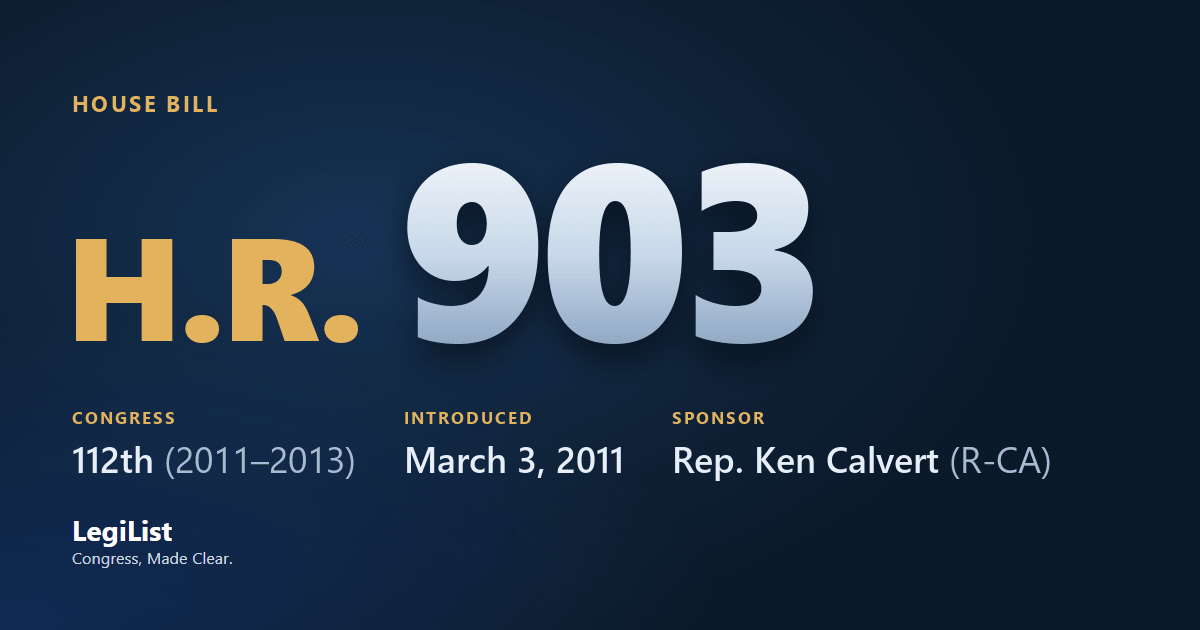
MORE Act of 2011
Latest action · Mar 7, 2011 Referred to the Subcommittee on Energy and Mineral Resources.
Progress
Where this bill reached, and when. A stage with no date was not reached; one that failed a vote and later carried shows the date it carried.
- IntroducedMar 3, 2011
- Passed HouseNot reached
- Passed SenateNot reached
- To the PresidentNot reached
- Became lawNot reached
Summary
Maximize Offshore Resource Exploration Act of 2011 or MORE Act of 2011 - Declares without force or effect all federal prohibitions against the expenditure of appropriated funds to conduct natural gas leasing and preleasing activities for any area of the Outer Continental Shelf (OCS).
Revokes all withdrawals of federal submerged lands from leasing for oil and natural gas exploration and production.
Amends the Outer Continental Shelf Lands Act to prohibit the Secretary of the Interior from granting an oil or natural gas lease for any OCS located within 25 miles of a state coastline unless the state has enacted a law approving the issuance of such leases by the Sectretary.
Sets forth an allocation schedule for a 75% state share of revenues derived from U.S. royalties under qualified oil and gas leases on submerged lands located within the seaward boundaries of a state.
Extends the jurisdiction of state civil and criminal law, as appropriate, to the Alaska, Pacific, Gulf of Mexico, and Atlantic OCS Region State Adjacent Zones and OCS Planning Areas.
Establishes a separate account in the Treasury to be known as the Renewable Energy Reserve, consisting of 12.5% of revenues derived from U.S. royalties under such oil and gas leases.
Makes the Reserve available to offset the cost of subsequently enacted legislation to: (1) accelerate the use of cleaner domestic energy resources and alternative fuels; (2) promote the utilization of energy-efficient products and practices; and (3) increase research, development, and deployment of clean renewable energy and efficiency technologies and job training programs for those purposes.
Cosponsors 17
Members who signed on, in the order they did. Signatures ran from Mar 3, 2011 to Mar 29, 2011; 13 are original cosponsors, there from the day it was introduced.
| Seat | Cosponsor | Signed on | |
|---|---|---|---|
| R-MO | Billy Long | Original | Mar 3, 2011 |
| R-OH | Bob Gibbs | Original | Mar 3, 2011 |
| R-CA | Daniel E. Lungren | Original | Mar 3, 2011 |
| R-CA | David Dreier | Original | Mar 3, 2011 |
| R-CA | Devin Nunes | Original | Mar 3, 2011 |
| R-CA | Elton Gallegly | Original | Mar 3, 2011 |
| R-CA | Gary G. Miller | Original | Mar 3, 2011 |
| R-MS | Gregg Harper | Original | Mar 3, 2011 |
| R-CA | Howard P. "Buck" McKeon | Original | Mar 3, 2011 |
| R-CA | Jerry Lewis | Original | Mar 3, 2011 |
| R-TX | John R. Carter | Original | Mar 3, 2011 |
| R-OH | Robert E. Latta | Original | Mar 3, 2011 |
| R-CA | Wally Herger | Original | Mar 3, 2011 |
| R-OK | Tom Cole | Mar 10, 2011 | |
| R-CA | Duncan Hunter | Mar 17, 2011 |
Committees 3
Where it was sent and what each committee and subcommittee did with it, in order.
| Chamber | Committee | What it did |
|---|---|---|
| House | Natural Resources Committee | Referred Mar 3, 2011 |
| Energy and Mineral Resources Subcommittee | Referred Mar 7, 2011 | |
| House | Budget Committee | Referred Mar 3, 2011 |
| House | Rules Committee | Referred Mar 3, 2011 |
Actions 3
Everything that happened, newest first.
- Mar 7, 2011Referred to the Subcommittee on Energy and Mineral Resources.
- Mar 3, 2011Introduced in House
- Mar 3, 2011Referred to the Committee on Natural Resources, and in addition to the Committees on the Budget, and Rules, for a period to be subsequently determined by the Speaker, in each case for consideration of such provisions as fall within the jurisdiction of the committee concerned.
Research
What has been written about this bill: committee reports, cost estimates, the sponsor’s authority statement, printed hearings and the Congressional Research Service’s work.
Constitutional authority
The sponsor’s statement, as printed in the page H1576.
Titles 3
Every title it has carried, official and short, at each stage.
- Official Title as Introduced
- To greatly enhance the Nation's environmental, energy, economic, and national security by terminating long-standing Federal prohibitions on the domestic production of abundant offshore supplies of oil and natural gas, and for other purposes.
- Short Titles as Introduced
- MORE Act of 2011
- Maximize Offshore Resource Exploration Act of 2011
Subjects
Assigned by the Library of Congress. Policy area: Public Lands and Natural Resources.
- Air quality
- Alternative and renewable resources
- Budget deficits and national debt
- Employment and training programs
- Energy efficiency and conservation
- Energy research
- Energy revenues and royalties
- Marine and coastal resources, fisheries
- Oil and gas
- Public Lands and Natural Resources
- Research administration and funding
- Research and development
- Water quality
Text 1
Each version as it was printed, newest first.
- Mar 3, 2011Introduced in House
Support LegiList
This page is free, carries no paywall, and is built and maintained by one person. If the record here is useful to you, a few dollars keeps it going.
Everything here is as published by Congress: the summary is the Congressional Research Service's, the action wording is the clerks', and the subjects are the Library of Congress's. How far it got is read from the actions themselves, taking the most recent one of each kind, so a bill that failed a vote and later passed is shown as having passed. Records come from this bill on Congress.gov and govinfo.gov; cost estimates are the Congressional Budget Office's, and the hearings are the printed hearings GovInfo publishes, which can appear months after the hearing.