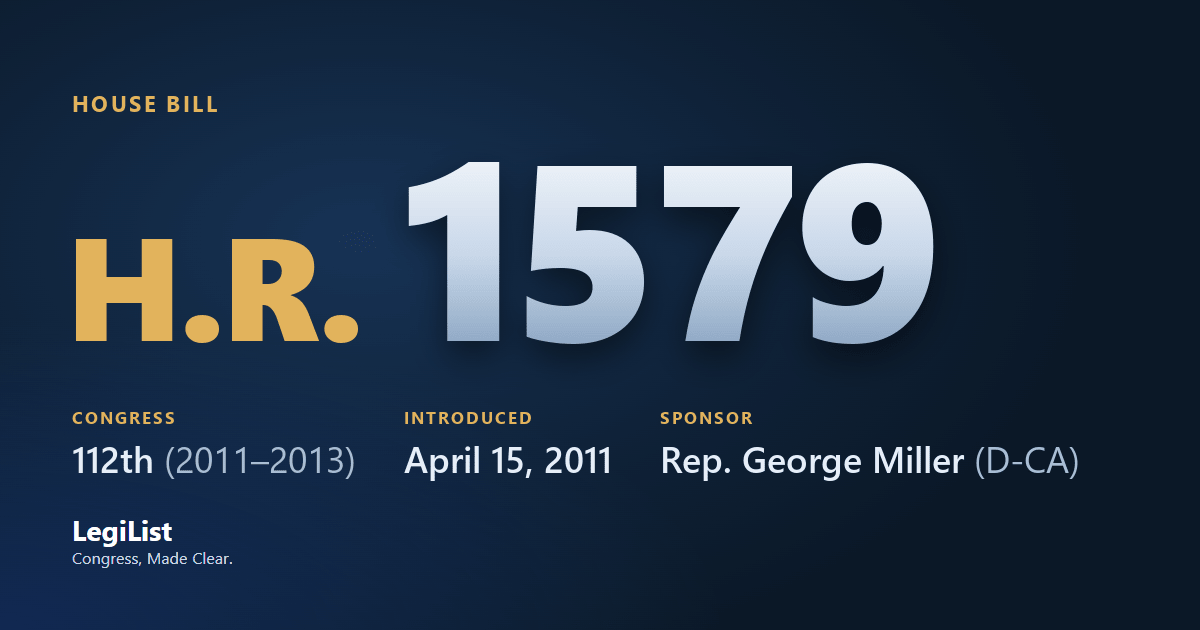
Robert C. Byrd Mine Safety Protection Act of 2011
Latest action · May 20, 2011 Referred to the Subcommittee on Workforce Protections.
Progress
Where this bill reached, and when. A stage with no date was not reached; one that failed a vote and later carried shows the date it carried.
- IntroducedApr 15, 2011
- Passed HouseNot reached
- Passed SenateNot reached
- To the PresidentNot reached
- Became lawNot reached
Summary
Robert C. Byrd Mine Safety Protection Act of 2011 - Amends the Federal Mine Safety and Health Act of 1977 to require the Secretary of Labor (Secretary), in conducting health and safety related accident investigations in coal or other mines, to: (1) determine why an accident occurred and whether there were violations of law, mandatory health and safety standards, or other requirements; (2) in cases involving violations of federal criminal law, refer them to the Attorney General; and (3) make recommendations to avoid any recurrence.
Requires an independent accident investigation by an independent panel appointed by the Secretary of Health and Human Services (HHS) for any accident: (1) involving three or more deaths, or (2) whose severity or scale merits an independent investigation.
Authorizes: (1) the Secretary's representatives and attorneys to question any individual privately during an inspection or investigation; and (2) any individual willing to speak with or provide a statement to such representatives or attorneys to do so without the presence, involvement, or knowledge of the mine operator or mine operator's agents or attorneys.
Allows the closest relative of a miner who is entrapped or otherwise prevented by an accident to designate a representative for the miner to participate in a mine inspection. Requires mine inspections to be conducted during various shifts and days of the week when miners are normally present.
Directs the Secretary, upon the request of the mine operator, to review with appropriate mine officials the Secretary's most recent evaluation for pattern (of violation) status during the course of a regular mine inspection, or at the Secretary's discretion, during the pre-inspection conference.
Prohibits an attorney from representing both a mine operator and miner during an inspection, investigation, or litigation, unless such miner knowingly waives all possible conflicts of interest.
Prescribes requirements for mine operators having a pattern of recurring citations, withdrawal orders, accidents, or injuries.
Requires the Secretary to assess and collect fees from mines in pattern status for the costs of additional inspections.
Requires the Secretary to: (1) revoke the approval of mine operator plans or programs based on certain criteria; and (2) order withdrawal of all persons from a mine or mine area, and prohibit them from entering it, until the operator submits and the Secretary approves a new plan.
Revises civil and criminal penalties and related administrative procedures.
Revises certain miner protections against discrimination. Prohibits discriminating against a miner or other employee of a mine operator for refusing to perform duties out of a good-faith and reasonable belief that performing such duties would pose a safety or health hazard.
Entitles a miner to full compensation by a mine operator at the regular rate of pay for the entire period (not to exceed 60 days) for which the miner is idled because of a Secretary's withdrawal order. (Under current law, miners are entitled to full compensation only for the time that they are idled, or for one week, whichever is the lesser, after all interested parties are given an opportunity for a public hearing and after such order is final.)
Prohibits an underground coal mine operator whose mine has been in pattern status for three years from discharging (or constructively discharging) a miner paid on an hourly basis without reasonable job-related grounds based on certain failures to perform job duties satisfactorily if the miner has completed the employer's probationary period of up to six months. Allows a miner aggrieved by violation of this prohibition to file a complaint in federal district court for reinstatement and compensatory damages.
Requires each underground coal mine operator to implement a communication program to ensure that each miner is orally briefed on and made aware of current mine conditions before traveling to or arriving at the mine work area and commencing assigned tasks.
Prescribes additional requirements for the monitoring of coal dust in underground mines.
Requires the Director of the National Institute for Occupational Safety and Health (NIOSH), acting through the Office of Mine Safety and Health Research, to issue recommendations to the Secretary regarding the use of atmospheric monitoring systems in the underground coal mining industry.
Revises mine operator health and safety training program requirements. Increases from 8 to 9 the minimum number of hours of refresher training all miners must receive at least once every 12 months, including 1 hour of training on miners statutory rights and responsibilities. Requires such training programs to include distribution of miners' rights as well as a toll-free hotline telephone number.
Requires the Secretary to order a mine operator to provide additional training to miners if a serious or fatal accident has occurred at a mine or it has experienced above-average accident and injury rates, citations, or withdrawal orders.
Amends the Mine Improvement and New Emergency Response Act of 2006 to require the Secretary to give special emphasis in the award of competitive grants for education and training (Brookwood-Sago Mine Safety Grants) to programs and materials that provide underground mine accident rescue simulation training to workers in smaller mines.
Requires the Secretary to issue mandatory standards to establish certification requirements and procedures for persons authorized by a mine operator to perform duties or provide training under such Act.
Authorizes the Secretary to make grants to states to assist them in developing and implementing miner certification programs.
Amends the Black Lung Benefits Act to require a mine operator to deliver within 14 days a complete copy of the examining physician's report to any miner required to submit to a medical examination.
Amends the Occupational Safety and Health Act of 1970 (OSHA) authorize the Director of NIOSH, acting through the Office of Mine Safety and Health, to enter into cooperative agreements with international institutions and private entities to improve mine safety and health through new interventions.
Cosponsors 18
Members who signed on, in the order they did. Signatures ran from Apr 15, 2011 to Apr 24, 2012; 7 are original cosponsors, there from the day it was introduced.
| Seat | Cosponsor | Signed on | |
|---|---|---|---|
| D-OH | Betty Sutton | Original | Apr 15, 2011 |
| D-NJ | Donald M. Payne | Original | Apr 15, 2011 |
| D-CA | Lynn C. Woolsey | Original | Apr 15, 2011 |
| D-HI | Mazie K. Hirono | Original | Apr 15, 2011 |
| D-WV | Nick J. Rahall II | Original | Apr 15, 2011 |
| D-AZ | Raúl M. Grijalva | Original | Apr 15, 2011 |
| D-NJ | Rush Holt | Original | Apr 15, 2011 |
| D-OH | Dennis J. Kucinich | May 2, 2011 | |
| D-IL | Jesse L. Jackson, Jr. | May 2, 2011 | |
| D-CA | Linda T. Sánchez | May 2, 2011 | |
| D-NY | Timothy H. Bishop | May 2, 2011 | |
| D-NY | Carolyn McCarthy | May 10, 2011 | |
| D-CO | Jared Polis | May 10, 2011 | |
| D-NY | Maurice D. Hinchey | May 10, 2011 | |
| D-NM | Martin Heinrich | Jun 3, 2011 | |
| D-OH | Tim Ryan | Dec 6, 2011 | |
| D-CT | Rosa L. DeLauro | Jan 17, 2012 | |
| D-OH | Marcia L. Fudge | Apr 24, 2012 |
Committees 1
Where it was sent and what each committee and subcommittee did with it, in order.
| Chamber | Committee | What it did |
|---|---|---|
| House | Education and Workforce Committee | Referred Apr 15, 2011 |
| Workforce Protections Subcommittee | Referred May 20, 2011 |
Actions 3
Everything that happened, newest first.
- May 20, 2011Referred to the Subcommittee on Workforce Protections.
- Apr 15, 2011Introduced in House
- Apr 15, 2011Referred to the House Committee on Education and the Workforce.
Research
What has been written about this bill: committee reports, cost estimates, the sponsor’s authority statement, printed hearings and the Congressional Research Service’s work.
Constitutional authority
The sponsor’s statement, as printed in the page H2914.
Printed hearings 1
Hearings whose printed record names this bill, newest first: hearings on it, and wider hearings where it came up.
| Number | Hearing | Committee | Held |
|---|---|---|---|
| Serial No. 112-56 | LEARNING FROM THE UPPER BIG BRANCH TRAGEDY133 pages | Education and Workforce Committee | Mar 27, 2012 |
Related bills 3
Companion bills and other measures the record links to this one.
| Bill | Title | Relationship | Latest action |
|---|---|---|---|
| S 153 | Robert C. Byrd Mine and Workplace Safety and Health Act of 2011 | Related bill | Jan 25, 2011 |
| S 3443 | Robert C. Byrd Mine and Workplace Safety and Health Act of 2012 | Related bill | Jul 25, 2012 |
| HR 3697 | Mine Safety Accountability and Improved Protection Act | Related bill | Mar 29, 2012 |
Titles 2
Every title it has carried, official and short, at each stage.
- Official Title as Introduced
- To improve compliance with mine safety and health laws, empower miners to raise safety concerns, prevent future mine tragedies, and for other purposes.
- Short Titles as Introduced
- Robert C. Byrd Mine Safety Protection Act of 2011
Subjects
Assigned by the Library of Congress. Policy area: Labor and Employment.
- Accidents
- Administrative law and regulatory procedures
- Administrative remedies
- Air quality
- Business ethics
- Business records
- Cardiovascular and respiratory health
- Civil actions and liability
- Coal
- Congressional oversight
- Criminal procedure and sentencing
- Department of Health and Human Services
- Department of Labor
- Employment and training programs
- Employment discrimination and employee rights
- Environmental assessment, monitoring, research
- Evidence and witnesses
- Federal Mine Safety and Health Review Commission
- Government information and archives
- Government studies and investigations
- Health information and medical records
- Interest, dividends, interest rates
- Judicial review and appeals
- Labor and Employment
- Lawyers and legal services
- Legal fees and court costs
- Licensing and registrations
- Medical tests and diagnostic methods
- Mining
- Performance measurement
- User charges and fees
- Worker safety and health
Text 1
Each version as it was printed, newest first.
- Apr 15, 2011Introduced in House
Support LegiList
This page is free, carries no paywall, and is built and maintained by one person. If the record here is useful to you, a few dollars keeps it going.
Everything here is as published by Congress: the summary is the Congressional Research Service's, the action wording is the clerks', and the subjects are the Library of Congress's. How far it got is read from the actions themselves, taking the most recent one of each kind, so a bill that failed a vote and later passed is shown as having passed. Records come from this bill on Congress.gov and govinfo.gov; cost estimates are the Congressional Budget Office's, and the hearings are the printed hearings GovInfo publishes, which can appear months after the hearing.