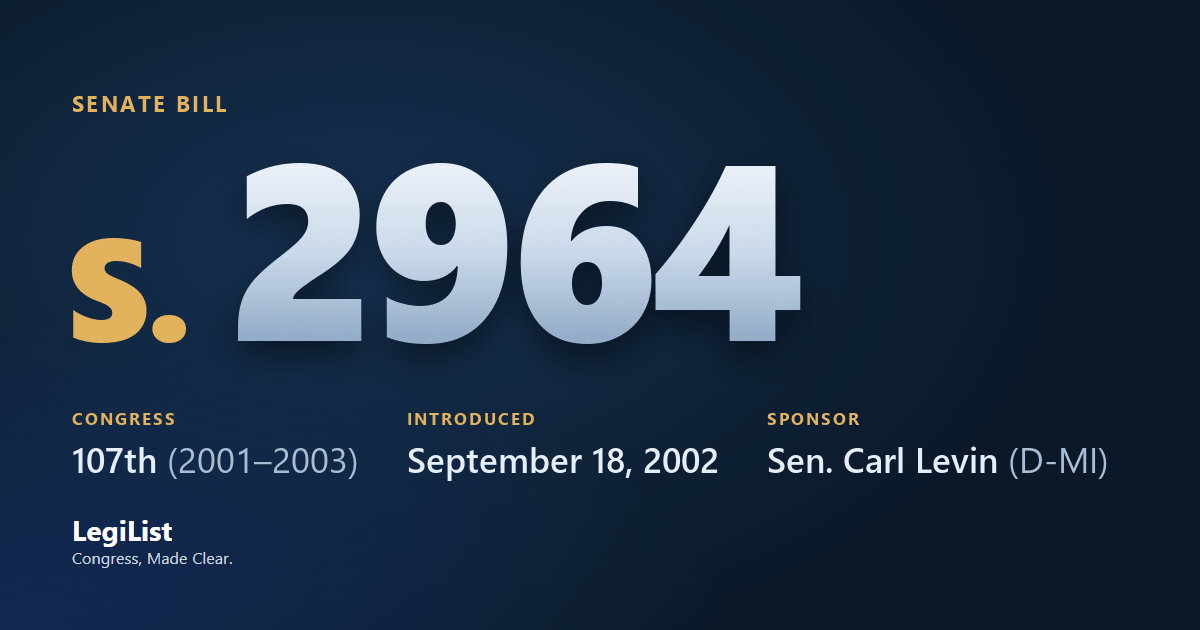
National Aquatic Invasive Species Act of 2002
Latest action · Sep 18, 2002 Read twice and referred to the Committee on Environment and Public Works.
Progress
Where this bill reached, and when. A stage with no date was not reached; one that failed a vote and later carried shows the date it carried.
- IntroducedSep 18, 2002
- Passed SenateNot reached
- Passed HouseNot reached
- To the PresidentNot reached
- Became lawNot reached
Summary
Requires the Task Force to recommend to appropriate Federal agencies additions to the list of AIS's.
Requires the Task Force, the Council, and the Secretary of State to coordinate activities to ensure that international efforts to prevent and manage AIS's are coordinated with U.S. policies.
Establishes minimum invasive species prevention requirements for all vessels entering U.S. ports.
Directs the Task Force to publish a priority pathway management program.
Prohibits the importation of live aquatic organisms not in trade without specified screening and approval.
Directs the Task Force to develop a national system of ecological surveys to rapidly detect recently-established AIS's in U.S. waters.
Requires the Assistant Secretary of the Army for Civil Works to construct and maintain a national dispersal barrier program to contain and control aquatic nuisances.
Makes any State with a rapid response contingency strategy eligible to receive emergency funding to implement rapid response measures for AIS's.
Requires the Task Force to encourage development of regional rapid response contingency strategies and develop a State model for such.
Requires the Council, in coordination with the Task Force and the heads of the appropriate Federal agencies, to establish a Federal rapid response team for the ten regions of the Standard Federal Regional Boundary System.
Requires the Task Force to establish a national subcommittee on nutria.
Provides for expansion of the Brown Tree Snake Control Program and Aquatic Nuisance Species Program information, education and outreach activities.
Requires specified agencies and research centers to develop and conduct marine research and demonstration programs to assess rates of, patterns of, and conditions surrounding introductions of nonnative aquatic species into aquatic ecosystems.
Requires the Secretary to develop a central national database of information on ballast water management and treatment.
Requires specified agencies to develop a vessel pathway standards research program.
Requires the National Science Foundation to establish a program of grants to institutions of higher education for research in systematics and taxonomy.
Cosponsors 13
Members who signed on, in the order they did. All signed on Sep 18, 2002.
| Seat | Cosponsor | Signed on | |
|---|---|---|---|
| D-HI | Daniel K. Akaka | Original | Sep 18, 2002 |
| D-HI | Daniel K. Inouye | Original | Sep 18, 2002 |
| D-MI | Debbie Stabenow | Original | Sep 18, 2002 |
| D-MA | Edward M. Kennedy | Original | Sep 18, 2002 |
| D-IN | Evan Bayh | Original | Sep 18, 2002 |
| R-OH | George V. Voinovich | Original | Sep 18, 2002 |
| D-RI | Jack Reed | Original | Sep 18, 2002 |
| R-VA | John Warner | Original | Sep 18, 2002 |
| D-WA | Maria Cantwell | Original | Sep 18, 2002 |
| R-OH | Mike DeWine | Original | Sep 18, 2002 |
| R-IL | Peter Fitzgerald | Original | Sep 18, 2002 |
| D-IL | Richard J. Durbin | Original | Sep 18, 2002 |
| R-ME | Susan M. Collins | Original | Sep 18, 2002 |
Committees 1
Where it was sent and what each committee and subcommittee did with it, in order.
| Chamber | Committee | What it did |
|---|---|---|
| Senate | Environment and Public Works Committee | Referred Sep 18, 2002 |
Actions 3
Everything that happened, newest first.
- Sep 18, 2002Introduced in Senate
- Sep 18, 2002Sponsor introductory remarks on measure. (CR S8960-8961)
- Sep 18, 2002Read twice and referred to the Committee on Environment and Public Works.
In the Congressional Record 1
Days the Record’s own index lists this bill, newest first, with the pages and the members it names. Pages starting H are the House, S the Senate, E Extensions of Remarks.
| Where | In the Record | Members | Date |
|---|---|---|---|
| Senate | Debate and remarks S8760 | Debbie Stabenow D-MI | Sep 18, 2002 |
Research
What has been written about this bill: committee reports, cost estimates, the sponsor’s authority statement, printed hearings and the Congressional Research Service’s work.
Printed hearings 2
Hearings whose printed record names this bill, newest first: hearings on it, and wider hearings where it came up.
| Number | Hearing | Committee | Held |
|---|---|---|---|
| S. Hrg. 107-921 | THOMASINA E. JORDAN INDIAN TRIBES OF VIRGINIA FEDERAL RECOGNITION ACT128 pages | Indian Affairs Committee | Oct 9, 2002 |
| Serial No. 107-153 | H.R. 992, H.R. 2345 and H.R. 5155135 pages | Natural Resources Committee | Sep 25, 2002 |
Titles 2
Every title it has carried, official and short, at each stage.
- Official Title as Introduced
- A bill to amend the Nonindigenous Aquatic Nuisance Prevention and Control Act of 1990 to reauthorize and improve that Act.
- Short Titles as Introduced
- National Aquatic Invasive Species Act of 2002
Subjects
Assigned by the Library of Congress. Policy area: Water Resources Development.
- Administrative fees
- Administrative procedure
- Agriculture and Food
- Algal blooms
- Animals
- Aquaculture
- Aquariums
- Aquatic animals
- Aquatic biology
- Aquatic ecology
- Aquatic pests
- Aquatic plants
- Aquatic weed control
- Armed Forces and National Security
- Authorization
- Biological diversity conservation
- Boats and boating
- Boundaries
- Business records
- Canada
- Canals
- Coastwise shipping
- Commerce
- Communication in science
- Conferences
- Congress
- Congressional reporting requirements
- Data banks
- Department of Transportation
- Ecological research
- Ecological surveys
- Economics and Public Finance
- Ecosystem management
- Education
- Electronic government information
- Emergency Management
- Environmental assessment
- Environmental education
- Environmental Protection
- Environmental research
- Environmental technology
- Executive reorganization
- Exotic animals
- Exotic plants
- Federal advisory bodies
- Federal aid to higher education
- Federal aid to research
- Federal aid to water pollution control
- Federal-Indian relations
- Federal-state relations
- Fishery management
- Foreign Trade and International Finance
- Government Operations and Politics
- Government paperwork
- Government publicity
- Graduate education
- Grants-in-aid
- Great Lakes
- Guam
- Habitat conservation
- Hawaii
- Health
- Higher education
- Horticulture
- Illinois
- Import restrictions
- Indian lands
- Inland water transportation
- International Affairs
- International agencies
- International environmental cooperation
- Internet
- Interstate relations
- Labor and Employment
- Latin America
- Law
- Licenses
- Marine and coastal resources, fisheries
- Marine fouling organisms
- Marine safety
- Marine transportation
- Merchant seamen
- Mexico
- Minorities
- Mississippi River
- National parks
- Native Americans
- Negotiations
- New York State
- Northern Mariana Islands
- Occupational health and safety
- Paints and varnishes
- Pest control
- Pests
- Pets
- Planning
- Public health
- Public Lands and Natural Resources
- Refuse and refuse disposal
- Regional planning
- Research and development
- Research grants
- Risk assessment
- Rivers
- Science, Technology, Communications
- Ships
- Signs and signboards
- Snakes
- Social Welfare
- Sports and Recreation
- Technological innovations
- Transportation and Public Works
- Treaties
- Volunteer workers
- Warships
- Waste disposal in rivers, lakes, etc.
- Waste disposal in the ocean
- Waste water
- Waste water treatment
- Water pollution control
- Water pollution measurement
- Water Resources Development
- Waterways
- Wildlife conservation
Text 1
Each version as it was printed, newest first.
- Sep 18, 2002Introduced in Senate
Everything here is as published by Congress: the summary is the Congressional Research Service's, the action wording is the clerks', and the subjects are the Library of Congress's. How far it got is read from the actions themselves, taking the most recent one of each kind, so a bill that failed a vote and later passed is shown as having passed. Records come from this bill on Congress.gov and govinfo.gov; cost estimates are the Congressional Budget Office's, and the hearings are the printed hearings GovInfo publishes, which can appear months after the hearing.