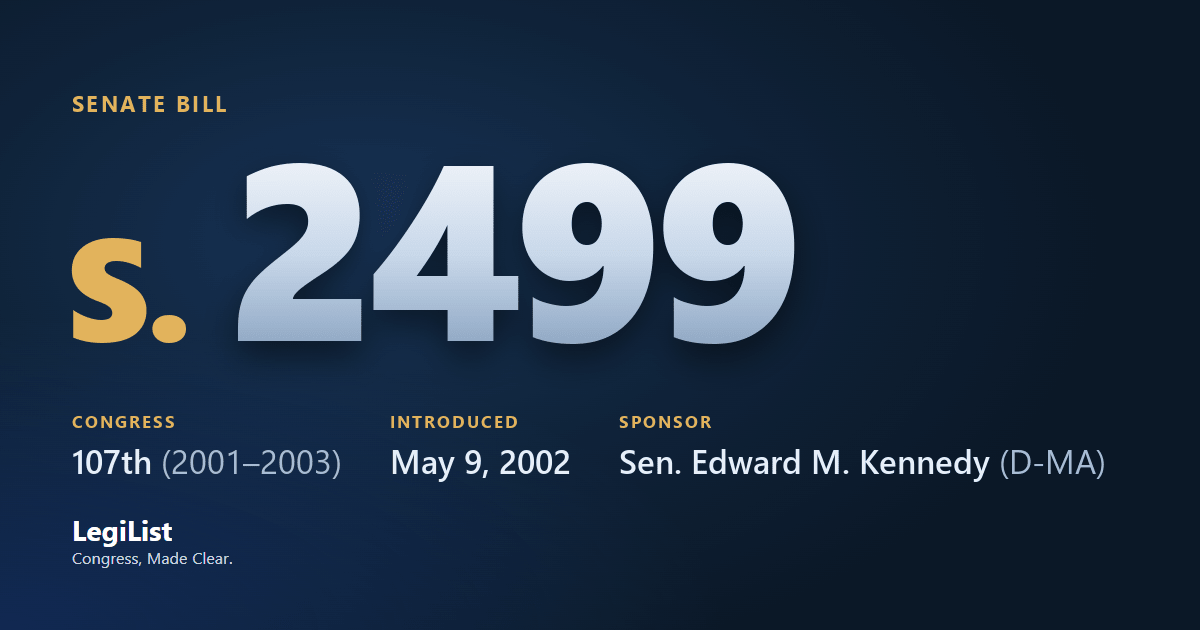
Food Allergen Labeling and Consumer Protection Act
Latest action · Oct 17, 2002 Placed on Senate Legislative Calendar under General Orders. Calendar No. 739.
Progress
Where this bill reached, and when. A stage with no date was not reached; one that failed a vote and later carried shows the date it carried.
- IntroducedMay 9, 2002
- Passed SenateNot reached
- Passed HouseNot reached
- To the PresidentNot reached
- Became lawNot reached
Summary
(Sec. 4) Requires the Secretary of Health and Human Services to issue a report to Congress analyzing various topics, including how foods can be unintentionally contaminated with major food allergens. States that the report shall recommend good manufacturing practices or other methods to reduce or eliminate such cross-contact of foods with major food allergens.
(Sec. 5) Directs the Secretary of Health and Human Services to give priority to increasing the number of inspections under the Act to ensure that foods comply with practices to reduce or eliminate cross-contact with major food allergen residues and to ensure that major food allergens are properly labeled on foods. Sets forth reporting requirements.
(Sec. 6) Requires the Secretary to contract with the Institute of Medicine to conduct a review of the science relating to glutens in food and celiac disease, and to issue a report to the Secretary and Congress on its findings. Directs the Secretary to issue a proposed rule followed by a final rule to define, and permit use of, the term "gluten-free" on the labeling of foods. Sets forth reporting requirements.
(Sec. 7) Directs the Secretary, with appropriate consultation, to complete a study on the existing systems of reporting, collecting, and analyzing national data on certain subjects, including the prevalence of food allergies, and to identify new or alternative enhancements to such systems. Sets forth reporting requirements. Authorizes appropriations.
(Sec. 8) Requires the Secretary, through the National Institutes of Health, to convene a panel of nationally recognized experts to review basic and clinical research efforts related to food allergies and to develop a plan for expanding, intensifying, and coordinating such research. Sets forth reporting requirements.
(Sec. 9) Directs the Secretary, in the Conference for Food Protection, as part of its cooperative activities between the States under the Public Health Service Act, to pursue certain revisions of the Food Code to provide guidelines for preparing allergen-free foods in food establishments.
(Sec. 10) Requires the Secretary to include assistance relating to the use of different modes of treatment for and prevention of allergic responses to foods when he or she provides technical assistance relating to trauma care and emergency medical services under the Public Health Service Act.
Cosponsors 2
Members who signed on, in the order they did. Signatures ran from May 9, 2002 to Sep 25, 2002; 1 is an original cosponsor, there from the day it was introduced.
| Seat | Cosponsor | Signed on | |
|---|---|---|---|
| D-NY | Hillary Rodham Clinton | Original | May 9, 2002 |
| D-NJ | Robert G. Torricelli | Sep 25, 2002 |
Committees 1
Where it was sent and what each committee and subcommittee did with it, in order.
| Chamber | Committee | What it did |
|---|---|---|
| Senate | Health, Education, Labor, and Pensions Committee | Referred May 9, 2002Markup Sep 25, 2002Reported Oct 17, 2002 |
Actions 6
Everything that happened, newest first.
- Oct 17, 2002Committee on Health, Education, Labor, and Pensions. Reported by Senator Kennedy with an amendment in the nature of a substitute. With written report No. 107-322.
- Oct 17, 2002Placed on Senate Legislative Calendar under General Orders. Calendar No. 739.
- Sep 25, 2002Committee on Health, Education, Labor, and Pensions. Ordered to be reported with an amendment in the nature of a substitute favorably.
- May 9, 2002Introduced in Senate
- May 9, 2002Sponsor introductory remarks on measure. (CR S4163-4164)
In the Congressional Record 1
Days the Record’s own index lists this bill, newest first, with the pages and the members it names. Pages starting H are the House, S the Senate, E Extensions of Remarks.
| Where | In the Record | Members | Date |
|---|---|---|---|
| Senate | Debate and remarks S4163Text printed S4164 | Edward M. Kennedy D-MA (text) | May 9, 2002 |
Research
What has been written about this bill: committee reports, cost estimates, the sponsor’s authority statement, printed hearings and the Congressional Research Service’s work.
Committee report
Related bills 1
Companion bills and other measures the record links to this one.
| Bill | Title | Relationship | Latest action |
|---|---|---|---|
| HR 4704 | Food Allergen Consumer Protection Act | Identical bill | May 17, 2002 |
Titles 3
Every title it has carried, official and short, at each stage.
- Official Title as Introduced
- A Bill to amend the Federal Food, Drug, and Cosmetic Act to establish labeling requirements regarding allergenic substances in food, and for other purposes.
- Short Titles as Introduced
- Food Allergen Consumer Protection Act
- Short Titles as Reported to Senate
- Food Allergen Labeling and Consumer Protection Act
Subjects
Assigned by the Library of Congress. Policy area: Agriculture and Food.
- Administrative procedure
- Agriculture and Food
- Barley
- Business records
- Child health
- Commerce
- Congress
- Congressional reporting requirements
- Consumer education
- Department of Health and Human Services
- Education
- Elementary and secondary education
- Elementary schools
- Families
- Federal advisory bodies
- Fines (Penalties)
- Food additives
- Food adulteration and inspection
- Food allergies
- Food industry
- Food safety
- Food service
- Government Operations and Politics
- Government paperwork
- Government publicity
- Governmental investigations
- Grain
- Health
- Labeling
- Law
- Medical research
- Medical statistics
- Milk
- Mortality
- Nuts
- Peanuts
- Poultry industry
- Proteins
- Restaurants
- Science, Technology, Communications
- Secondary education
- Shellfish
- Soybeans
- Spices
- Telephone
- Wheat
Text 2
Each version as it was printed, newest first.
- Oct 17, 2002Reported to Senate
- May 9, 2002Introduced in Senate
Support LegiList
This page is free, carries no paywall, and is built and maintained by one person. If the record here is useful to you, a few dollars keeps it going.
Everything here is as published by Congress: the summary is the Congressional Research Service's, the action wording is the clerks', and the subjects are the Library of Congress's. How far it got is read from the actions themselves, taking the most recent one of each kind, so a bill that failed a vote and later passed is shown as having passed. Records come from this bill on Congress.gov and govinfo.gov; cost estimates are the Congressional Budget Office's, and the hearings are the printed hearings GovInfo publishes, which can appear months after the hearing.