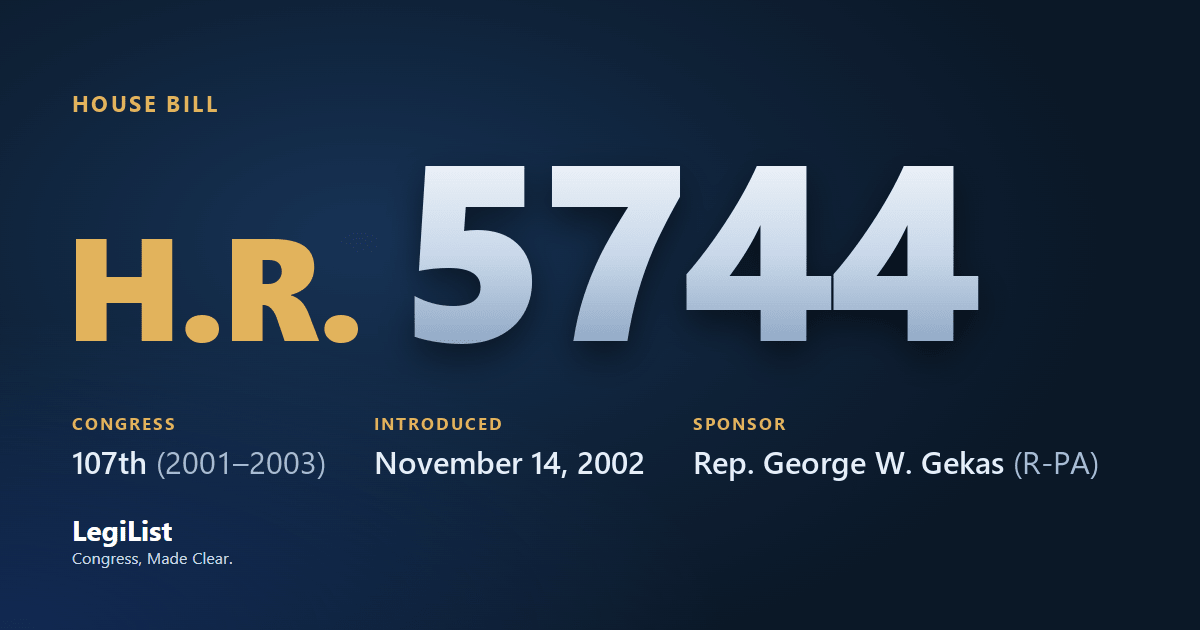
Bankruptcy Abuse Prevention and Consumer Protection Act of 2002
Latest action · Nov 14, 2002 Referred to the Committee on the Judiciary, and in addition to the Committee on Financial Services, for a period to be subsequently determined by the Speaker, in each case for consideration of such provisions as fall within the jurisdiction of the committee concerned.
Progress
Where this bill reached, and when. A stage with no date was not reached; one that failed a vote and later carried shows the date it carried.
- IntroducedNov 14, 2002
- Passed HouseNot reached
- Passed SenateNot reached
- To the PresidentNot reached
- Became lawNot reached
Summary
Reenacts Chapter 12, Adjustment of Debts of a Family Farmer with Regular Annual Income.
Brings family fishermen within the purview of Federal bankruptcy protection.
Prescribes guidelines for insolvent health care businesses and related patients' rights.
Bankruptcy Judgeship Act of 2002 - Amends the Federal Judicial Code to mandate appointments for additional temporary bankruptcy judgeships in designated States. (This provision does not appear in H.R. 5745, as inserted in H.R. 333).
Prescribes additional consumer credit disclosures, including open end credit plans and introductory rates.
Cosponsors
Members who signed on, in the order they did.
Committees 2
Where it was sent and what each committee and subcommittee did with it, in order.
| Chamber | Committee | What it did |
|---|---|---|
| House | Judiciary Committee | Referred Nov 14, 2002 |
| House | Financial Services Committee | Referred Nov 14, 2002 |
Actions 2
Everything that happened, newest first.
- Nov 14, 2002Introduced in House
- Nov 14, 2002Referred to the Committee on the Judiciary, and in addition to the Committee on Financial Services, for a period to be subsequently determined by the Speaker, in each case for consideration of such provisions as fall within the jurisdiction of the committee concerned.
Research
What has been written about this bill: committee reports, cost estimates, the sponsor’s authority statement, printed hearings and the Congressional Research Service’s work.
Printed hearings 1
Hearings whose printed record names this bill, newest first: hearings on it, and wider hearings where it came up.
| Number | Hearing | Committee | Held |
|---|---|---|---|
| Serial No. 107-69 | H.R. 1239 AND H.R. 274272 pages | Natural Resources Committee | Oct 17, 2001 |
Titles 2
Every title it has carried, official and short, at each stage.
- Official Title as Introduced
- To amend title 11 of the United States Code, and for other purposes.
- Short Titles as Introduced
- Bankruptcy Abuse Prevention and Consumer Protection Act of 2002
Subjects
Assigned by the Library of Congress. Policy area: Finance and Financial Sector.
- Administrative procedure
- Advertising
- Agriculture and Food
- Alabama
- Alimony
- Alternative dispute resolution
- Animals
- Appellate courts
- Appellate procedure
- Aquaculture
- Auditing
- Automobiles
- Bank failures
- Bank marketing
- Bank records
- Bankruptcy
- Bankruptcy courts
- Books
- Branch banking
- Brokers
- Business records
- California
- Caregivers
- Cemeteries and funerals
- Change of venue
- Charities
- Child health
- Child support
- Child support enforcement
- Chronically ill
- Civil actions and liability
- Civil Rights and Liberties, Minority Issues
- Civil Service pensions
- Close corporations
- Clothing
- Collection of accounts
- College costs
- College students
- Commerce
- Congress
- Congressional investigations
- Congressional reporting requirements
- Consumer credit
- Consumer education
- Consumer goods
- Consumer protection
- Contracts
- Cooperative housing
- Corporate debt
- Corporate profits
- Corporate reorganizations
- Counseling
- Court records
- Credit cards
- Credit unions
- Crime and Law Enforcement
- Criminal investigation
- Curricula
- Custody of children
- Damages
- Data banks
- Debit cards
- Debt limit
- Debtor and creditor
- Delaware
- Department of Justice
- Deposit insurance
- Derivative securities
- Disabled
- District courts
- Divorce
- Driver licenses
- Drug abuse
- Drug traffic
- Drunk driving
- Easements
- Economics and Public Finance
- Education
- Education savings accounts
- Electronic commerce
- Electronic government information
- Elementary and secondary education
- Elementary education
- Employee benefit plans
- Energy
- Eviction
- Evidence (Law)
- Families
- Family farms
- Family violence
- Farm income
- Farm produce
- Farmers
- Federal advisory bodies
- Federal Deposit Insurance Corporation
- Federal law enforcement officers
- Federal Reserve System
- Federally-assisted loans
- Federally-guaranteed loans
- Finance and Financial Sector
- Financial planning
- Financial statements
- Fines (Penalties)
- Fisheries
- Fishing boats
- Florida
- Foreclosure
- Foreign banks and banking
- Foreign Trade and International Finance
- Fraud
- Frivolous lawsuits
- Futures trading
- Gasoline tax
- Georgia
- Government corporations
- Government Operations and Politics
- Government paperwork
- Government publicity
- Government trust funds
- Governmental investigations
- Health
- Health care industry
- Health facilities
- Health insurance
- Higher education
- Home care services
- Home equity loans
- Homestead law
- Hospices (Terminal care)
- Hospital records
- Hospitals
- Households
- Housing and Community Development
- Housing finance
- Identification devices
- Immigration
- Income
- Income tax
- Individual retirement accounts
- Injunctions
- Interest
- Interest rates
- International Affairs
- International cooperation
- Internet
- Investment banking
- Investors
- Judges
- Judicial districts
- Judicial review of administrative acts
- Judicial statistics
- Judicial tenure
- Jurisdiction
- Labor and Employment
- Landlord and tenant
- Law
- Leases
- Legal education
- Legal ethics
- Legal fees
- Legislation
- Licenses
- Liens
- Limitation of actions
- Livestock
- Loan defaults
- Loans
- Local employees
- Local taxation
- Long-term care facilities
- Margins (Security trading)
- Marine and coastal resources, fisheries
- Married people
- Maryland
- Medical records
- Medicare
- Michigan
- Mississippi
- Municipal bankruptcy
- Negligence
- Nevada
- New Jersey
- New York State
- North Carolina
- Nursing homes
- Ombudsman
- Options (Contract)
- Partnerships
- Passports
- Paternity
- Patients' rights
- Pennsylvania
- Pension funds
- Personal budgets
- Personal income tax
- Photography
- Professional fees
- Property insurance
- Property tax
- Public prosecutors
- Public utilities
- Puerto Rico
- Punitive damages
- Quality of care
- Real estate appraisal
- Real property tax
- Recognition (International law)
- Rental housing
- Right of privacy
- Science, Technology, Communications
- Secondary education
- Securities
- Securities fraud
- Securities regulation
- Separation (Law)
- Small business
- Social security numbers
- Social Welfare
- South Carolina
- State courts
- State employees
- State taxation
- Stock exchanges
- Stocks
- Storage
- Student loan funds
- Students
- Support of dependents
- Surety and fidelity
- Swaps (Finance)
- Tariff
- Tax administration
- Tax deductions
- Tax evasion
- Tax exclusion
- Tax liens
- Tax penalties
- Tax preparers
- Tax refunds
- Tax returns
- Tax-deferred compensation plans
- Tax-exempt organizations
- Taxation
- Teaching materials
- Telephone
- Tennessee
- Torts
- Transportation and Public Works
- Trusts and trustees
- Valuation
- Victims of crimes
- Violence
- Virginia
- Wages
- Women
Text 1
Each version as it was printed, newest first.
- Nov 14, 2002Introduced in House
Support LegiList
This page is free, carries no paywall, and is built and maintained by one person. If the record here is useful to you, a few dollars keeps it going.
Everything here is as published by Congress: the summary is the Congressional Research Service's, the action wording is the clerks', and the subjects are the Library of Congress's. How far it got is read from the actions themselves, taking the most recent one of each kind, so a bill that failed a vote and later passed is shown as having passed. Records come from this bill on Congress.gov and govinfo.gov; cost estimates are the Congressional Budget Office's, and the hearings are the printed hearings GovInfo publishes, which can appear months after the hearing.