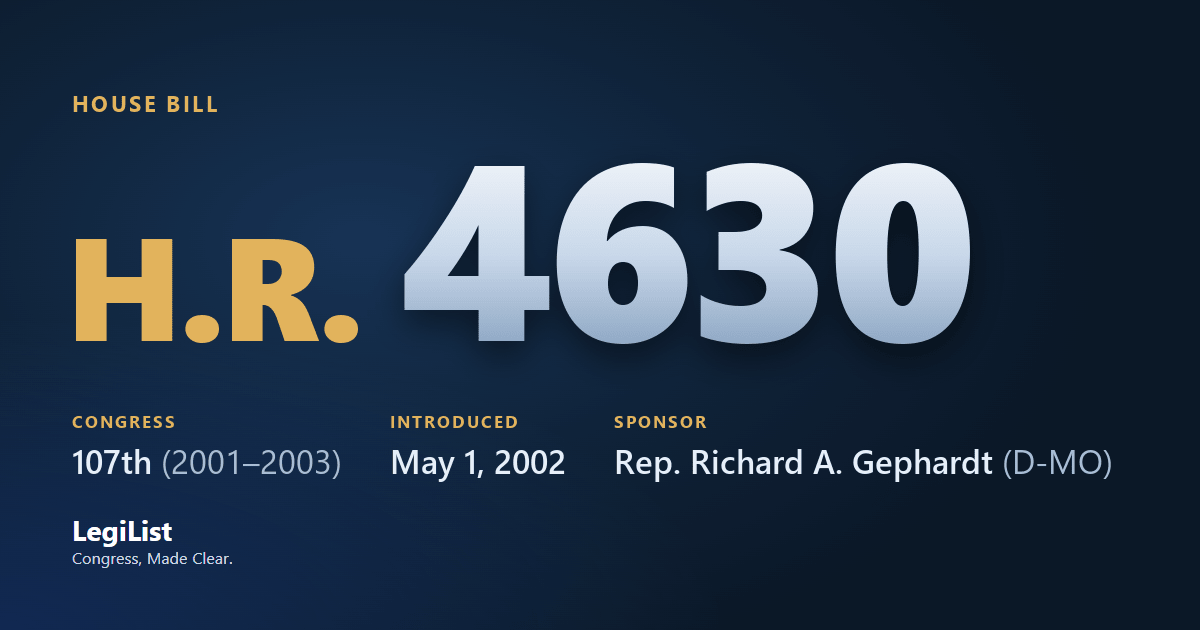
Corporate Subsidy Reform Commission Act of 2002
Latest action · May 1, 2002 Referred to the Committee on Government Reform, and in addition to the Committees on Ways and Means, Rules, and the Budget, for a period to be subsequently determined by the Speaker, in each case for consideration of such provisions as fall within the jurisdiction of the committee concerned.
Progress
Where this bill reached, and when. A stage with no date was not reached; one that failed a vote and later carried shows the date it carried.
- IntroducedMay 1, 2002
- Passed HouseNot reached
- Passed SenateNot reached
- To the PresidentNot reached
- Became lawNot reached
Summary
Requires each Federal agency to include in budget documents submitted in 2003 a list of programs or tax laws within that agency that provide inequitable Federal subsidies, together with recommendations for appropriate action. Provides a special review requirement for international trade programs.
Requires the President to: (1) report to the Commission and Congress on his approval or disapproval of the entire package of Commission recommendations; and (2) certify the recommendations to Congress if the package is approved either initially or after being revised by the Commission after initial disapproval. Sets forth procedures for congressional implementation and consideration of recommendations certified by the President.
Cosponsors 27
Members who signed on, in the order they did. Signatures ran from May 1, 2002 to Jul 8, 2002; 21 are original cosponsors, there from the day it was introduced.
| Seat | Cosponsor | Signed on | |
|---|---|---|---|
| D-MA | Barney Frank | Original | May 1, 2002 |
| D-CA | Bob Filner | Original | May 1, 2002 |
| D-CA | Brad Sherman | Original | May 1, 2002 |
| D-NY | Charles B. Rangel | Original | May 1, 2002 |
| D-GA | Cynthia A. McKinney | Original | May 1, 2002 |
| D-MI | David E. Bonior | Original | May 1, 2002 |
| D-OR | Earl Blumenauer | Original | May 1, 2002 |
| D-MA | Edward J. Markey | Original | May 1, 2002 |
| D-NC | Eva M. Clayton | Original | May 1, 2002 |
| D-NY | Gregory W. Meeks | Original | May 1, 2002 |
| D-CA | Howard L. Berman | Original | May 1, 2002 |
| D-RI | James R. Langevin | Original | May 1, 2002 |
| D-MA | John F. Tierney | Original | May 1, 2002 |
| D-PA | Joseph M. Hoeffel | Original | May 1, 2002 |
| D-NY | Louise McIntosh Slaughter | Original | May 1, 2002 |
Committees 4
Where it was sent and what each committee and subcommittee did with it, in order.
| Chamber | Committee | What it did |
|---|---|---|
| House | Oversight and Government Reform Committee | Referred May 1, 2002 |
| House | Ways and Means Committee | Referred May 1, 2002 |
| House | Rules Committee | Referred May 1, 2002 |
| House | Budget Committee | Referred May 1, 2002 |
Actions 2
Everything that happened, newest first.
- May 1, 2002Introduced in House
- May 1, 2002Referred to the Committee on Government Reform, and in addition to the Committees on Ways and Means, Rules, and the Budget, for a period to be subsequently determined by the Speaker, in each case for consideration of such provisions as fall within the jurisdiction of the committee concerned.
Related bills 1
Companion bills and other measures the record links to this one.
| Bill | Title | Relationship | Latest action |
|---|---|---|---|
| S 2181 | Corporate Subsidy Reform Commission Act of 2002 | Identical bill | Apr 17, 2002 |
Titles 2
Every title it has carried, official and short, at each stage.
- Official Title as Introduced
- To review, reform, and terminate unnecessary and inequitable Federal subsidies.
- Short Titles as Introduced
- Corporate Subsidy Reform Commission Act of 2002
Subjects
Assigned by the Library of Congress. Policy area: Economics and Public Finance.
- Business income tax
- Commerce
- Congress
- Congressional agencies
- Congressional investigations
- Congressional oversight
- Congressional reporting requirements
- Corporation taxes
- Corporations
- Economics and Public Finance
- Expedited congressional procedure
- Federal advisory bodies
- Federal employees
- Foreign Trade and International Finance
- Foreign trade policy
- General Accounting Office
- Government and business
- Government Operations and Politics
- Government paperwork
- House rules and procedure
- Income tax
- Industrial policy
- Industrial promotion
- Internal revenue law
- Joint ventures
- Labor and Employment
- Legislation
- Partnerships
- Planning-programming-budgeting
- Senate rules and procedure
- Subsidies
- Tax expenditures
- Tax incidence
- Tax rates
- Taxation
- Transfer of employees
Text 1
Each version as it was printed, newest first.
- May 1, 2002Introduced in House
Support LegiList
This page is free, carries no paywall, and is built and maintained by one person. If the record here is useful to you, a few dollars keeps it going.
Everything here is as published by Congress: the summary is the Congressional Research Service's, the action wording is the clerks', and the subjects are the Library of Congress's. How far it got is read from the actions themselves, taking the most recent one of each kind, so a bill that failed a vote and later passed is shown as having passed. Records come from this bill on Congress.gov and govinfo.gov; cost estimates are the Congressional Budget Office's, and the hearings are the printed hearings GovInfo publishes, which can appear months after the hearing.