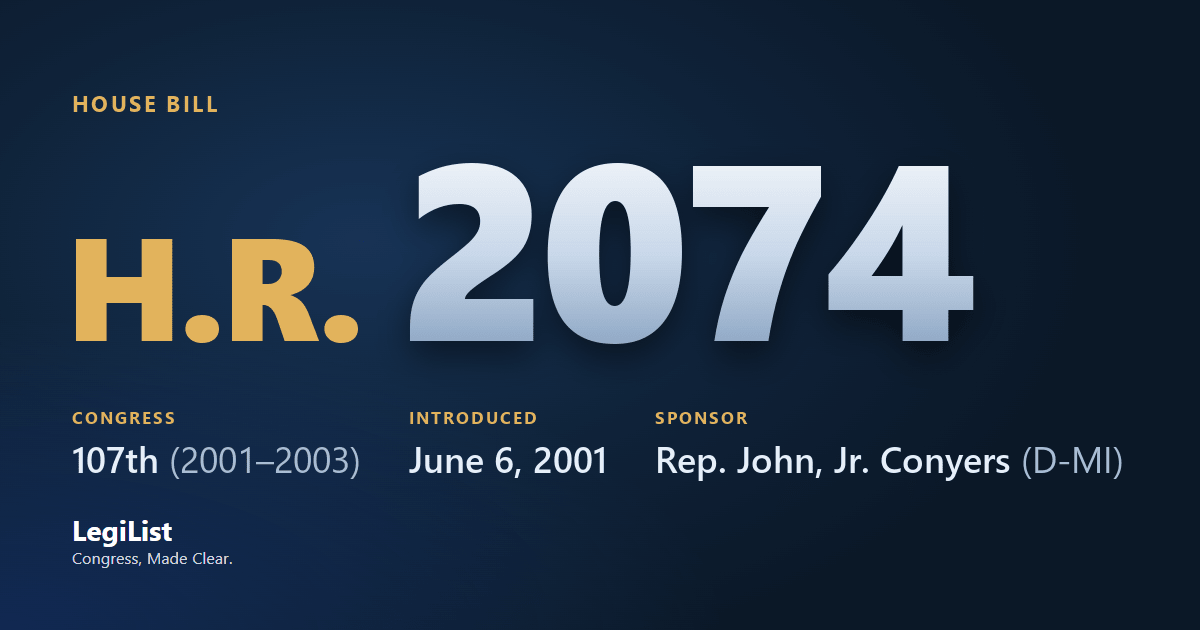
End Racial Profiling Act of 2001
Latest action · Jul 16, 2001 Referred to the Subcommittee on Crime.
Progress
Where this bill reached, and when. A stage with no date was not reached; one that failed a vote and later carried shows the date it carried.
- IntroducedJun 6, 2001
- Passed HouseNot reached
- Passed SenateNot reached
- To the PresidentNot reached
- Became lawNot reached
Summary
Specifies that proof that the routine investigatory activities of law enforcement agents in a jurisdiction have had a disparate impact on racial or ethnic minorities shall constitute prima facie evidence of a violation. Authorizes the court to allow a prevailing plaintiff, other than the United States, reasonable attorneys' fees as part of the costs, including expert fees.
Requires Federal law enforcement agencies to: (1) maintain adequate policies and procedures designed to eliminate racial profiling; and (2) cease existing practices that encourage racial profiling.
Directs that any application by a State or governmental unit for funding under a covered program include a certification that such unit and any agency to which it is redistributing program funds: (1) maintains adequate policies and procedures designed to eliminate racial profiling; and (2) has ceased existing practices that encourage racial profiling.
Authorizes the Attorney General to make grants to States, law enforcement agencies and other governmental units, Indian tribal governments, or other public and private entities to develop and implement best practice devices and systems to ensure the racially neutral administration of justice.
Directs the Attorney General to submit to Congress a report on racial profiling by Federal, State, and local law enforcement agencies.
Cosponsors 95
Members who signed on, in the order they did. Signatures ran from Jun 6, 2001 to Jul 23, 2002; 15 are original cosponsors, there from the day it was introduced.
| Seat | Cosponsor | Signed on | |
|---|---|---|---|
| R-CT | Christopher Shays | Original | Jun 6, 2001 |
| R-MD | Constance A. Morella | Original | Jun 6, 2001 |
| D-OR | David Wu | Original | Jun 6, 2001 |
| D-NJ | Donald M. Payne | Original | Jun 6, 2001 |
| D-CA | Fortney Pete Stark | Original | Jun 6, 2001 |
| R-PA | James C. Greenwood | Original | Jun 6, 2001 |
| R-NY | James T. Walsh | Original | Jun 6, 2001 |
| D-NY | Jose E. Serrano | Original | Jun 6, 2001 |
| D-CA | Michael M. Honda | Original | Jun 6, 2001 |
| R-NJ | Mike Ferguson | Original | Jun 6, 2001 |
| D-VA | Robert C. "Bobby" Scott | Original | Jun 6, 2001 |
| D-NJ | Robert Menendez | Original | Jun 6, 2001 |
| R-NJ | Rodney P. Frelinghuysen | Original | Jun 6, 2001 |
| D-TX | Sheila Jackson Lee | Original | Jun 6, 2001 |
| R-IL | Timothy V. Johnson | Original | Jun 6, 2001 |
Committees 1
Where it was sent and what each committee and subcommittee did with it, in order.
| Chamber | Committee | What it did |
|---|---|---|
| House | Judiciary Committee | Referred Jun 6, 2001 |
| Crime and Federal Government Surveillance Subcommittee | Referred Jul 16, 2001 |
Actions 4
Everything that happened, newest first.
- Jul 16, 2001Referred to the Subcommittee on Crime.
- Jun 6, 2001Introduced in House
- Jun 6, 2001Sponsor introductory remarks on measure. (CR E1037-1038)
- Jun 6, 2001Referred to the House Committee on the Judiciary.
In the Congressional Record 1
Days the Record’s own index lists this bill, newest first, with the pages and the members it names. Pages starting H are the House, S the Senate, E Extensions of Remarks.
| Where | In the Record | Members | Date |
|---|---|---|---|
| Extensions | Debate and remarks E1037 | John Conyers, Jr. D-MI | Jun 6, 2001 |
Research
What has been written about this bill: committee reports, cost estimates, the sponsor’s authority statement, printed hearings and the Congressional Research Service’s work.
Printed hearings 2
Hearings whose printed record names this bill, newest first: hearings on it, and wider hearings where it came up.
| Number | Hearing | Committee | Held |
|---|---|---|---|
| S. Hrg. 107-537 | S. 989: THE END RACIAL PROFILING ACT OF 2001135 pages | Judiciary Committee | Aug 1, 2001 |
| Serial No. 107-36 | THE BENEFITS OF AUDIO-VISUAL TECHNOLOGY IN ADDRESSING RACIAL PROFILING190 pages | Oversight and Government Reform Committee | Jul 19, 2001 |
Related bills 1
Companion bills and other measures the record links to this one.
| Bill | Title | Relationship | Latest action |
|---|---|---|---|
| S 989 | End Racial Profiling Act of 2001 | Identical bill | Aug 1, 2001 |
Titles 2
Every title it has carried, official and short, at each stage.
- Official Title as Introduced
- To prohibit racial profiling.
- Short Titles as Introduced
- End Racial Profiling Act of 2001
Subjects
Assigned by the Library of Congress. Policy area: Crime and Law Enforcement.
- Alien labor
- Arrest
- Block grants
- Civil actions and liability
- Civil Rights and Liberties, Minority Issues
- Civil rights enforcement
- Community policing
- Computers
- Congress
- Congressional reporting requirements
- Crime and Law Enforcement
- Criminal investigation
- Criminal statistics
- Disciplining of employees
- Discrimination in law enforcement
- Economics and Public Finance
- Ethnic groups
- Evidence (Law)
- Expert witnesses
- Federal aid to law enforcement
- Freedom of information
- Government Operations and Politics
- Government paperwork
- Government vehicles
- Governmental investigations
- Immigration
- Indian law enforcement
- Injunctions
- Judicial opinions
- Labor and Employment
- Law
- Law enforcement officers
- Legal fees
- Minorities
- Pedestrians
- Police
- Police-community relations
- Prejudice
- Racial discrimination
- Science, Technology, Communications
- Searches and seizures
- Traffic accidents and safety
- Transportation and Public Works
- Video tape recording
Text 1
Each version as it was printed, newest first.
- Jun 6, 2001Introduced in House
Support LegiList
This page is free, carries no paywall, and is built and maintained by one person. If the record here is useful to you, a few dollars keeps it going.
Everything here is as published by Congress: the summary is the Congressional Research Service's, the action wording is the clerks', and the subjects are the Library of Congress's. How far it got is read from the actions themselves, taking the most recent one of each kind, so a bill that failed a vote and later passed is shown as having passed. Records come from this bill on Congress.gov and govinfo.gov; cost estimates are the Congressional Budget Office's, and the hearings are the printed hearings GovInfo publishes, which can appear months after the hearing.