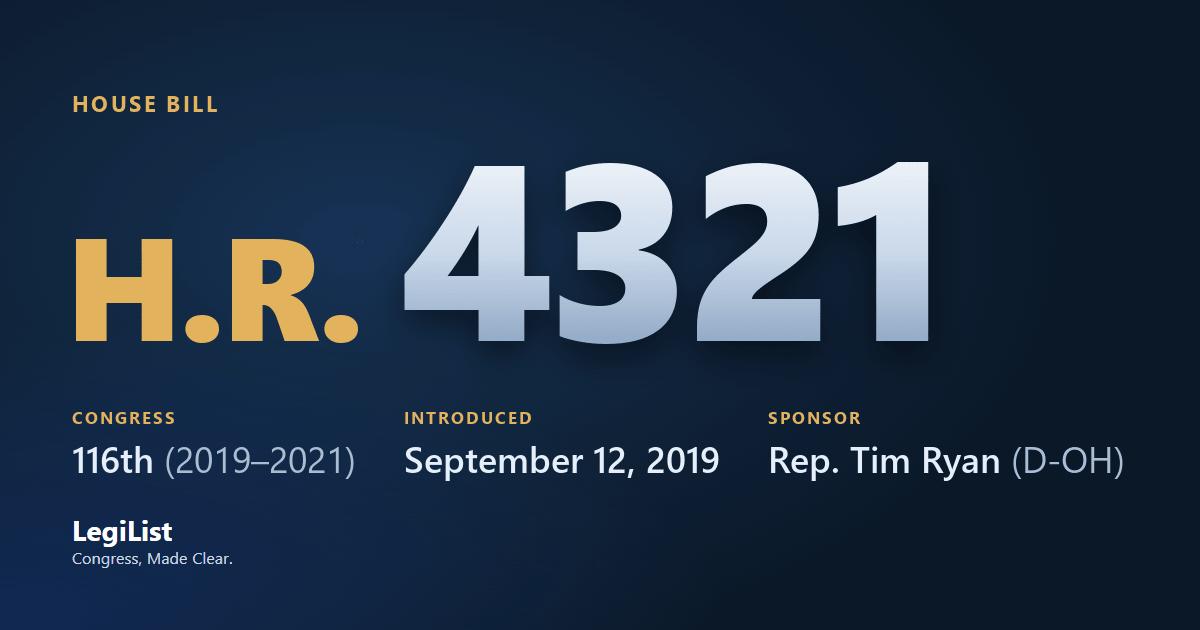
GET THE LEAD OUT Act of 2019
Latest action · Sep 13, 2019 Referred to the Subcommittee on Environment and Climate Change.
Progress
Where this bill reached, and when. A stage with no date was not reached; one that failed a vote and later carried shows the date it carried.
- IntroducedSep 12, 2019
- Passed HouseNot reached
- Passed SenateNot reached
- To the PresidentNot reached
- Became lawNot reached
Summary
Grants for Eliminating the Toxic Hazard of Environmental Lead in Our Towns Act of 2019 or GET THE LEAD OUT Act of 2019
This bill addresses the reduction of lead-based hazards. It also modifies the tax treatment of carried interest (i.e., compensation that is typically received by a partner of a private equity or hedge fund and is based on a share of the fund's profits) and the estate tax.
With respect to lead-based hazards, the bill allows the Department of Housing and Urban Development (HUD) to provide grants to state and local governments to reduce lead-based pipe hazards in housing. Additionally, HUD must require risk assessments, inspections, interim controls, and abatement of these hazards in federally assisted housing.
HUD and the Environmental Protection Agency (EPA) must require the disclosure of such hazards in housing that is for sale or lease. Persons that fail to disclose such hazards are subject to civil penalties from HUD and may be liable to purchasers or lessees for treble damages.
Additionally, the EPA must ensure that individuals who work with lead-based pipes have proper training and certification. States may enforce and administer such training and certification programs upon receiving EPA approval. The EPA must publish an information pamphlet regarding the health risks and best practices for dealing with lead hazards.
The bill also modifies the tax treatment of carried interest by, for example, requiring it to be included in gross income and taxed as ordinary income, with certain exceptions. Under current law, carried interest is taxed as investment income.
In addition, the bill reduces the estate tax exemption level.
Cosponsors 7
Members who signed on, in the order they did. Signatures ran from Oct 11, 2019 to Jan 13, 2020.
| Seat | Cosponsor | Signed on | |
|---|---|---|---|
| D-PA | Michael F. Doyle | Oct 11, 2019 | |
| D-PA | Brendan F. Boyle | Oct 16, 2019 | |
| D-MI | Debbie Dingell | Oct 22, 2019 | |
| D-TX | Sheila Jackson Lee | Nov 12, 2019 | |
| D-TN | Steve Cohen | Jan 8, 2020 | |
| D-NY | Eliot L. Engel | Jan 13, 2020 | |
| D-CA | Nanette Diaz Barragán | Jan 13, 2020 |
Committees 3
Where it was sent and what each committee and subcommittee did with it, in order.
| Chamber | Committee | What it did |
|---|---|---|
| House | Energy and Commerce Committee | Referred Sep 12, 2019 |
| Environment Subcommittee | Referred Sep 13, 2019 | |
| House | Financial Services Committee | Referred Sep 12, 2019 |
| House | Ways and Means Committee | Referred Sep 12, 2019 |
Actions 3
Everything that happened, newest first.
- Sep 13, 2019Referred to the Subcommittee on Environment and Climate Change.
- Sep 12, 2019Introduced in House
- Sep 12, 2019Referred to the Committee on Energy and Commerce, and in addition to the Committees on Financial Services, and Ways and Means, for a period to be subsequently determined by the Speaker, in each case for consideration of such provisions as fall within the jurisdiction of the committee concerned.
Research
What has been written about this bill: committee reports, cost estimates, the sponsor’s authority statement, printed hearings and the Congressional Research Service’s work.
Constitutional authority
The sponsor’s statement, as printed in the Congressional Record, vol. 165, no. 146, September 12, 2019, page H7706.
Related bills 3
Companion bills and other measures the record links to this one.
| Bill | Title | Relationship | Latest action |
|---|---|---|---|
| S 781 | Carried Interest Fairness Act of 2019 | Related bill | Mar 13, 2019 |
| HR 1376 | GET THE LEAD OUT Act of 2021 | Reintroduced Bill | Feb 26, 2021 |
| HR 1735 | Carried Interest Fairness Act of 2019 | Related bill | Mar 13, 2019 |
Titles 3
Every title it has carried, official and short, at each stage.
- Official Title as Introduced
- To eliminate lead-based pipe and tap hazards in housing, and for other purposes.
- Short Title(s) as Introduced
- GET THE LEAD OUT Act of 2019
- Grants for Eliminating the Toxic Hazard of Environmental Lead in Our Towns Act of 2019
Subjects
Assigned by the Library of Congress. Policy area: Housing and Community Development.
- Accounting and auditing
- Administrative law and regulatory procedures
- Capital gains tax
- Civil actions and liability
- Congressional oversight
- Consumer affairs
- Department of Housing and Urban Development
- Environmental assessment, monitoring, research
- Environmental Protection Agency (EPA)
- Financial services and investments
- Government buildings, facilities, and property
- Government information and archives
- Government studies and investigations
- Hazardous wastes and toxic substances
- Housing and Community Development
- Housing and community development funding
- Housing finance and home ownership
- Housing industry and standards
- Income tax rates
- Infrastructure development
- Legal fees and court costs
- Licensing and registrations
- Low- and moderate-income housing
- Performance measurement
- Public housing
- Public utilities and utility rates
- Residential rehabilitation and home repair
- State and local government operations
- Tax administration and collection, taxpayers
- User charges and fees
- Vocational and technical education
- Water quality
- Water use and supply
Text 1
Each version as it was printed, newest first.
- Sep 12, 2019Introduced in House
Support LegiList
This page is free, carries no paywall, and is built and maintained by one person. If the record here is useful to you, a few dollars keeps it going.
Everything here is as published by Congress: the summary is the Congressional Research Service's, the action wording is the clerks', and the subjects are the Library of Congress's. How far it got is read from the actions themselves, taking the most recent one of each kind, so a bill that failed a vote and later passed is shown as having passed. Records come from this bill on Congress.gov and govinfo.gov; cost estimates are the Congressional Budget Office's, and the hearings are the printed hearings GovInfo publishes, which can appear months after the hearing.