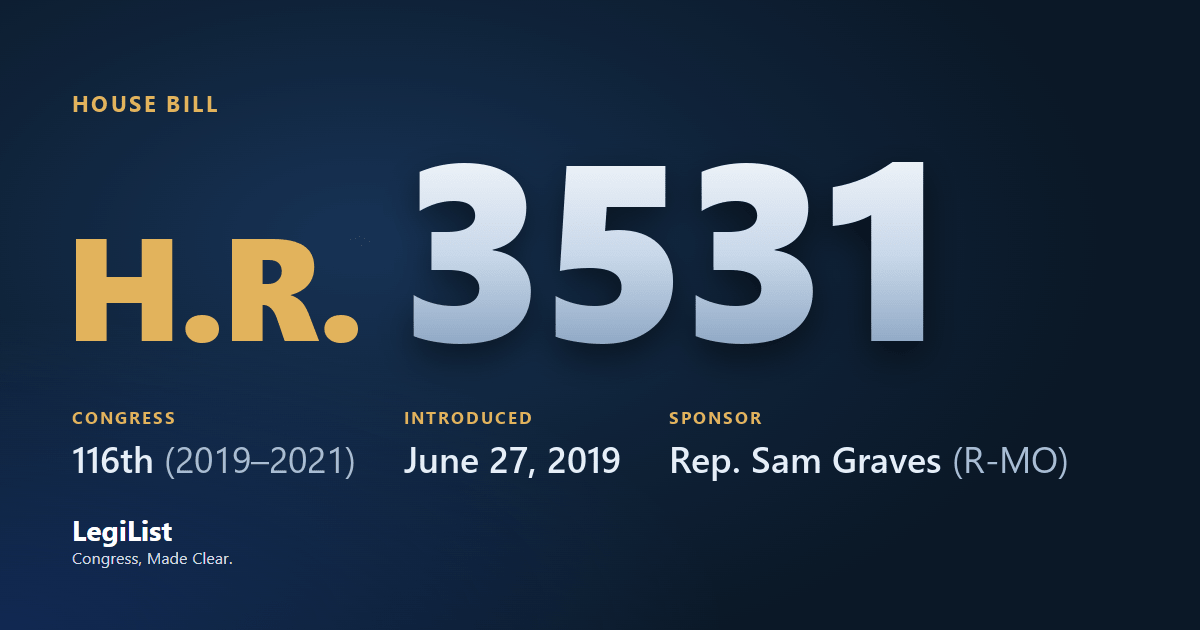
Resilient Communities Act of 2019
Latest action · Jun 28, 2019 Referred to the Subcommittee on Economic Development, Public Buildings, and Emergency Management.
Progress
Where this bill reached, and when. A stage with no date was not reached; one that failed a vote and later carried shows the date it carried.
- IntroducedJun 27, 2019
- Passed HouseNot reached
- Passed SenateNot reached
- To the PresidentNot reached
- Became lawNot reached
Summary
Resilient Communities Act of 2019
This bill permits the Federal Emergency Management Agency (FEMA) to provide capitalization grants to states to establish revolving funds to mitigate disaster risks for homeowners, businesses, nonprofit organizations, and communities from multiple hazards.
Cosponsors
Members who signed on, in the order they did.
Committees 1
Where it was sent and what each committee and subcommittee did with it, in order.
| Chamber | Committee | What it did |
|---|---|---|
| House | Transportation and Infrastructure Committee | Referred Jun 27, 2019 |
| Economic Development, Public Buildings, and Emergency Management Subcommittee | Referred Jun 28, 2019 |
Actions 3
Everything that happened, newest first.
- Jun 28, 2019Referred to the Subcommittee on Economic Development, Public Buildings, and Emergency Management.
- Jun 27, 2019Introduced in House
- Jun 27, 2019Referred to the House Committee on Transportation and Infrastructure.
Research
What has been written about this bill: committee reports, cost estimates, the sponsor’s authority statement, printed hearings and the Congressional Research Service’s work.
Constitutional authority
The sponsor’s statement, as printed in the Congressional Record, vol. 165, no. 109, June 27, 2019, page H5258.
CRS reports 1
Congressional Research Service work that CRS links to this bill or the law it became, newest first.
Cite it 1
Products on other subjects that cite it, usually among other measures.
| Product | Title | Kind | Published |
|---|---|---|---|
| R46921 | Marine Harmful Algal Blooms (HABs): Background, Statutory Authorities, and Issues for Congress | Report | Sep 27, 2021 |
Titles 2
Every title it has carried, official and short, at each stage.
- Official Title as Introduced
- To amend the Robert T. Stafford Disaster Relief and Emergency Assistance Act to allow the Administrator of the Federal Emergency Management Agency to provide capitalization grants to States to establish revolving funds to provide assistance to reduce the harmful impacts to people and property from multiple hazards, and for other purposes.
- Short Title(s) as Introduced
- Resilient Communities Act of 2019
Subjects
Assigned by the Library of Congress. Policy area: Emergency Management.
- Accounting and auditing
- Administrative law and regulatory procedures
- Atmospheric science and weather
- Disaster relief and insurance
- Emergency Management
- Emergency planning and evacuation
- Environmental assessment, monitoring, research
- Fires
- First responders and emergency personnel
- Floods and storm protection
- Government information and archives
- Government studies and investigations
- Hazardous wastes and toxic substances
- Health facilities and institutions
- Infrastructure development
- Land use and conservation
- Lighting, heating, cooling
- Natural disasters
- Seashores and lakeshores
- Small business
- State and local finance
- State and local government operations
- Wetlands
Text 1
Each version as it was printed, newest first.
- Jun 27, 2019Introduced in House
Support LegiList
This page is free, carries no paywall, and is built and maintained by one person. If the record here is useful to you, a few dollars keeps it going.
Everything here is as published by Congress: the summary is the Congressional Research Service's, the action wording is the clerks', and the subjects are the Library of Congress's. How far it got is read from the actions themselves, taking the most recent one of each kind, so a bill that failed a vote and later passed is shown as having passed. Records come from this bill on Congress.gov and govinfo.gov; cost estimates are the Congressional Budget Office's, and the hearings are the printed hearings GovInfo publishes, which can appear months after the hearing.