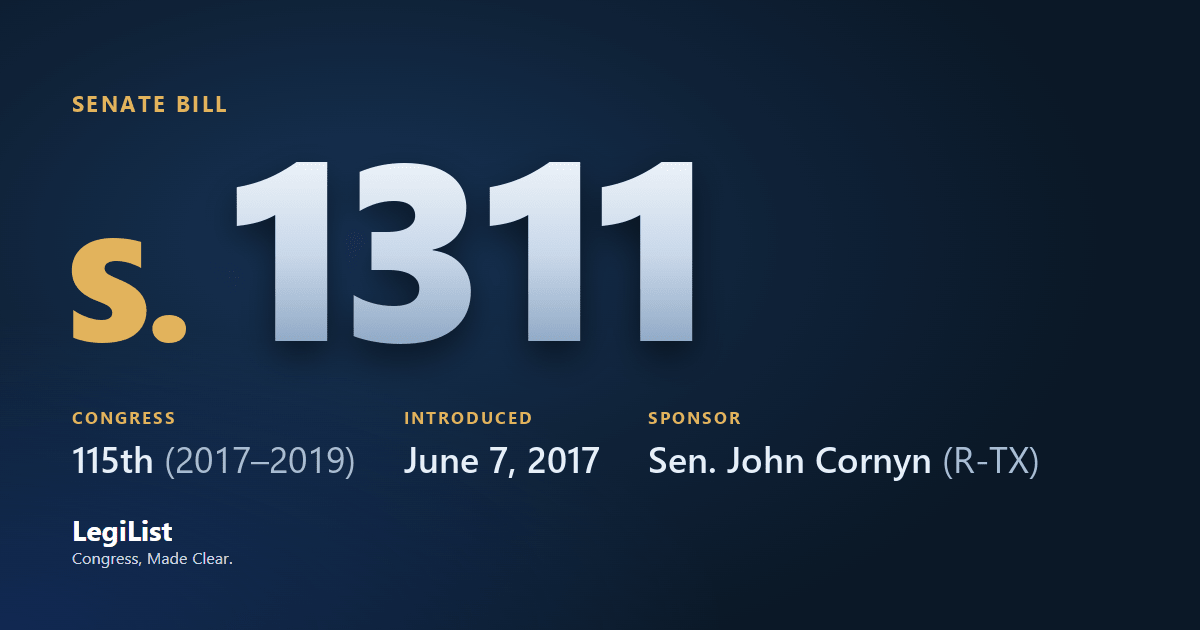
Abolish Human Trafficking Act of 2017
Latest action · Dec 21, 2018 Became Public Law No: 115-392.
Progress
Where this bill reached, and when. A stage with no date was not reached; one that failed a vote and later carried shows the date it carried.
- IntroducedJun 7, 2017
- Passed SenateSep 11, 2017
- Passed HouseSep 28, 2018
- To the PresidentDec 20, 2018
- Became lawDec 21, 2018Public Law 115-392
Summary
Abolish Human Trafficking Act of 2017
(Sec. 2) This bill expresses the sense of Congress that the Domestic Trafficking Victims' Fund is intended to supplement—not supplant—any other funding for domestic trafficking victims and has achieved that objective.
It reauthorizes the Domestic Trafficking Victims' Fund through FY2023.
The bill reauthorizes through FY2021 the requirement for federal courts to impose an additional assessment on a non-indigent person or entity convicted of a specified offense related to human trafficking, sexual abuse or exploitation, or smuggling.
(Sec. 3) It requires a court to order mandatory restitution, in addition to other criminal or civil penalties, for an offense involving transportation for illegal sexual activity.
(Sec. 4) The Department of Justice (DOJ) Assets Forfeiture Fund may be used for payments of awards for information or assistance related to sexual exploitation offenses.
The Department of the Treasury Assets Forfeiture Fund may be used to purchase evidence or information related to offenses human trafficking, sexual abuse, sexual exploitation, or transportation for prostitution or illegal sexual activity.
(Sec. 5) The Department of Homeland Security (DHS) must issue a directive to law enforcement officials and task force members who investigate human trafficking offenses. The directive must provide instructions on how to investigate individuals who solicit human trafficking victims and how to limit arrests or prosecutions of trafficking victims for crimes committed as a direct result of their victimization.
Additionally, DHS must establish a victim screening protocol for use during anti-trafficking law enforcement operations.
(Sec. 6) This section authorizes DOJ's Office of Juvenile Justice and Delinquency Prevention to make grants to provide direct services to minor victims of severe forms of trafficking.
(Sec. 7) Human trafficking training programs for law enforcement officers and prosecutors must do the following:
- emphasize that a commercial sex act with a minor constitutes a human trafficking offense, and
- develop curricula for investigating, arresting, and prosecuting individuals who engage in a commercial sex act or profit from human trafficking.
(Sec. 8) DOJ must issue guidance that does the following:
- emphasizes that a commercial sex act with a minor constitutes a human trafficking offense;
- implements best practices for collecting additional assessments for offenses related to human trafficking, sexual abuse or exploitation, or smuggling; and
- clarifies that commercial sex exploitation is a form of gender-based violence.
(Sec. 9) The National Strategy for Combatting Human Trafficking must include a national strategy to prevent human trafficking and reduce demand for human trafficking victims.
(Sec. 10) This bill revises an existing grant program to authorize grants for additional purposes—to improve services for trafficking survivors and to improve partnerships between victim service providers and law enforcement agencies and other entities.
(Sec. 11) This section increases the maximum prison terms for certain offenses related to peonage, slavery, involuntary servitude, forced labor, and trafficking.
(Sec. 12) This section imposes an enhanced 10-year prison term on a member of a street gang who commits (or conspires to commit) an offense involving human trafficking, sexual abuse, sexual exploitation, or transportation for prostitution or illegal sexual activity.
(Sec. 13) This bill expands DOJ's authority to intercept wire, oral, or electronic communications in investigations of offenses related to peonage, slavery, and trafficking in persons.
(Sec. 14) The bill revises the specific intent element for certain offenses involving interstate or foreign travel to engage in or facilitate illicit sexual conduct. Specifically, the government must prove that engaging in illicit sexual conduct was a motivating purpose (currently, a purpose) of the interstate or foreign travel.
(Sec. 15) This section directs the Department of Justice to designate
- at least one Human Trafficking Coordinator in each federal judicial district to implement the National Strategy for Combatting Human Trafficking and to prosecute cases, conduct outreach, and enforce relevant laws; and
- a National Human Trafficking Coordinator within DOJ to coordinate, promote, and support DOJ's work related to human trafficking.
(Sec. 16) DOJ must include, in its annual human trafficking report, data on the number of convictions for human trafficking offenses.
(Sec. 17) The Federal Bureau of Investigation must revise the Uniform Crime Reports and the National Incident-Based Reporting System to make additional distinctions in its data on reports of human trafficking offenses. Currently, it distinguishes between reports of incidents of prostitution, assisting or promoting prostitution, and purchasing prostitution. Now it must also include distinctions for incidents of assisting or promoting prostitution of a minor and purchasing prostitution of a minor.
(Sec. 18) The Interagency Task Force to Monitor and Combat Trafficking must report annually on the number of referrals from the national human trafficking hotline by federal departments and agencies.
Additionally, the national human trafficking hotline number must be posted in a visible place in all federal buildings.
(Sec. 19) This section prohibits the use of federal funds for any program that funds or supports an organization that provides adult entertainment and profits from the commercial sex trade.
(Sec. 20) The bill directs the National Institute of Justice and the Centers for Disease Control and Prevention to jointly study the physical and psychological effects of severe forms of trafficking in persons.
(Sec. 21) It reauthorizes for FY2018-FY2021 grants (1) for victims services providers and (2) for investigating severe forms of trafficking in persons.
(Sec. 22) It subjects grants authorized in this bill to various accountability measures.
(Sec. 23) This section provides statutory authority for the Human Exploitation Rescue Operation (HERO) Child-Rescue Corps Program within the Cyber Crimes Center of U.S. Immigration and Customs Enforcement.
The HERO Child-Rescue Corps Program, operated in partnership with the Department of Defense and the National Association to Protect Children, must recruit, train, equip, and employ wounded, ill, and injured veterans and other members of the military to combat and prevent child exploitation.
Cosponsors 31
Members who signed on, in the order they did. Signatures ran from Jun 7, 2017 to Aug 3, 2017; 12 are original cosponsors, there from the day it was introduced.
| Seat | Cosponsor | Signed on | |
|---|---|---|---|
| D-MN | Amy Klobuchar | Original | Jun 7, 2017 |
| R-TN | Bob Corker | Original | Jun 7, 2017 |
| D-DE | Christopher A. Coons | Original | Jun 7, 2017 |
| R-IA | Chuck Grassley | Original | Jun 7, 2017 |
| R-NV | Dean Heller | Original | Jun 7, 2017 |
| D-CA | Dianne Feinstein | Original | Jun 7, 2017 |
| D-ND | Heidi Heitkamp | Original | Jun 7, 2017 |
| R-FL | Marco Rubio | Original | Jun 7, 2017 |
| R-UT | Orrin G. Hatch | Original | Jun 7, 2017 |
| R-NC | Richard Burr | Original | Jun 7, 2017 |
| D-OR | Ron Wyden | Original | Jun 7, 2017 |
| D-OH | Sherrod Brown | Original | Jun 7, 2017 |
| D-NY | Kirsten E. Gillibrand | Jun 15, 2017 | |
| R-ID | Mike Crapo | Jun 15, 2017 | |
| R-WV | Shelley Moore Capito | Jun 19, 2017 | |
| R-SD | John Thune | Jun 21, 2017 | |
| D-HI | Mazie K. Hirono | Jun 21, 2017 | |
| D-CT | Richard Blumenthal | Jun 21, 2017 | |
| R-MS | Roger F. Wicker | Jun 21, 2017 | |
| R-OK | James Lankford | Jun 22, 2017 | |
| D-VT | Patrick J. Leahy | Jun 22, 2017 | |
| D-NV | Catherine Cortez Masto | Jun 26, 2017 | |
| R-NC | Thom Tillis | Jun 26, 2017 | |
| D-MO | Claire McCaskill | Jul 10, 2017 | |
| D-IL | Richard J. Durbin | Jul 10, 2017 | |
| R-TX | Ted Cruz | Jul 20, 2017 | |
| R-AR | John Boozman | Jul 24, 2017 | |
| D-MN | Al Franken | Jul 27, 2017 | |
| R-LA | John Kennedy | Aug 2, 2017 | |
| R-OK | James M. Inhofe | Aug 3, 2017 | |
| R-MO | Roy Blunt | Aug 3, 2017 |
Committees 5
Where it was sent and what each committee and subcommittee did with it, in order.
| Chamber | Committee | What it did |
|---|---|---|
| Senate | Judiciary Committee | Referred Jun 7, 2017Markup Jun 29, 2017Reported Aug 1, 2017 |
| House | Judiciary Committee | Referred Sep 13, 2017Discharged Sep 28, 2018 |
| Immigration Integrity, Security, and Enforcement Subcommittee | Referred Sep 21, 2017 | |
| Crime and Federal Government Surveillance Subcommittee | Referred Sep 21, 2017 | |
| House | Foreign Affairs Committee | Referred Sep 13, 2017Discharged Sep 28, 2018 |
| House | Energy and Commerce Committee | Referred Sep 13, 2017Discharged Sep 28, 2018 |
| Health Subcommittee | Referred Sep 15, 2017 | |
| House | Homeland Security Committee | Referred Sep 13, 2017Exchange of letters Feb 22, 2018Exchange of letters Feb 23, 2018Discharged Sep 28, 2018 |
| Border Security and Enforcement Subcommittee | Referred Sep 14, 2017 |
Actions 29
Everything that happened, newest first.
- Dec 21, 2018Signed by President.
- Dec 21, 2018Became Public Law No: 115-392.
- Dec 20, 2018Presented to President.
- Dec 18, 2018Message on Senate action sent to the House.
- Dec 17, 2018Resolving differences -- Senate actions: Senate agreed to House amendment to S. 1311 by Unanimous Consent. (consideration: CR S7628; text: CR S7628)
In the Congressional Record 8
Days the Record’s own index lists this bill, newest first, with the pages and the members it names. Pages starting H are the House, S the Senate, E Extensions of Remarks.
| Where | In the Record | Members | Date |
|---|---|---|---|
| Senate | Debate and remarks S7841 | Chuck Grassley R-IA | Dec 19, 2018 |
| Senate | Debate and remarks S7628Motions S7628 | Mitch McConnell R-KY (motion) | Dec 17, 2018 |
| House | Debate and remarks H9373–H9381Text printed H9373, H9377–H9381Amendments H9377 | Tom Marino R-PA (amendment) | Sep 28, 2018 |
| Senate | Debate and remarks S1861 | Chuck Grassley R-IA | Mar 21, 2018 |
| Senate | Debate and remarks S5210 | Dianne Feinstein D-CA | Sep 12, 2017 |
Research
What has been written about this bill: committee reports, cost estimates, the sponsor’s authority statement, printed hearings and the Congressional Research Service’s work.
Printed hearings 1
Hearings whose printed record names this bill, newest first: hearings on it, and wider hearings where it came up.
| Number | Hearing | Committee | Held |
|---|---|---|---|
| S. Hrg. 115-282 | FORCE MULTIPLIERS: HOW TRANSPORTATION AND SUPPLY CHAIN STAKEHOLDERS ARE COMBATTING HUMAN TRAFFICKING239 pages | Commerce, Science, and Transportation Committee | Jul 12, 2017 |
CRS reports 2
Congressional Research Service work that CRS links to this bill or the law it became, newest first.
Cite it 2
Products on other subjects that cite it, usually among other measures.
| Product | Title | Kind | Published |
|---|---|---|---|
| R45447 | Permanent Employment-Based Immigration and the Per-country Ceiling Archived | Report | Dec 21, 2018 |
| R44876 | India-U.S. Relations: Issues for Congress Archived | Report | Jun 19, 2017 |
Amendments 2
Amendments offered to this bill.
| Amendment | Description | Offered by | Status |
|---|---|---|---|
| SA 936 | To improve the bill. | John Cornyn R-TX | Amendment SA 936 agreed to in Senate by Unanimous Consent. |
| HAmdt 975 | Amendment to strike all after the enacting clause and insert a complete new text. | Tom Marino R-PA | On agreeing to the Marino amendment (A001) Agreed to without objection. |
Related bills 4
Companion bills and other measures the record links to this one.
| Bill | Title | Relationship | Latest action |
|---|---|---|---|
| S 1236 | A bill to require the Attorney General to designate Human Trafficking Coordinators for Federal judicial districts, and for other purposes. | Related bill | May 25, 2017 |
| S 1517 | HERO Improvements Act of 2017 | Related bill | Jun 29, 2017 |
| HR 2803 | Abolish Human Trafficking Act of 2017 | Identical bill | Jul 12, 2017 |
| HR 3304 | Human Trafficking Accountability Act | Related bill | Aug 17, 2017 |
Titles 8
Every title it has carried, official and short, at each stage.
- Official Title
- An act to provide assistance in abolishing human trafficking in the United States
- Short Title
- Abolish Human Trafficking Act of 2017
- Official Title as Introduced
- A bill to provide assistance in abolishing human trafficking in the United States.
- Short Titles as Introduced
- Abolish Human Trafficking Act of 2017
- Short Titles as Reported to Senate
- Abolish Human Trafficking Act of 2017
- Short Titles as Passed House
- Abolish Human Trafficking Act of 2017
- Short Titles as Passed Senate
- Abolish Human Trafficking Act of 2017
- Short Titles as Enacted
- Abolish Human Trafficking Act of 2017
Subjects
Assigned by the Library of Congress. Policy area: Crime and Law Enforcement.
- Accounting and auditing
- Advisory bodies
- Appropriations
- Child safety and welfare
- Civil actions and liability
- Congressional oversight
- Crime and Law Enforcement
- Crime prevention
- Crime victims
- Crimes against children
- Criminal investigation, prosecution, interrogation
- Criminal justice information and records
- Criminal procedure and sentencing
- Debt collection
- Department of Homeland Security
- Department of Justice
- Domestic violence and child abuse
- Evidence and witnesses
- Executive agency funding and structure
- Federal officials
- Government buildings, facilities, and property
- Government information and archives
- Government studies and investigations
- Government trust funds
- Health information and medical records
- Health personnel
- Health programs administration and funding
- Human trafficking
- Law enforcement administration and funding
- Law enforcement officers
- Medical education
- Medical research
- Mental health
- Organized crime
- Sex offenses
- Social work, volunteer service, charitable organizations
- Tax administration and collection, taxpayers
- Tax-exempt organizations
- Travel and tourism
- Youth employment and child labor
Text 6
Each version as it was printed, newest first.
- —Enrolled Bill
- Sep 28, 2018Engrossed Amendment House
- Sep 12, 2017Referred in House
- Sep 11, 2017Engrossed in Senate
- Aug 1, 2017Reported to Senate
- Jun 7, 2017Introduced in Senate
Everything here is as published by Congress: the summary is the Congressional Research Service's, the action wording is the clerks', and the subjects are the Library of Congress's. How far it got is read from the actions themselves, taking the most recent one of each kind, so a bill that failed a vote and later passed is shown as having passed. Records come from this bill on Congress.gov and govinfo.gov; cost estimates are the Congressional Budget Office's, and the hearings are the printed hearings GovInfo publishes, which can appear months after the hearing.