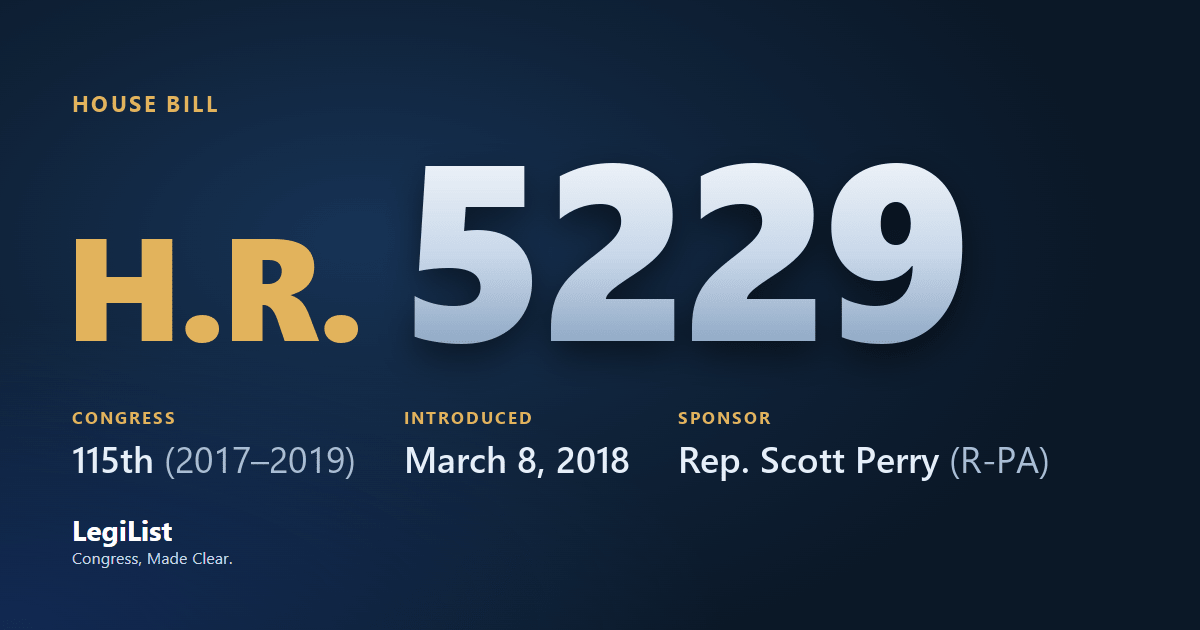
Tuition Fairness for Citizens Act
Latest action · Apr 30, 2018 Referred to the Subcommittee on Immigration and Border Security.
Progress
Where this bill reached, and when. A stage with no date was not reached; one that failed a vote and later carried shows the date it carried.
- IntroducedMar 8, 2018
- Passed HouseNot reached
- Passed SenateNot reached
- To the PresidentNot reached
- Became lawNot reached
Summary
Tuition Fairness for Citizens Act
This bill amends the Illegal Immigration Reform and Immigrant Responsibility Act of 1996 to make aliens who are not lawfully present in the United States ineligible for postsecondary education benefits (e.g., in-state tuition) unless all U.S. citizens and nationals are eligible for the same benefit. Under current law, states are not permitted to give postsecondary education benefits to such aliens on the basis of residency, but are allowed to give such benefits based on other criteria. This bill eliminates the option to give such benefits based on any criteria if they are not available to all U.S. citizens and nationals.
In addition, the bill grants a private right of action to a person who is aggrieved by a violation of this requirement.
Cosponsors 5
Members who signed on, in the order they did. All signed on Mar 8, 2018.
| Seat | Cosponsor | Signed on | |
|---|---|---|---|
| R-AZ | Andy Biggs | Original | Mar 8, 2018 |
| R-MD | Andy Harris | Original | Mar 8, 2018 |
| R-TX | Brian Babin | Original | Mar 8, 2018 |
| R-GA | Jody B. Hice | Original | Mar 8, 2018 |
| R-IA | Steve King | Original | Mar 8, 2018 |
Committees 2
Where it was sent and what each committee and subcommittee did with it, in order.
| Chamber | Committee | What it did |
|---|---|---|
| House | Judiciary Committee | Referred Mar 8, 2018 |
| Immigration Integrity, Security, and Enforcement Subcommittee | Referred Apr 30, 2018 | |
| House | Education and Workforce Committee | Referred Mar 8, 2018 |
Actions 3
Everything that happened, newest first.
- Apr 30, 2018Referred to the Subcommittee on Immigration and Border Security.
- Mar 8, 2018Introduced in House
- Mar 8, 2018Referred to the Committee on the Judiciary, and in addition to the Committee on Education and the Workforce, for a period to be subsequently determined by the Speaker, in each case for consideration of such provisions as fall within the jurisdiction of the committee concerned.
Research
What has been written about this bill: committee reports, cost estimates, the sponsor’s authority statement, printed hearings and the Congressional Research Service’s work.
Constitutional authority
The sponsor’s statement, as printed in the Congressional Record, vol. 164, no. 41, March 8, 2018, page H1502.
Titles 2
Every title it has carried, official and short, at each stage.
- Official Title as Introduced
- To amend section 505 of the Illegal Immigration Reform and Immigrant Responsibility Act of 1996 to clarify the prohibition on postsecondary education benefits for certain aliens, to grant a private right of action to persons injured by a violation of such prohibition, and for other purposes.
- Short Titles as Introduced
- Tuition Fairness for Citizens Act
Subjects
Assigned by the Library of Congress. Policy area: Education.
Text 1
Each version as it was printed, newest first.
- Mar 8, 2018Introduced in House
Support LegiList
This page is free, carries no paywall, and is built and maintained by one person. If the record here is useful to you, a few dollars keeps it going.
Everything here is as published by Congress: the summary is the Congressional Research Service's, the action wording is the clerks', and the subjects are the Library of Congress's. How far it got is read from the actions themselves, taking the most recent one of each kind, so a bill that failed a vote and later passed is shown as having passed. Records come from this bill on Congress.gov and govinfo.gov; cost estimates are the Congressional Budget Office's, and the hearings are the printed hearings GovInfo publishes, which can appear months after the hearing.