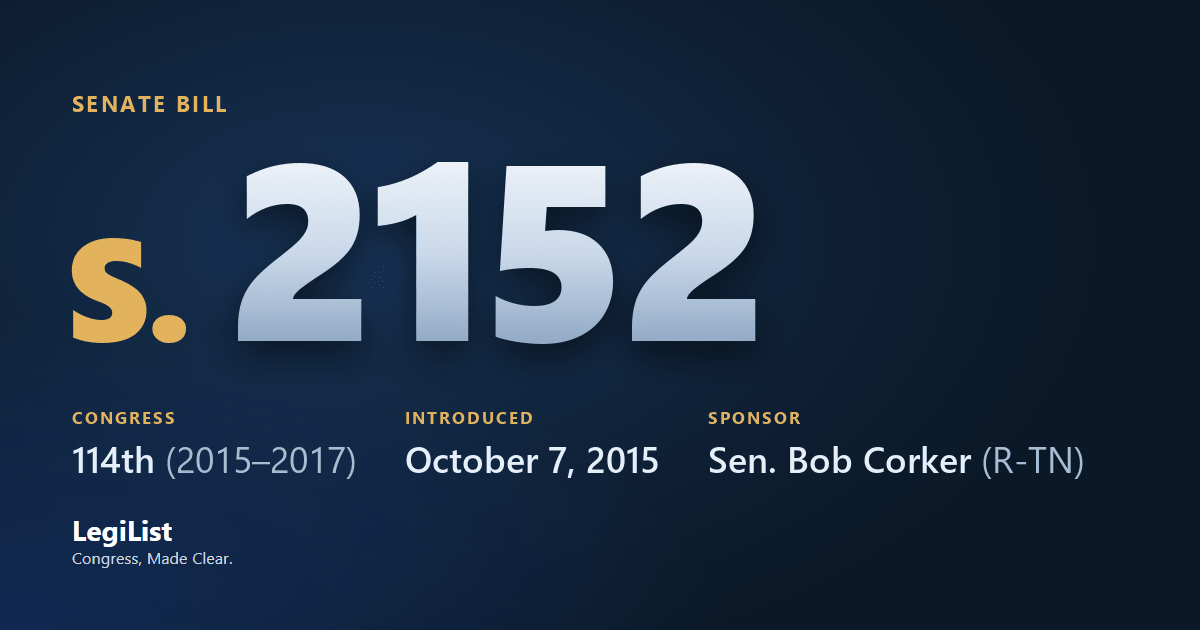
Electrify Africa Act of 2015
Latest action · Feb 8, 2016 Became Public Law No: 114-121.
Progress
Where this bill reached, and when. A stage with no date was not reached; one that failed a vote and later carried shows the date it carried.
- IntroducedOct 7, 2015
- Passed SenateDec 18, 2015
- Passed HouseFeb 1, 2016
- To the PresidentFeb 3, 2016
- Became lawFeb 8, 2016Public Law 114-121
Summary
(This measure has not been amended since it was passed by the Senate on December 18, 2015. The summary of that version is repeated here.)
Electrify Africa Act of 2015
(Sec. 3) This bill states that it is U.S. policy to partner with the governments of sub-Saharan African countries, international financial institutions, and African regional economic communities, cooperatives, and private sectors to:
- promote first-time access to power services for at least 50 million people in sub-Saharan Africa by 2020;
- encourage the installation of at least 20,000 additional megawatts of electrical power in sub-Saharan Africa by 2020;
- promote reliable and affordable power in urban, rural, and under served areas;
- encourage necessary reforms to support electricity access projects and market-based power generation and distribution;
- promote policies to displace kerosene lighting with other technologies;
- promote an energy development strategy for sub-Saharan Africa that includes the use of oil, natural gas, coal, hydroelectric, wind, solar, and geothermal power; and
- promote the use of private financing and seek ways to remove barriers to private financing and assistance for projects, including through charitable organizations.
(Sec. 4) The President shall: (1) establish a multiyear strategy to assist countries in sub-Saharan Africa implement national power strategies and develop an appropriate mix of power solutions to provide access to reliable, affordable, and sustainable power in order to reduce poverty and drive economic growth and job creation; and (2) ensure that the strategy remains responsive to local community concerns and technological innovation.
The President may establish an interagency working group to coordinate the activities of U.S. government departments and agencies involved in carrying out the strategy.
(Sec. 5) The U.S. Agency for International Development, the Trade and Development Agency, the Overseas Private Investment Corporation, and the Millennium Challenge Corporation are urged to: (1) prioritize efforts and assistance for power projects and markets in sub-Saharan Africa; and (2) partner with other investors and local institutions, including private sector actors, to increase access to reliable, affordable, and sustainable power.
(Sec. 6) The President should use U.S. influence at international bodies to advocate for:
- increasing investment in power sector and electrification projects in sub-Saharan Africa,
- addressing energy needs of individuals and communities where electricity grid access is impractical or cost-prohibitive,
- enhancing private sector coordination, and
- assisting sub-Saharan African governments to remove unnecessary regulatory barriers to investment.
(Sec. 7) Within three years the President shall transmit a strategy progress report to Congress which includes information regarding: (1) U.S. programs supporting policy and legislative changes leading to increased power generation and access in sub-Saharan Africa, and (2) power projects receiving U.S. government support.
Cosponsors 23
Members who signed on, in the order they did. Signatures ran from Oct 7, 2015 to Dec 17, 2015; 3 are original cosponsors, there from the day it was introduced.
| Seat | Cosponsor | Signed on | |
|---|---|---|---|
| D-MD | Benjamin L. Cardin | Original | Oct 7, 2015 |
| D-DE | Christopher A. Coons | Original | Oct 7, 2015 |
| R-FL | Marco Rubio | Original | Oct 7, 2015 |
| D-MA | Edward J. Markey | Oct 8, 2015 | |
| R-AZ | Jeff Flake | Oct 8, 2015 | |
| R-GA | Johnny Isakson | Oct 8, 2015 | |
| R-AK | Lisa Murkowski | Oct 8, 2015 | |
| R-CO | Cory Gardner | Oct 22, 2015 | |
| R-TN | Lamar Alexander | Oct 22, 2015 | |
| R-SC | Lindsey Graham | Oct 22, 2015 | |
| R-IL | Mark Kirk | Oct 22, 2015 | |
| D-IL | Richard J. Durbin | Oct 22, 2015 | |
| R-MO | Roy Blunt | Oct 22, 2015 | |
| R-ME | Susan M. Collins | Oct 22, 2015 | |
| D-MI | Gary C. Peters | Oct 27, 2015 | |
| R-AR | John Boozman | Oct 27, 2015 | |
| R-AZ | John McCain | Nov 4, 2015 | |
| D-NY | Kirsten E. Gillibrand | Nov 4, 2015 | |
| R-SD | John Thune | Nov 16, 2015 | |
| D-WA | Patty Murray | Nov 16, 2015 | |
| D-CT | Christopher Murphy | Nov 19, 2015 | |
| D-OH | Sherrod Brown | Nov 19, 2015 | |
| R-SD | Mike Rounds | Dec 17, 2015 |
Committees 2
Where it was sent and what each committee and subcommittee did with it, in order.
| Chamber | Committee | What it did |
|---|---|---|
| Senate | Foreign Relations Committee | Referred Oct 7, 2015Markup Oct 8, 2015Reported Nov 5, 2015 |
| House | Foreign Affairs Committee | Referred Dec 18, 2015 |
Actions 20
Everything that happened, newest first.
- Feb 8, 2016Signed by President.
- Feb 8, 2016Became Public Law No: 114-121.
- Feb 3, 2016Presented to President.
- Feb 1, 2016Mr. Royce moved to suspend the rules and pass the bill.
- Feb 1, 2016Considered under suspension of the rules. (consideration: CR H396-400)
In the Congressional Record 3
Days the Record’s own index lists this bill, newest first, with the pages and the members it names. Pages starting H are the House, S the Senate, E Extensions of Remarks.
| Where | In the Record | Members | Date |
|---|---|---|---|
| Extensions | Debate and remarks E167 | Nita M. Lowey D-NY | Feb 11, 2016 |
| House | Debate and remarks H396–H400Text printed H396–H398 | Brendan F. Boyle D-PA, Christopher H. Smith R-NJ, Edward R. Royce R-CA, Karen Bass D-CA, Sheila Jackson Lee D-TX | Feb 1, 2016 |
| Senate | Debate and remarks S8861, S8863Text printed S8863–S8865Amendments S8861, S8863, S8889 | Bob Corker R-TN (amendment), Mitch McConnell R-KY | Dec 18, 2015 |
Research
What has been written about this bill: committee reports, cost estimates, the sponsor’s authority statement, printed hearings and the Congressional Research Service’s work.
Committee report
Congressional Budget Office cost estimate
- Oct 21, 2015S. 2152, Electrify Africa Act of 2015As ordered reported by the Senate Committee on Foreign Relations on October 8, 2015
CRS reports 9
Congressional Research Service work that CRS links to this bill or the law it became, newest first.
Cite it 9
Products on other subjects that cite it, usually among other measures.
| Product | Title | Kind | Published |
|---|---|---|---|
| R49080 | China-Sub-Saharan Africa Ties and U.S. Policy | Report | Aug 6, 2026 |
| IF12652 | U.S. International Climate Finance: FY2025 Archived | Resource | May 6, 2024 |
| R46368 | U.S. Assistance for Sub-Saharan Africa: An Overview Archived | Report | Nov 7, 2023 |
| R45428 | Sub-Saharan Africa: Overview and U.S. Engagement Archived | Report | Jul 21, 2023 |
| R47007 | Economic Growth Approaches in U.S. Foreign Assistance | Report | Jan 12, 2022 |
Amendments 1
Amendments offered to this bill.
| Amendment | Description | Offered by | Status |
|---|---|---|---|
| SA 2939 | To improve the bill. | Bob Corker R-TNfor Mitch McConnell | Amendment SA 2939 agreed to in Senate by Unanimous Consent. |
Related bills 2
Companion bills and other measures the record links to this one.
| Bill | Title | Relationship | Latest action |
|---|---|---|---|
| S 1933 | Electrify Africa Act of 2015 | Related bill | Aug 4, 2015 |
| HR 2847 | Electrify Africa Act of 2015 | Related bill | Jun 23, 2015 |
Titles 6
Every title it has carried, official and short, at each stage.
- Official Title as Introduced
- A bill to establish a comprehensive United States Government policy to encourage the efforts of countries in sub-Saharan Africa to develop an appropriate mix of power solutions, including renewable energy, for more broadly distributed electricity access in order to support poverty reduction, promote development outcomes, and drive economic growth, and for other purposes.
- Short Titles as Introduced
- Electrify Africa Act of 2015
- Short Titles as Reported to Senate
- Electrify Africa Act of 2015
- Short Titles as Passed House
- Electrify Africa Act of 2015
- Short Titles as Passed Senate
- Electrify Africa Act of 2015
- Short Titles as Enacted
- Electrify Africa Act of 2015
Subjects
Assigned by the Library of Congress. Policy area: International Affairs.
- Africa
- Alternative and renewable resources
- Congressional oversight
- Electric power generation and transmission
- Foreign aid and international relief
- Infrastructure development
- International Affairs
- International organizations and cooperation
- Lighting and heating
- Lighting, heating, cooling
- Multilateral development programs
- Public-private cooperation
- Social work, volunteer service, charitable organizations
- U.S. and foreign investments
Text 5
Each version as it was printed, newest first.
- —Enrolled Bill
- Dec 18, 2015Engrossed in Senate
- Dec 18, 2015Referred in House
- Nov 5, 2015Reported to Senate
- Oct 7, 2015Introduced in Senate
Everything here is as published by Congress: the summary is the Congressional Research Service's, the action wording is the clerks', and the subjects are the Library of Congress's. How far it got is read from the actions themselves, taking the most recent one of each kind, so a bill that failed a vote and later passed is shown as having passed. Records come from this bill on Congress.gov and govinfo.gov; cost estimates are the Congressional Budget Office's, and the hearings are the printed hearings GovInfo publishes, which can appear months after the hearing.