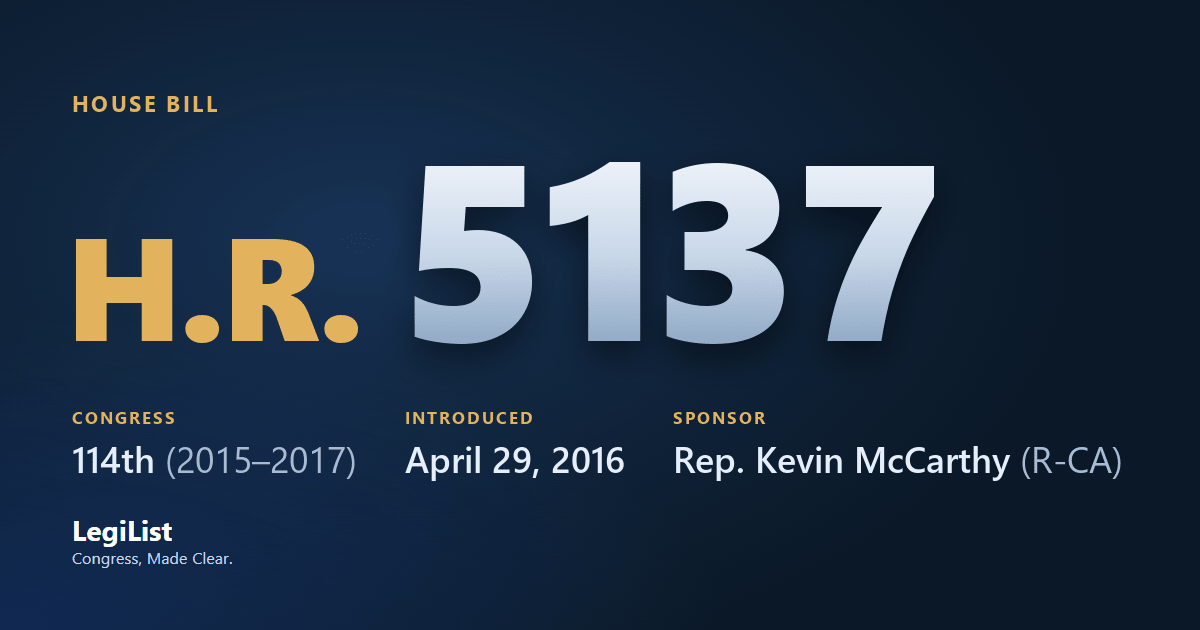
Moving to Work Reform and Expansion Act of 2016
Latest action · Apr 29, 2016 Referred to the House Committee on Financial Services.
Progress
Where this bill reached, and when. A stage with no date was not reached; one that failed a vote and later carried shows the date it carried.
- IntroducedApr 29, 2016
- Passed HouseNot reached
- Passed SenateNot reached
- To the PresidentNot reached
- Became lawNot reached
Summary
Moving to Work Reform and Expansion Act of 2016
This bill amends the Departments of Veterans Affairs and Housing and Urban Development, and Independent Agencies Appropriations Act, 1996 to revise the public housing/section 8 (rental voucher) Moving to Work demonstration program.
The bill makes the program permanent and replaces its current purposes with the purpose to develop measures to promote employment and economic independence for:
- families with children whose head of household is working, seeking work, or preparing for work;
- able-bodied individuals; and
- persons with disabilities who are able to work on a limited basis.
Any number of public housing agencies (PHAs) may participate in the program.
The plan in a PHA's application to participate shall include criteria for:
- a speedy process to determine a tenant's temporary hardship exemption from program requirements; and
- an informal administrative hearing or grievance process, made public on tenant request, before eviction or termination of assistance.
The Department of Housing and Urban Development (HUD) shall establish standards for a 10-year participation by all PHAs that have not been designated as troubled during the most recent two fiscal years.
These PHAs must include in their applications lists of innovative proposals designed to reduce the cost and increase the cost-efficiency of housing, and of innovative ways to assist families and accomplish annual goals.
HUD shall review and process applications to enable the transition to the program of at least 25 PHAs per year, with reserved spots for small and rural PHAs.
Each PHA shall:
- submit annually to HUD budget plans meeting specified requirements, and
- hold as many meetings as necessary to give all assisted families a good-faith opportunity to hear and comment on the budget plan and related PHA reports.
HUD shall review annually the activities of each participating PHA and determine its impact, effectiveness, and progress toward meeting program goals.
HUD shall not terminate the program participation of any PHA except upon certain findings concerning performance, including persistent failure to meet the goals identified in its application or failure to cure a material deficiency in performance.
The Government Accountability Office shall review the program every eight years.
Cosponsors 26
Members who signed on, in the order they did. Signatures ran from Apr 29, 2016 to Jul 14, 2016; 17 are original cosponsors, there from the day it was introduced.
| Seat | Cosponsor | Signed on | |
|---|---|---|---|
| R-TN | Charles J. "Chuck" Fleischmann | Original | Apr 29, 2016 |
| R-CA | David G. Valadao | Original | Apr 29, 2016 |
| R-CA | Doug LaMalfa | Original | Apr 29, 2016 |
| R-CA | Duncan Hunter | Original | Apr 29, 2016 |
| R-CA | Edward R. Royce | Original | Apr 29, 2016 |
| R-AR | J. French Hill | Original | Apr 29, 2016 |
| D-CA | Janice Hahn | Original | Apr 29, 2016 |
| R-PA | Keith J. Rothfus | Original | Apr 29, 2016 |
| R-GA | Lynn A. Westmoreland | Original | Apr 29, 2016 |
| R-PA | Michael G. Fitzpatrick | Original | Apr 29, 2016 |
| R-NC | Patrick T. McHenry | Original | Apr 29, 2016 |
| R-TX | Randy Neugebauer | Original | Apr 29, 2016 |
| R-IL | Robert J. Dold | Original | Apr 29, 2016 |
| R-NJ | Rodney P. Frelinghuysen | Original | Apr 29, 2016 |
| R-CA | Stephen Knight | Original | Apr 29, 2016 |
| R-NM | Stevan Pearce | Original | Apr 29, 2016 |
| R-OH | Steve Stivers | Original | Apr 29, 2016 |
| R-CA | Devin Nunes | May 18, 2016 | |
| R-CA | Jeff Denham | May 18, 2016 | |
| D-CA | Jerry McNerney | May 18, 2016 | |
| R-LA | Charles W. Boustany, Jr. | Jun 10, 2016 | |
| D-CA | John Garamendi | Jun 10, 2016 | |
| D-CA | Julia Brownley | Jul 6, 2016 | |
| D-CA | Tony Cárdenas | Jul 6, 2016 | |
| D-CA | Eric Swalwell | Jul 11, 2016 | |
| R-KY | Brett Guthrie | Jul 14, 2016 |
Committees 1
Where it was sent and what each committee and subcommittee did with it, in order.
| Chamber | Committee | What it did |
|---|---|---|
| House | Financial Services Committee | Referred Apr 29, 2016 |
Actions 2
Everything that happened, newest first.
- Apr 29, 2016Introduced in House
- Apr 29, 2016Referred to the House Committee on Financial Services.
Research
What has been written about this bill: committee reports, cost estimates, the sponsor’s authority statement, printed hearings and the Congressional Research Service’s work.
Constitutional authority
The sponsor’s statement, as printed in the Congressional Record, vol. 162, no. 67, April 29, 2016, page H2150.
Printed hearings 1
Hearings whose printed record names this bill, newest first: hearings on it, and wider hearings where it came up.
| Number | Hearing | Committee | Held |
|---|---|---|---|
| Serial No. 114-86 | THE FUTURE OF HOUSING IN AMERICA: A COMPARISON OF THE UNITED KINGDOM AND UNITED STATES MODELS OF AFFORDABLE HOUSING122 pages | Financial Services Committee | May 12, 2016 |
Titles 2
Every title it has carried, official and short, at each stage.
- Official Title as Introduced
- To reform the Moving to Work Program of the Department of Housing and Urban Development, and for other purposes.
- Short Titles as Introduced
- Moving to Work Reform and Expansion Act of 2016
Subjects
Assigned by the Library of Congress. Policy area: Housing and Community Development.
Text 1
Each version as it was printed, newest first.
- Apr 29, 2016Introduced in House
Support LegiList
This page is free, carries no paywall, and is built and maintained by one person. If the record here is useful to you, a few dollars keeps it going.
Everything here is as published by Congress: the summary is the Congressional Research Service's, the action wording is the clerks', and the subjects are the Library of Congress's. How far it got is read from the actions themselves, taking the most recent one of each kind, so a bill that failed a vote and later passed is shown as having passed. Records come from this bill on Congress.gov and govinfo.gov; cost estimates are the Congressional Budget Office's, and the hearings are the printed hearings GovInfo publishes, which can appear months after the hearing.