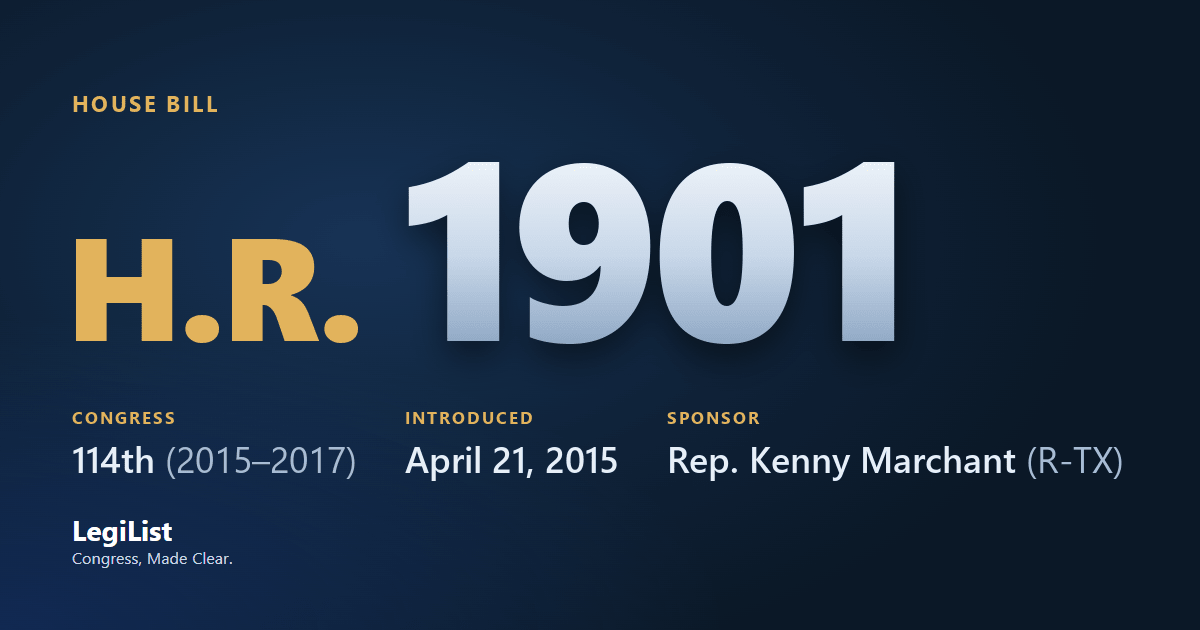
PTC Elimination Act
Latest action · Apr 30, 2015 Sponsor introductory remarks on measure. (CR H2671)
Progress
Where this bill reached, and when. A stage with no date was not reached; one that failed a vote and later carried shows the date it carried.
- IntroducedApr 21, 2015
- Passed HouseNot reached
- Passed SenateNot reached
- To the PresidentNot reached
- Became lawNot reached
Summary
PTC Elimination Act
This bill amends the Internal Revenue Code to phase out and eventually eliminate the tax credit for production of electricity from renewable resources. The bill repeals the inflation adjustment for current recipients of the tax credit and modifies the "beginning of construction" requirement to require that construction of an eligible project is continuous and makes significant progress. The credit is repealed in its entirety after December 31, 2025.
The bill expresses the sense of Congress that the credit should be allowed to expire and should not be extended beyond its expiration date.
The bill also reduces the corporate income tax by an applicable percentage based on increases in revenues resulting from this bill.
Cosponsors 53
Members who signed on, in the order they did. Signatures ran from Apr 21, 2015 to Jan 6, 2016; 6 are original cosponsors, there from the day it was introduced.
| Seat | Cosponsor | Signed on | |
|---|---|---|---|
| R-TX | Bill Flores | Original | Apr 21, 2015 |
| R-PA | Bill Shuster | Original | Apr 21, 2015 |
| R-KS | Mike Pompeo | Original | Apr 21, 2015 |
| R-TX | Sam Johnson | Original | Apr 21, 2015 |
| R-PA | Scott Perry | Original | Apr 21, 2015 |
| R-LA | Steve Scalise | Original | Apr 21, 2015 |
| R-TX | Joe Barton | Apr 23, 2015 | |
| R-MD | Andy Harris | Apr 30, 2015 | |
| R-GA | Austin Scott | May 1, 2015 | |
| R-TX | Louie Gohmert | May 1, 2015 | |
| R-TN | David P. Roe | May 8, 2015 | |
| R-CO | Doug Lamborn | May 8, 2015 | |
| R-TN | Scott DesJarlais | May 8, 2015 | |
| R-NC | Walter B. Jones | May 8, 2015 | |
| R-IL | Randy Hultgren | May 12, 2015 | |
| R-TX | John R. Carter | May 14, 2015 | |
| R-TX | Pete Olson | May 15, 2015 | |
| R-VA | H. Morgan Griffith | Jun 1, 2015 | |
| R-TX | John Abney Culberson | Jun 12, 2015 | |
| R-OH | Jim Jordan | Jun 17, 2015 | |
| R-WI | Reid J. Ribble | Jun 24, 2015 | |
| R-IL | John Shimkus | Jun 25, 2015 | |
| R-KY | Andy Barr | Jul 7, 2015 | |
| R-OK | Jim Bridenstine | Jul 7, 2015 | |
| R-AL | Mo Brooks | Jul 7, 2015 | |
| R-PA | Tim Murphy | Jul 7, 2015 | |
| R-AZ | Paul A. Gosar | Jul 13, 2015 | |
| R-GA | Tom Graves | Jul 13, 2015 | |
| R-VA | Bob Goodlatte | Jul 14, 2015 | |
| R-KY | Brett Guthrie | Jul 14, 2015 | |
| R-WY | Cynthia M. Lummis | Jul 14, 2015 | |
| R-SC | Jeff Duncan | Jul 16, 2015 | |
| R-NC | Mark Walker | Jul 16, 2015 | |
| R-MS | Gregg Harper | Jul 22, 2015 | |
| R-FL | Richard B. Nugent | Jul 22, 2015 | |
| R-GA | Earl L. "Buddy" Carter | Jul 23, 2015 | |
| R-GA | Lynn A. Westmoreland | Jul 27, 2015 | |
| R-VA | Dave Brat | Jul 29, 2015 | |
| R-AZ | David Schweikert | Jul 29, 2015 | |
| R-TX | John Ratcliffe | Jul 29, 2015 | |
| R-GA | Barry Loudermilk | Aug 4, 2015 | |
| R-TN | Stephen Lee Fincher | Sep 8, 2015 | |
| R-SC | Mick Mulvaney | Sep 9, 2015 | |
| R-AZ | Trent Franks | Sep 10, 2015 | |
| R-TX | Randy K. Weber, Sr. | Sep 15, 2015 | |
| R-AL | Robert B. Aderholt | Sep 15, 2015 | |
| R-NY | Chris Collins | Sep 17, 2015 | |
| R-ID | Raul R. Labrador | Oct 21, 2015 | |
| R-OK | Steve Russell | Oct 22, 2015 | |
| R-TX | Jeb Hensarling | Nov 16, 2015 | |
| R-TX | Brian Babin | Dec 8, 2015 | |
| R-TX | Pete Sessions | Dec 8, 2015 | |
| R-MN | John Kline | Jan 6, 2016 |
Committees 1
Where it was sent and what each committee and subcommittee did with it, in order.
| Chamber | Committee | What it did |
|---|---|---|
| House | Ways and Means Committee | Referred Apr 21, 2015 |
Actions 3
Everything that happened, newest first.
- Apr 30, 2015Sponsor introductory remarks on measure. (CR H2671)
- Apr 21, 2015Introduced in House
- Apr 21, 2015Referred to the House Committee on Ways and Means.
In the Congressional Record 1
Days the Record’s own index lists this bill, newest first, with the pages and the members it names. Pages starting H are the House, S the Senate, E Extensions of Remarks.
| Where | In the Record | Members | Date |
|---|---|---|---|
| House | Debate and remarks H2671 | Kenny Marchant R-TX | Apr 30, 2015 |
Research
What has been written about this bill: committee reports, cost estimates, the sponsor’s authority statement, printed hearings and the Congressional Research Service’s work.
Constitutional authority
The sponsor’s statement, as printed in the Congressional Record, vol. 161, no. 58, April 21, 2015, page H2355.
CRS reports 1
Congressional Research Service work that CRS links to this bill or the law it became, newest first.
Cite it 1
Products on other subjects that cite it, usually among other measures.
| Product | Title | Kind | Published |
|---|---|---|---|
| R43453 | The Renewable Electricity Production Tax Credit: In Brief Archived | Report | Apr 29, 2020 |
Related bills 1
Companion bills and other measures the record links to this one.
| Bill | Title | Relationship | Latest action |
|---|---|---|---|
| S 2158 | PTC Elimination Act | Related bill | Oct 7, 2015 |
Titles 2
Every title it has carried, official and short, at each stage.
- Official Title as Introduced
- To amend the Internal Revenue Code of 1986 to phaseout and repeal the credit for electricity produced from certain renewable resources, to reduce the corporate income tax, and for other purposes.
- Short Titles as Introduced
- PTC Elimination Act
Subjects
Assigned by the Library of Congress. Policy area: Taxation.
Text 1
Each version as it was printed, newest first.
- Apr 21, 2015Introduced in House
Everything here is as published by Congress: the summary is the Congressional Research Service's, the action wording is the clerks', and the subjects are the Library of Congress's. How far it got is read from the actions themselves, taking the most recent one of each kind, so a bill that failed a vote and later passed is shown as having passed. Records come from this bill on Congress.gov and govinfo.gov; cost estimates are the Congressional Budget Office's, and the hearings are the printed hearings GovInfo publishes, which can appear months after the hearing.