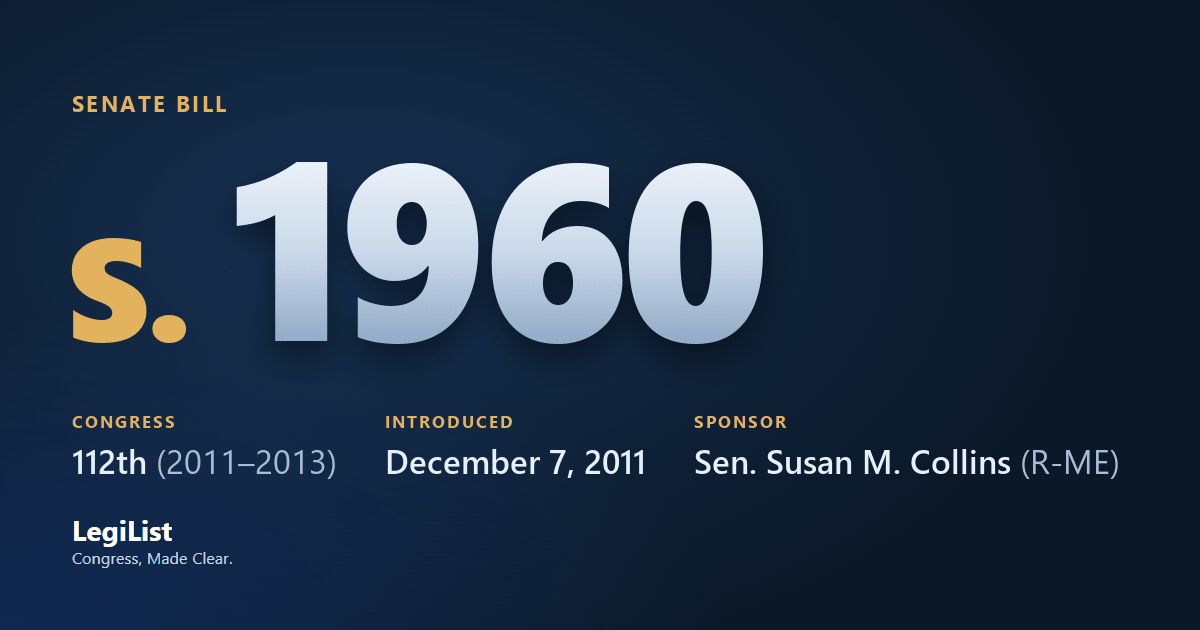
Jobs Creation Act
Latest action · Dec 7, 2011 Read twice and referred to the Committee on Finance.
Progress
Where this bill reached, and when. A stage with no date was not reached; one that failed a vote and later carried shows the date it carried.
- IntroducedDec 7, 2011
- Passed SenateNot reached
- Passed HouseNot reached
- To the PresidentNot reached
- Became lawNot reached
Summary
Jobs Creation Act - Title I: Tax Incentives - Subtitle A: Payroll Tax Holiday - Amends the Tax Relief, Unemployment Reauthorization, and Job Creation Act of 2010 to: (1) extend through 2012 the 2% reduction in employment tax rates for employees and self-employed individuals (payroll tax holiday), (2) allow a 2% reduction of the employment tax rate for employers and tax-exempt organizations, and (3) allow an additional 2% reduction in the tax rate for self-employed individuals.
Subtitle B: American Opportunity - American Opportunity Act of 2011 - Amends the Internal Revenue Code to allow a tax credit for 25% of a qualified equity investment in a qualified small business entity (angel investment tax credit). Defines "qualified small business entity" as a domestic corporation or partnership that: (1) is a small business headquartered in the United States; (2) is engaged in a high technology trade or business; (3) has been in existence for less than five years as of the date of the qualified equity investment; and (4) employs less than 100 full-time employees, more than 50% of whom perform substantially all of their services in the United States. Limits the dollar amount of such credit to $500 million for each of calendar years 2011 through 2015.
Subtitle C: Extension of Expiring Provisions - Amends the Internal Revenue Code to extend for one year: (1) bonus depreciation and the 100% expensing allowance for depreciable business assets; (2) the election to accelerate the alternative minimum tax (AMT) credit in lieu of bonus depreciation; (3) the tax deduction for qualified tuition and related expenses; (4) the tax credit for increasing research activities; (5) accelerated depreciation for qualified leasehold improvements, qualified restaurant buildings and improvements, and qualified retail improvements; (6) the tax deductions for charitable contributions of food inventory and book inventories to public elementary or secondary schools; and (7) the tax deduction for corporate contributions of computer technology or equipment for educational purposes.
Title II: Infrastructure Provisions - Revises the state infrastructure bank program to make $10 billion available to the Secretary of Transportation (DOT) to make a special single allocation to each state for deposit into the state infrastructure bank.
Authorizes a state to use 20% of allocated funds for: (1) investigating the viability of identifying revenue sources for repayment capital transportation projects, (2) technical assistance, (3) promotion to potential borrowers, and (4) other activities to enhance the project pipeline.
Directs the Secretary to make allocations to each state that elects not to establish, or is prohibited by state law from establishing, an infrastructure bank of: (1) 20% of funds that would otherwise be allocated to the state for such activities, or (2) 10% of funds that would otherwise be allocated for other surface transportation projects.
Appropriates $25 billion to the Secretary for: (1) certain highway improvement projects (including bridges on public roads), (2) seismic retrofit and painting of bridges, and (3) mitigation costs to address adverse impacts of projects.
Prescribes the federal share of project costs at up to 100%.
Makes $800 million available to the Administrator of the Environmental Protection Agency (EPA) for state water pollution control revolving funds and state drinking water treatment revolving loan funds.
Title III: Regulatory Reform - Subtitle A: Clearing Unnecessary Regulatory Burdens - Clearing Unnecessary Regulatory Burdens Act or the CURB Act - Requires each federal agency to: (1) report to the Office of Information and Regulatory Affairs on the costs and benefits of each significant regulatory action and of identified alternatives; (2) develop or have written procedures for the approval of significant guidance documents; (3) maintain on its website a list of such documents in effect; (4) establish and advertise on its website a means for the public to electronically submit comments on such documents and a request for issuance, reconsideration, modification, or rescission of such documents; and (5) publish a notice in the Federal Register announcing that a draft of an economically significant guidance document is available, make such document publicly available, invite comment on such draft, and respond to such comments.
Defines a "significant regulatory action" as any regulatory action that is likely to result in a regulation that may: (1) have an annual effect on the economy of $100 million or more or adversely affect in a material way the economy, a sector of the economy, productivity, competition, jobs, the environment, public health or safety, or state, local, or tribal governments or communities; (2) create a serious inconsistency or otherwise interfere with an action taken or planned by another agency; (3) materially alter the budgetary impact of entitlements, grants, user fees, or loan programs or the rights and obligations of recipients thereof; or (4) raise novel legal or policy issues arising out of legal mandates and the priorities, principles, and provisions of this Act.
Authorizes an agency head, in consultation with the Administrator of the Office of Information and Regulatory Affairs, to identify a particular document or category of such documents for which the procedures of this Act are not feasible or appropriate.
Allows a reduction or waiver of civil penalties on small entities for failure to comply with collection of information or recordkeeping requirements.
Subtitle B: EPA Regulatory Relief - EPA Regulatory Relief Act of 2011 - Provides that the following rules shall have no force or effect and shall be treated as though they had never taken effect: (1) the National Emission Standards for Hazardous Air Pollutants for Major Sources: Industrial, Commercial, and Institutional Boilers and Process Heaters; (2) the National Emission Standards for Hazardous Air Pollutants for Area Sources: Industrial, Commercial, and Institutional Boilers; (3) the Standards of Performance for New Stationary Sources and Emission Guidelines for Existing Sources: Commercial and Industrial Solid Waste Incineration Units; and (4) Identification of Non-Hazardous Secondary Materials That are Solid Waste.
Requires the EPA Administrator, in place of such rules, to promulgate within 15 months regulations for industrial, commercial, and institutional boilers and process heaters and commercial and industrial solid waste incinerator units subject to such rules, that: (1) establish maximum achievable control technology standards, performance standards, and other requirements for hazardous air pollutants or solid waste combustion under the Clean Air Act; and (2) identify non-hazardous secondary materials that, when used as fuels or ingredients in combustion units of such boilers, heaters, or incinerator units, are solid waste under the Solid Waste Disposal Act for purposes of determining the extent to which such combustion units are required to meet emission standards for such pollutants under such Act. Requires the Administrator to establish compliance dates for such standards and requirements after considering compliance costs, non-air quality health and environmental impacts and energy requirements, the feasibility of implementation, the availability of equipment, suppliers, and labor, and potential net employment impacts.
Sets forth guidelines for such rules and regulations, including requiring the Administrator to: (1) ensure that emissions standards for existing and new sources can be met under actual operating conditions consistently and concurrently with emission standards for all other air pollutants regulated by the rule for the source category, and (2) impose the least burdensome regulatory alternative for each regulation promulgated.
Requires the Administrator to publish a list of nonhazardous secondary materials that are not solid waste when combusted in units designed for energy recovery. Specifies material to be included in such list.
Title IV: Workforce Development - Subtitle A: Job Training Program Consolidation - Job Training Program Consolidation Act of 2011 - Requires the Director of the Office of Management and Budget (OMB) to study the effectiveness of current federal job training programs and the consolidation of duplicative job training programs.
Requires the Director to prepare recommendations for legislation that: (1) reduce the number and costs of job training programs, and (2) consolidate all such programs under a single agency that emphasizes job training that develops skills needed by state or local employers.
Prescribes uses of saved funds due to recommended legislation, including: (1) half to increase funds for individual training accounts of adults and dislocated workers, and (2) half for federal debt reduction.
Subtitle B: Innovation and Job Creation - National Innovation and Job Creation Act of 2011 - Establishes in the Executive Office of the President the National Innovation Council to: (1) formulate federal innovation policy, and (2) provide financial assistance for state and local innovation initiatives. Transfers to the Council several other specified federal programs.
Establishes the National Innovation Council Board.
Establishes within the Council the CLUSTER (Competitive Leadership for the United States Through its Economic Regions) Information Center (CLIC).
Directs the CLIC to maintain a publicly available registry of CLUSTER Initiatives and CLUSTER Programs.
Directs the Council to award grants to eligible entities to operate a CLUSTER Grant Program for the award of grants to CLUSTER Initiatives.
Directs the Council to award: (1) competitive National Sector Research grants to eligible companies and joint ventures to encourage innovation through research partnerships between U.S. academic institutions and industry research alliances, (2) Productivity Enhancement Research grants to U.S. academic institutions and to joint ventures composed of academic institutions and private companies to support early-staged research into methods of increasing industry productivity and innovation, (3) State Innovation-Based Economic Development Partnership grants to state economic development entities to spur innovation or productivity activities, and (4) Technology Diffusion grants to manufacturing extension partnership centers to promote the diffusion of existing technological innovations to companies in which such innovations are underutilized.
Title V: Offsets - Subtitle A: Surtax on High-income Taxpayers - Amends the Internal Revenue Code to impose an additional 2% tax in taxable years beginning after 2012 and before 2023 on the modified adjusted gross income of any individual taxpayer in excess of $1 million.
Subtitle B: Closing Big Oil Tax Loopholes - Close Big Oil Tax Loopholes Act - Amends the Internal Revenue Code to deny to any major integrated oil company (an oil company which had gross receipts in excess of $1 billion for its last taxable year ending during 2005 and an average daily worldwide production of crude oil of at least 500,000 barrels for a taxable year): (1) a foreign tax credit if such company is a dual capacity taxpayer (a person who is subject to a levy of a foreign country or U.S. possession and who receives a specific economic benefit from such country or possession directly or indirectly); (2) the tax deduction for income attributable to domestic production of oil, natural gas, or primary products thereof; (3) the tax deduction for intangible drilling and development costs; (4) the percentage depletion allowance for oil and gas wells; and (5) the tax deduction for qualified tertiary injectant expenses.
Amends the Energy Policy Act of 2005 to repeal the authority of the Secretary of the Interior to grant royalty relief (suspension of royalties) for natural gas production from certain deep wells and deep water oil and natural gas production in the Outer Continental Shelf.
Cosponsors 1
Members who signed on, in the order they did. All signed on Dec 7, 2011.
| Seat | Cosponsor | Signed on | |
|---|---|---|---|
| D-MO | Claire McCaskill | Original | Dec 7, 2011 |
Committees 1
Where it was sent and what each committee and subcommittee did with it, in order.
| Chamber | Committee | What it did |
|---|---|---|
| Senate | Finance Committee | Referred Dec 7, 2011 |
Actions 3
Everything that happened, newest first.
- Dec 7, 2011Introduced in Senate
- Dec 7, 2011Sponsor introductory remarks on measure. (CR S8415-8417)
- Dec 7, 2011Read twice and referred to the Committee on Finance.
In the Congressional Record 1
Days the Record’s own index lists this bill, newest first, with the pages and the members it names. Pages starting H are the House, S the Senate, E Extensions of Remarks.
| Where | In the Record | Members | Date |
|---|---|---|---|
| Senate | Debate and remarks S8415–S8417 | Susan M. Collins R-ME | Dec 7, 2011 |
Research
What has been written about this bill: committee reports, cost estimates, the sponsor’s authority statement, printed hearings and the Congressional Research Service’s work.
CRS reports 1
Congressional Research Service work that CRS links to this bill or the law it became, newest first.
Cite it 1
Products on other subjects that cite it, usually among other measures.
| Product | Title | Kind | Published |
|---|---|---|---|
| R41613 | Fishery, Aquaculture, and Marine Mammal Issues in the 112th Congress Archived | Report | Jan 22, 2013 |
Related bills 4
Companion bills and other measures the record links to this one.
| Bill | Title | Relationship | Latest action |
|---|---|---|---|
| S 256 | American Opportunity Act of 2011 | Related bill | Feb 2, 2011 |
| S 602 | CURB Act | Related bill | Jul 20, 2011 |
| S 1392 | EPA Regulatory Relief Act of 2011 | Related bill | Jul 20, 2011 |
| HR 2250 | EPA Regulatory Relief Act of 2011 | Related bill | Oct 18, 2011 |
Titles 9
Every title it has carried, official and short, at each stage.
- Official Title as Introduced
- A bill to provide incentives to create American jobs.
- Short Titles as Introduced
- Jobs Creation Act
- Short Titles as Introduced for portions of this bill
- CURB Act
- National Innovation and Job Creation Act of 2011
- Close Big Oil Tax Loopholes Act
- Job Training Program Consolidation Act of 2011
- EPA Regulatory Relief Act of 2011
- Clearing Unnecessary Regulatory Burdens Act
- American Opportunity Act of 2011
Subjects
Assigned by the Library of Congress. Policy area: Economics and Public Finance.
- Administrative law and regulatory procedures
- Advanced technology and technological innovations
- Air quality
- Alternative and renewable resources
- Appropriations
- Aquaculture
- Books and print media
- Business investment and capital
- Civil actions and liability
- Computers and information technology
- Congressional oversight
- Economic development
- Economic performance and conditions
- Economics and Public Finance
- Electric power generation and transmission
- Elementary and secondary education
- Employment and training programs
- Employment taxes
- Energy efficiency and conservation
- Energy revenues and royalties
- Environmental Protection Agency (EPA)
- Environmental regulatory procedures
- Environmental technology
- Executive agency funding and structure
- Executive Office of the President
- Food assistance and relief
- Food industry and services
- Government information and archives
- Government lending and loan guarantees
- Government studies and investigations
- Hazardous wastes and toxic substances
- Income tax credits
- Income tax deductions
- Income tax rates
- Industrial facilities
- Industrial policy and productivity
- Inflation and prices
- Infrastructure development
- Manufacturing
- Marine and coastal resources, fisheries
- Materials
- Oil and gas
- Public participation and lobbying
- Research administration and funding
- Research and development
- Retail and wholesale trades
- Roads and highways
- Securities
- Self-employed
- Small business
- Social security and elderly assistance
- Solid waste and recycling
- State and local government operations
- Student aid and college costs
- Taxation of foreign income
- Teaching, teachers, curricula
- Technology transfer and commercialization
- Transportation programs funding
- Water quality
Text 1
Each version as it was printed, newest first.
- Dec 7, 2011Introduced in Senate
Support LegiList
This page is free, carries no paywall, and is built and maintained by one person. If the record here is useful to you, a few dollars keeps it going.
Everything here is as published by Congress: the summary is the Congressional Research Service's, the action wording is the clerks', and the subjects are the Library of Congress's. How far it got is read from the actions themselves, taking the most recent one of each kind, so a bill that failed a vote and later passed is shown as having passed. Records come from this bill on Congress.gov and govinfo.gov; cost estimates are the Congressional Budget Office's, and the hearings are the printed hearings GovInfo publishes, which can appear months after the hearing.