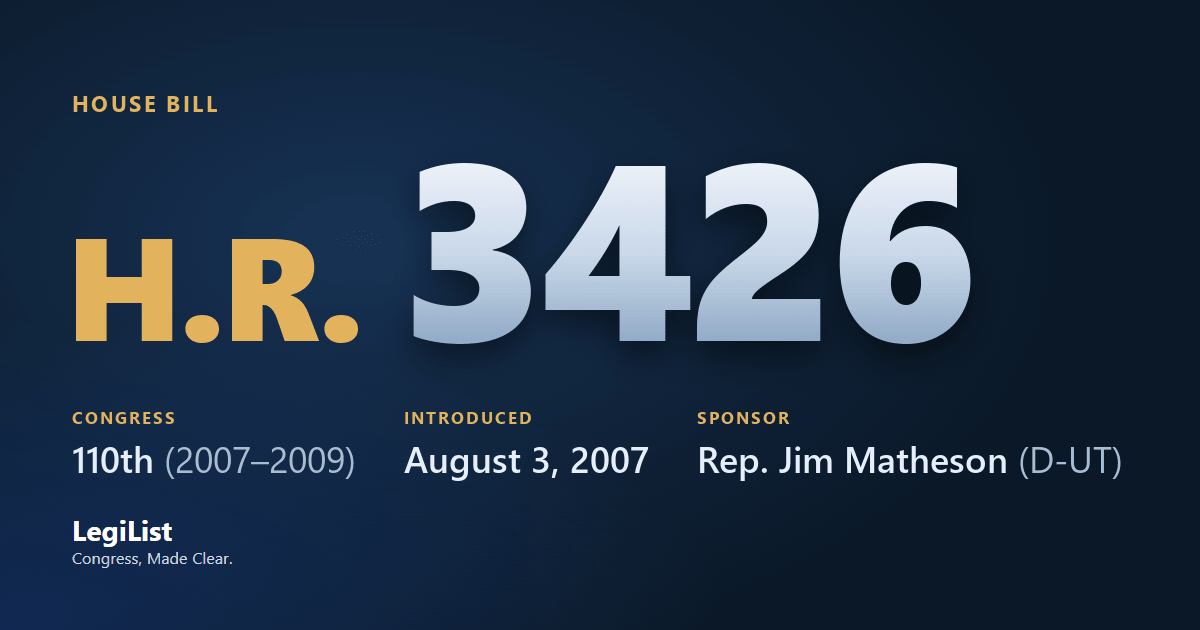
Flexibility for Individual Excellence in Education Act of 2007
Latest action · Sep 19, 2007 Referred to the Subcommittee on Early Childhood, Elementary, and Secondary Education.
Progress
Where this bill reached, and when. A stage with no date was not reached; one that failed a vote and later carried shows the date it carried.
- IntroducedAug 3, 2007
- Passed HouseNot reached
- Passed SenateNot reached
- To the PresidentNot reached
- Became lawNot reached
Summary
Flexibility for Individual Excellence in Education Act of 2007 - Amends the Elementary and Secondary Education Act of 1965 to alter the requirement that teachers be highly qualified by: (1) applying it only to teachers of core subjects; (2) allowing new middle or secondary school teachers to teach subjects for which they earned a college minor; (3) allowing greater consideration to be given to the time experienced teachers have spent teaching a subject; and (4) extending the deadline for rural teachers to meet such requirements.
Provides additional funding for rural teacher recruitment, retention, and professional development activities.
Allows state determinations of students' adequate yearly progress (AYP) toward state academic performance standards to: (1) assess disabled students at the instructional level most closely corresponding to their individualized education plans; and (2) use growth models and multiple measures of student achievement.
Requires local educational agencies (LEAs) to identify schools as needing improvement, corrective action, or restructuring only if they fail to make AYP in the same subject for the same group of students over the requisite period of time. Provides school transfers and supplemental services to students in the failing group, rather than to all students in an affected school. Gives LEAs the option of providing such students with supplemental services rather than transfers for the year following a school's identification as needing improvement.
Cosponsors 4
Members who signed on, in the order they did. Signatures ran from Oct 2, 2007 to May 19, 2008.
| Seat | Cosponsor | Signed on | |
|---|---|---|---|
| D-TN | Bart Gordon | Oct 2, 2007 | |
| D-AR | Mike Ross | Dec 4, 2007 | |
| D-AL | Robert E. (Bud) Cramer Jr. | Dec 18, 2007 | |
| D-VA | Rick Boucher | May 19, 2008 |
Committees 1
Where it was sent and what each committee and subcommittee did with it, in order.
| Chamber | Committee | What it did |
|---|---|---|
| House | Education and Workforce Committee | Referred Aug 3, 2007 |
| Early Childhood, Elementary, and Secondary Education Subcommittee | Referred Sep 19, 2007 |
Actions 3
Everything that happened, newest first.
- Sep 19, 2007Referred to the Subcommittee on Early Childhood, Elementary, and Secondary Education.
- Aug 3, 2007Introduced in House
- Aug 3, 2007Referred to the House Committee on Education and Labor.
Titles 2
Every title it has carried, official and short, at each stage.
- Official Title as Introduced
- To modify certain amendments made by the No Child Left Behind Act of 2001.
- Short Titles as Introduced
- Flexibility for Individual Excellence in Education Act of 2007
Subjects
Assigned by the Library of Congress. Policy area: Education.
- Academic performance
- Authorization
- Compensatory education
- Continuing education
- Department of Education
- Disabled
- Economics and Public Finance
- Education
- Education of the disadvantaged
- Educational accountability
- Educational tests
- Elementary and secondary education
- Elementary education
- English language
- Federal aid to education
- Government Operations and Politics
- Higher education
- Housing and Community Development
- Illiteracy
- Labor and Employment
- Literacy programs
- Minorities
- Minority education
- Rating of teachers
- Recruiting of employees
- Rural education
- School choice
- Secondary education
- Social Welfare
- Special education
- Teacher education
- Teacher supply and demand
- Teachers
Text 1
Each version as it was printed, newest first.
- Aug 3, 2007Introduced in House
Everything here is as published by Congress: the summary is the Congressional Research Service's, the action wording is the clerks', and the subjects are the Library of Congress's. How far it got is read from the actions themselves, taking the most recent one of each kind, so a bill that failed a vote and later passed is shown as having passed. Records come from this bill on Congress.gov and govinfo.gov; cost estimates are the Congressional Budget Office's, and the hearings are the printed hearings GovInfo publishes, which can appear months after the hearing.