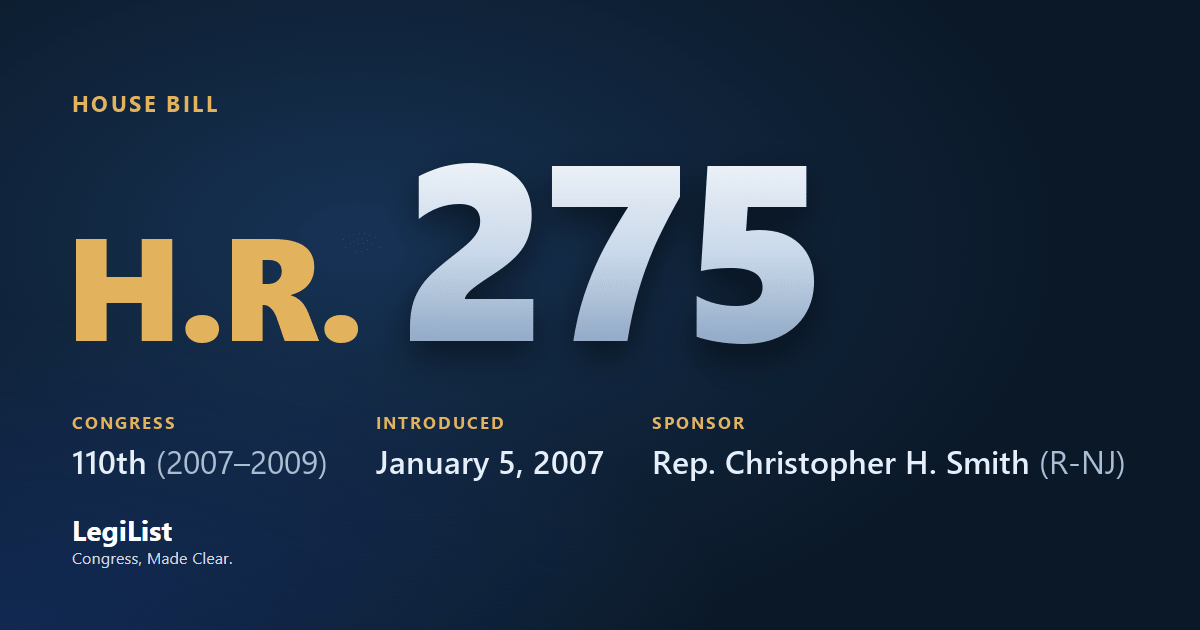
Global Online Freedom Act of 2007
Latest action · Feb 22, 2008 Placed on the Union Calendar, Calendar No. 320.
Progress
Where this bill reached, and when. A stage with no date was not reached; one that failed a vote and later carried shows the date it carried.
- IntroducedJan 5, 2007
- Passed HouseNot reached
- Passed SenateNot reached
- To the PresidentNot reached
- Became lawNot reached
Summary
Global Online Freedom Act of 2007 - (Sec. 3) Defines, for this Act, "United States business" to mean: (1) a company with its principal place of business in the United States or that is organized under the U.S. or state laws; (2) any issuer of a security registered under specified provisions of the Securities Exchange Act of 1934; and (3) any foreign subsidiary of such entities to the extent such entity controls the voting shares or other equities of the foreign subsidiary or authorizes, directs, controls, or participates in acts carried out by the foreign subsidiary that are prohibited by this Act.
Title I: Promotion of Global Internet Freedom - (Sec. 101) Declares that it is U.S. policy to: (1) promote the right to seek, receive, and impart information and ideas through any media; (2) use all appropriate instruments of U.S. influence to support the free flow of information; and (3) deter U.S. businesses from cooperating with Internet-restricting countries in effecting online censorship.
(Sec. 102) Expresses the sense of Congress that: (1) the President should seek international agreements to protect Internet freedom; and (2) some U.S. businesses, in assisting foreign governments to restrict online access to U.S.-supported websites and government reports or to identify individual Internet users, are working contrary to U.S. foreign policy interests.
(Sec. 103) Amends the Foreign Assistance Act of 1961 to require annual assessments of electronic information freedom in each foreign country.
(Sec. 104) Establishes in the Department of State the Office of Global Internet Freedom (OGIF) to perform various duties, including serving as the focal point for interagency efforts to protect and promote freedom of electronic information abroad and developing and ensuring the implementation of a global strategy and programs to combat state-sponsored and state-directed Internet jamming by authoritarian foreign governments. Authorizes appropriations.
(Sec. 105) Directs the President to annually designate Internet-restricting countries.
Title II: Minimum Corporate Standards for Online Freedom - (Sec. 201) Prohibits U.S. businesses from locating, within a designated Internet-restricting country, any electronic communication that contains any personally identifiable information.
(Sec. 202) Prohibits U.S. businesses that collect or obtain personally identifiable information through the Internet from providing that information to Internet-restricting countries, except for legitimate foreign law enforcement purposes as determined by the Department of Justice. Establishes a private right of action for violations, allowing damages, including punitive damages, without regard to the amount in controversy and without regard to the citizenship of the parties.
(Sec. 203) Requires any U.S. business that creates, provides, or hosts an Internet search engine to provide the OGIF with all terms and parameters used to filter or otherwise affect search results that are implemented because of any direct or indirect communication by any foreign official of an Internet-restricting country or to comply with a policy or practice of restrictions on Internet freedom in an Internet-restricting country.
(Sec. 204) Requires U.S. businesses that maintain an Internet content hosting service to report certain Internet censorship information involving Internet-restricting countries to the OGIF.
(Sec. 205) Prohibits U.S. businesses that maintain Internet content hosting services from jamming of U.S.-supported websites or U.S.-supported content in Internet-restricting countries.
(Sec. 206) Establishes civil and criminal penalties for companies and individuals for violations of various provisions of this Act.
(Sec. 207) Authorizes the President to waive the application of certain provisions of this title regarding a U.S. business or an Internet-restricting country. Directs the President to report waivers to Congress.
Title III: Export Controls for Internet-Restricting Countries - (Sec. 301) Directs the Secretary of Commerce to conduct a feasibility study regarding the development of export controls and export licensing requirements relating to any item subject to regulations commonly known as the Export Administration Regulations to an end user in Internet-restricting countries for the purpose of facilitating substantial restrictions on Internet freedom. Requires a related report to appropriate congressional committees.
Cosponsors 8
Members who signed on, in the order they did. Signatures ran from Jan 5, 2007 to Oct 29, 2007; 1 is an original cosponsor, there from the day it was introduced.
| Seat | Cosponsor | Signed on | |
|---|---|---|---|
| R-VA | Frank R. Wolf | Original | Jan 5, 2007 |
| R-MI | Thaddeus G. McCotter | Mar 14, 2007 | |
| R-CA | Dana Rohrabacher | Jul 25, 2007 | |
| D-OH | Tim Ryan | Jul 25, 2007 | |
| D-CA | Tom Lantos | Oct 22, 2007 | |
| R-IN | Dan Burton | Oct 23, 2007 | |
| D-OR | David Wu | Oct 23, 2007 | |
| D-CA | Brad Sherman | Oct 29, 2007 |
Committees 3
Where it was sent and what each committee and subcommittee did with it, in order.
| Chamber | Committee | What it did |
|---|---|---|
| House | Foreign Affairs Committee | Referred Jan 5, 2007Markup Oct 23, 2007Reported Dec 10, 2007 |
| House | Energy and Commerce Committee | Referred Jan 5, 2007Discharged Feb 22, 2008 |
| Communications and Technology Subcommittee | Referred Feb 2, 2007 | |
| Commerce, Manufacturing, and Trade Subcommittee | Referred Feb 2, 2007 | |
| House | Judiciary Committee | Referred Jan 16, 2008Discharged Feb 22, 2008 |
Actions 17
Everything that happened, newest first.
- Feb 22, 2008Committee on Energy and Commerce discharged.
- Feb 22, 2008Committee on Judiciary discharged.
- Feb 22, 2008Placed on the Union Calendar, Calendar No. 320.
- Feb 8, 2008House Committee on Judiciary Granted an extension for further consideration ending not later than Feb. 22, 2008.
- Feb 1, 2008House Committee on Energy and Commerce Granted an extension for further consideration ending not later than Feb. 22, 2008.
- Feb 1, 2008House Committee on Judiciary Granted an extension for further consideration ending not later than Feb. 8, 2008.
- Jan 16, 2008Referred sequentially to the House Committee on the Judiciary for a period ending not later than Feb. 1, 2008 for consideration of such provisions of the bill and amendment as fall within the jurisdiction of that committee pursuant to clause 1(k), rule X.
- Jan 15, 2008House Committee on Energy and Commerce Granted an extension for further consideration ending not later than Feb. 1, 2008.
- Dec 10, 2007Reported (Amended) by the Committee on Foreign Affairs. H. Rept. 110-481, Part I.
- Dec 10, 2007House Committee on Energy and Commerce Granted an extension for further consideration ending not later than Jan. 16, 2008.
- Oct 23, 2007Committee Consideration and Mark-up Session Held.
- Oct 23, 2007Ordered to be Reported in the Nature of a Substitute by Voice Vote.
- Mar 30, 2007Sponsor introductory remarks on measure. (CR E702-703)
- Feb 2, 2007Referred to the Subcommittee on Telecommunications and the Internet.
- Feb 2, 2007Referred to the Subcommittee on Commerce, Trade and Consumer Protection.
- Jan 5, 2007Introduced in House
- Jan 5, 2007Referred to the Committee on Foreign Affairs, and in addition to the Committee on Energy and Commerce, for a period to be subsequently determined by the Speaker, in each case for consideration of such provisions as fall within the jurisdiction of the committee concerned.
In the Congressional Record 4
Days the Record’s own index lists this bill, newest first, with the pages and the members it names. Pages starting H are the House, S the Senate, E Extensions of Remarks.
| Where | In the Record | Members | Date |
|---|---|---|---|
| House | Debate and remarks H7347 | Frank R. Wolf R-VA | Jul 30, 2008 |
| House | Debate and remarks H5283 | Christopher H. Smith R-NJ | Jun 11, 2008 |
| House | Debate and remarks H2054 | Christopher H. Smith R-NJ | Apr 8, 2008 |
| Extensions | Debate and remarks E702 | Christopher H. Smith R-NJ | Mar 30, 2007 |
Research
What has been written about this bill: committee reports, cost estimates, the sponsor’s authority statement, printed hearings and the Congressional Research Service’s work.
Committee report
Congressional Budget Office cost estimates 2
- Nov 20, 2007H.R. 275, Global Online Freedom Act of 2007<p>Cost estimate for the bill as ordered reported by the House Committee on Foreign Affairs on October 23, 2007</p>
- Nov 20, 2007H.R. 275, Global Online Freedom Act of 2007Cost estimate for the bill as ordered reported by the House Committee on Foreign Affairs on October 23, 2007
Printed hearings 1
Hearings whose printed record names this bill, newest first: hearings on it, and wider hearings where it came up.
| Number | Hearing | Committee | Held |
|---|---|---|---|
| Serial No. 110-124 | VARIOUS BILLS AND RESOLUTIONS389 pages | Foreign Affairs Committee | Oct 23, 2007 |
CRS reports 1
Congressional Research Service work that CRS links to this bill or the law it became, newest first.
Cite it 1
Products on other subjects that cite it, usually among other measures.
| Product | Title | Kind | Published |
|---|---|---|---|
| RL33316 | U.S.-Vietnam Relations in 2008: Background and Issues for Congress Archived | Report | Jan 2, 2009 |
Titles 3
Every title it has carried, official and short, at each stage.
- Official Title as Introduced
- To promote freedom of expression on the Internet, to protect United States businesses from coercion to participate in repression by authoritarian foreign governments, and for other purposes.
- Short Titles as Introduced
- Global Online Freedom Act of 2007
- Short Titles as Reported to House
- Global Online Freedom Act of 2007
Subjects
Assigned by the Library of Congress. Policy area: International Affairs.
- Administrative procedure
- Africa (Sub-Saharan)
- Armed Forces and National Security
- Arms sales
- Belarus
- Business ethics
- Censorship
- Central Asia
- China
- Civil actions and liability
- Civil Rights and Liberties, Minority Issues
- Commerce
- Computers
- Congress
- Congress and foreign policy
- Congressional oversight
- Congressional reporting requirements
- Corporate accountability
- Corporation directors
- Crime and Law Enforcement
- Cuba
- Damages
- Democracy
- Department of State
- East Asia
- Economic assistance
- Electronic mail systems
- Ethiopia
- Executive reorganization
- Export controls
- Fines (Penalties)
- Foreign Trade and International Finance
- Freedom of information
- Freedom of speech
- Government Operations and Politics
- Government paperwork
- Government publicity
- Human rights
- Information services
- Interactive media
- International Affairs
- International broadcasting
- Internet
- Iran
- Laos
- Law
- Liability (Law)
- Middle East and North Africa
- Military assistance
- Negotiations
- Opposition (Political science)
- Political persecution
- President and foreign policy
- Punitive damages
- Religion
- Religious liberty
- Right of privacy
- Science, Technology, Communications
- Standards
- Stockholders
- Technological innovations
- Telecommunication industry
- Tunisia
- Vietnam
- Web sites
Text 2
Each version as it was printed, newest first.
- Feb 22, 2008Reported in House
- Jan 5, 2007Introduced in House
Support LegiList
This page is free, carries no paywall, and is built and maintained by one person. If the record here is useful to you, a few dollars keeps it going.
Everything here is as published by Congress: the summary is the Congressional Research Service's, the action wording is the clerks', and the subjects are the Library of Congress's. How far it got is read from the actions themselves, taking the most recent one of each kind, so a bill that failed a vote and later passed is shown as having passed. Records come from this bill on Congress.gov and govinfo.gov; cost estimates are the Congressional Budget Office's, and the hearings are the printed hearings GovInfo publishes, which can appear months after the hearing.