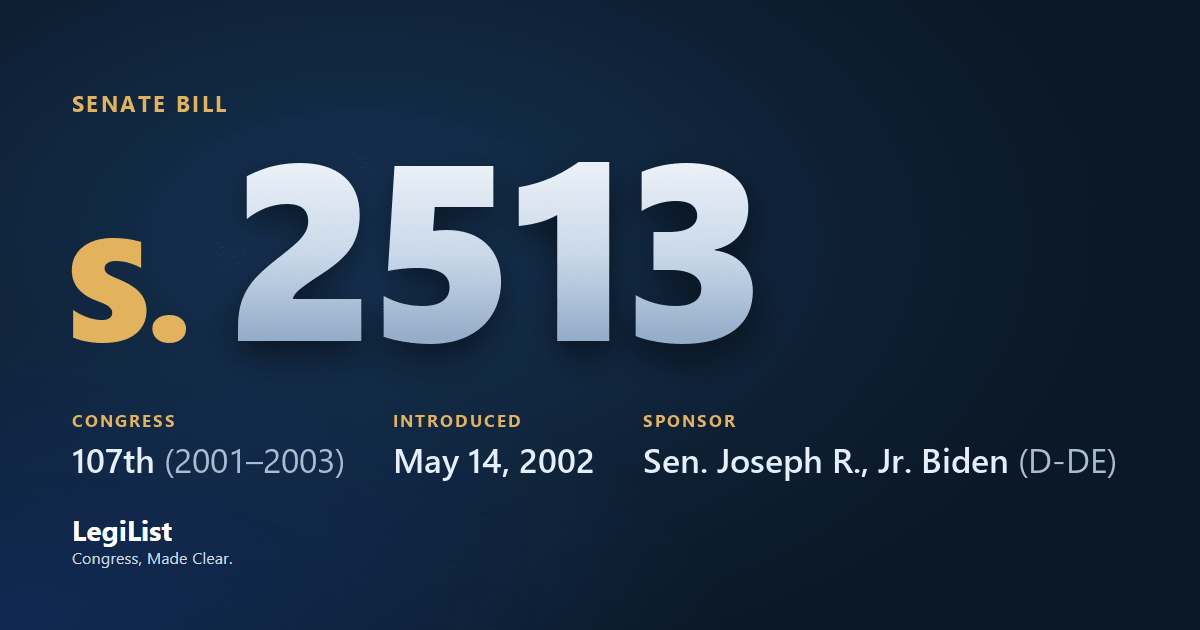
DNA Sexual Assault Justice Act of 2002
Latest action · Nov 4, 2002 By Senator Leahy from Committee on the Judiciary filed written report under authority of the order of the Senate of 10/17/2002. Report No. 107-334.
Progress
Where this bill reached, and when. A stage with no date was not reached; one that failed a vote and later carried shows the date it carried.
- IntroducedMay 14, 2002
- Passed SenateSep 12, 2002
- Passed HouseNot reached
- To the PresidentNot reached
- Became lawNot reached
Summary
(Sec. 3) Amends the DNA Analysis Backlog Elimination Act of 2000 to: (1) authorize grants to States to ensure that DNA testing and analysis of samples from rape kits and non-suspect cases are carried out in a timely manner; (2) reauthorize grants; (3) authorize local governments and Indian tribes to apply for and receive grants (but requires certification by local government applicants that they participate in a State laboratory system; assurances by States, local governments, and Indian tribes regarding implementation of a plan for forwarding all samples collected in sexual assault cases to a laboratory that meets quality assurance standards for testing; and certifications by such entities of compliance with regulations under this Act); (4) direct the Attorney General to give priority in awarding grants to a State or local governmental unit that has a significant rape kit or non-suspect case backlog; (5) authorize appropriations to the Federal Bureau of Investigation (FBI) for the collection and use of DNA identification information from certain Federal offenders; (6) expand the scope of DNA samples subject to privacy protections; and (7) set the penalty for use (currently, limited to disclosure) of a DNA sample or DNA analysis at $100,000 per offense (currently, up to $100,000).
(Sec. 7) Directs the Attorney General to review existing national, State, local, and tribal government protocols on the collection and processing of DNA evidence at crime scenes and to develop a recommended national protocol, including for crimes of rape and other sexual assault.
Amends the Victims of Trafficking and Violence Protection Act of 2000 to direct the Attorney General to recommend sexual assault forensic examination training for all emergency response personnel.
(Sec. 8) Directs the Attorney General to make grants to States, local governments, institutes of higher learning, Indian tribes, sexual assault examination programs, and State sexual assault coalitions to: (1) establish and maintain sexual assault examiner programs; (2) carry out sexual assault examiner training and certification; and (3) acquire or improve forensic equipment. Directs the Attorney General to give priority to proposed or existing programs for under-served populations.
(Sec. 9) Directs the Attorney General to make grants to States, local governments, institutes of higher learning, and Indian tribes to train: (1) law enforcement personnel and all other first responders at crime scenes in the handling of sexual assault cases and the collection and use of DNA samples for use as forensic evidence; (2) State and local prosecutors on the use of DNA samples for use as forensic evidence; and (3) law enforcement personnel to recognize, detect, report, and respond to drug-facilitated sexual assaults.
(Sec. 10) Amends: (1) the Federal criminal code and the Federal Rules of Criminal Procedure to authorize "John Doe" DNA indictments for sexual abuse (allows describing a person as an unknown individual who has a particular DNA profile if the identity of the accused or defendant is unknown); and (2) the DNA Identification Act of 1994 to authorize appropriations to the FBI to carry out a redesign of the Combined DNA Index System.
(Sec. 13) Amends the DNA Analysis Backlog Elimination Act to direct the Attorney General to establish procedures to limit access to, or use of, stored DNA samples or DNA analyses. Requires that such regulations: (1) limit use, dissemination, and re-dissemination of such information; (2) ensure accuracy, security, and confidentiality; (3) protect privacy rights; and (4) provide for timely removal and destruction of inaccurate information.
Cosponsors 20
Members who signed on, in the order they did. Signatures ran from May 14, 2002 to Sep 17, 2002; 1 is an original cosponsor, there from the day it was introduced.
| Seat | Cosponsor | Signed on | |
|---|---|---|---|
| D-NY | Hillary Rodham Clinton | Original | May 14, 2002 |
| D-WA | Maria Cantwell | May 15, 2002 | |
| D-DE | Thomas R. Carper | May 22, 2002 | |
| D-NY | Charles E. Schumer | Jun 24, 2002 | |
| D-CA | Dianne Feinstein | Jun 27, 2002 | |
| R-UT | Orrin G. Hatch | Jun 27, 2002 | |
| D-VT | Patrick J. Leahy | Jun 27, 2002 | |
| D-IL | Richard J. Durbin | Jun 27, 2002 | |
| R-VT | James M. Jeffords | Jul 12, 2002 | |
| D-PA | Arlen Specter | Jul 17, 2002 | |
| D-MO | Jean Carnahan | Jul 30, 2002 | |
| R-VA | John Warner | Jul 30, 2002 | |
| R-ID | Mike Crapo | Jul 30, 2002 | |
| D-WA | Patty Murray | Jul 30, 2002 | |
| D-SD | Tim Johnson | Jul 31, 2002 |
Committees 2
Where it was sent and what each committee and subcommittee did with it, in order.
| Chamber | Committee | What it did |
|---|---|---|
| Senate | Judiciary Committee | Referred May 14, 2002Markup Jul 18, 2002Reported Jul 18, 2002 |
| House | Judiciary Committee | Referred Sep 13, 2002 |
| Crime and Federal Government Surveillance Subcommittee | Referred Oct 7, 2002 |
Actions 12
Everything that happened, newest first.
- Nov 4, 2002By Senator Leahy from Committee on the Judiciary filed written report under authority of the order of the Senate of 10/17/2002. Report No. 107-334.
- Oct 7, 2002Referred to the Subcommittee on Crime, Terrorism, and Homeland Security.
- Sep 13, 2002Message on Senate action sent to the House.
- Sep 13, 2002Received in the House.
- Sep 13, 2002Referred to the House Committee on the Judiciary.
In the Congressional Record 2
Days the Record’s own index lists this bill, newest first, with the pages and the members it names. Pages starting H are the House, S the Senate, E Extensions of Remarks.
| Where | In the Record | Members | Date |
|---|---|---|---|
| Senate | Debate and remarks S8577, S8580Text printed S8577–S8580 | Harry Reid D-NV | Sep 12, 2002 |
| Senate | Debate and remarks S4331–S4333 | Joseph R. Biden Jr. D-DE | May 14, 2002 |
Research
What has been written about this bill: committee reports, cost estimates, the sponsor’s authority statement, printed hearings and the Congressional Research Service’s work.
Committee report
Congressional Budget Office cost estimates 2
- Aug 9, 2002S. 2513, DNA Sexual Assault Justice Act of 2002<p>Cost estimate for the bill as reported by the Senate Committee on the Judiciary on July 18, 2002</p>
- Aug 9, 2002S. 2513, DNA Sexual Assault Justice Act of 2002Cost estimate for the bill as reported by the Senate Committee on the Judiciary on July 18, 2002
Titles 4
Every title it has carried, official and short, at each stage.
- Official Title as Introduced
- A bill to asses the extent of the backlog in DNA analysis of rape kit samples, and to improve investigation and prosecution of sexual assault cases with DNA evidence.
- Short Titles as Introduced
- DNA Sexual Assault Justice Act of 2002
- Short Titles as Reported to Senate
- DNA Sexual Assault Justice Act of 2002
- Short Titles as Passed Senate
- DNA Sexual Assault Justice Act of 2002
Subjects
Assigned by the Library of Congress. Policy area: Crime and Law Enforcement.
- Administrative procedure
- Arrest
- Authorization
- Civil Rights and Liberties, Minority Issues
- Congress
- Congressional reporting requirements
- Crime and Law Enforcement
- Criminal investigation
- Criminal justice information systems
- Data banks
- Department of Justice
- DNA fingerprints
- Drug abuse
- Drugs and crime
- Economics and Public Finance
- Education
- Emergency Management
- Emergency medical personnel
- Employee training
- Evidence (Law)
- Federal aid to higher education
- Federal aid to law enforcement
- Federal aid to nursing education
- Fines (Penalties)
- Forensic medicine
- Government Operations and Politics
- Health
- Higher education
- Identification of criminals
- Indian law enforcement
- Indictments
- Labor and Employment
- Laboratories
- Law
- Limitation of actions
- Medical education
- Medical laboratories
- Minorities
- Nurses
- Police training
- Prosecution
- Public prosecutors
- Rape
- Rape victim services
- Recidivists
- Right of privacy
- Science, Technology, Communications
- Scientific instruments and apparatus
- Sex crimes
- Standards
- Surveys
- Victims of crimes
- Women
Text 4
Each version as it was printed, newest first.
- Sep 13, 2002Referred in House
- Sep 12, 2002Engrossed in Senate
- Jul 18, 2002Reported to Senate
- May 14, 2002Introduced in Senate
Support LegiList
This page is free, carries no paywall, and is built and maintained by one person. If the record here is useful to you, a few dollars keeps it going.
Everything here is as published by Congress: the summary is the Congressional Research Service's, the action wording is the clerks', and the subjects are the Library of Congress's. How far it got is read from the actions themselves, taking the most recent one of each kind, so a bill that failed a vote and later passed is shown as having passed. Records come from this bill on Congress.gov and govinfo.gov; cost estimates are the Congressional Budget Office's, and the hearings are the printed hearings GovInfo publishes, which can appear months after the hearing.