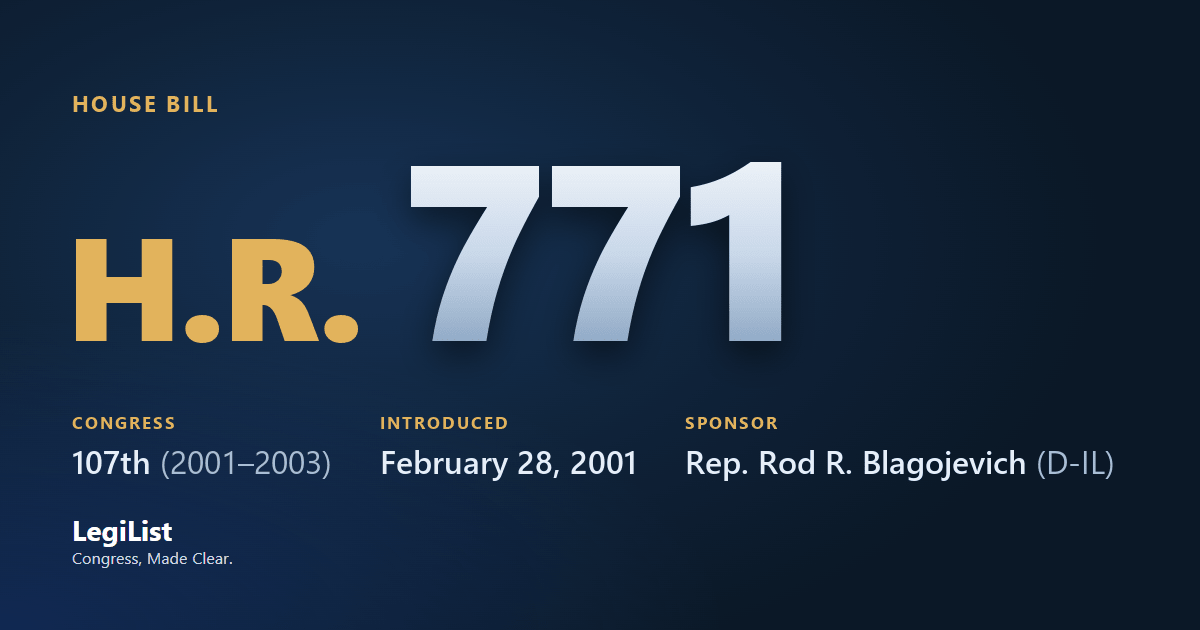
Schools for the 21st Century Act
Latest action · Apr 20, 2001 Referred to the Subcommittee on Education Reform.
Progress
Where this bill reached, and when. A stage with no date was not reached; one that failed a vote and later carried shows the date it carried.
- IntroducedFeb 28, 2001
- Passed HouseNot reached
- Passed SenateNot reached
- To the PresidentNot reached
- Became lawNot reached
Summary
Amends the Internal Revenue Code to establish a limited tax credit for holders of qualified public school modernization bonds. Repeals a restriction on zone academy bond holders.
Amends the General Education Provisions Act to apply certain labor standards on construction projects financed under such public school modernization bond program and specified zone academy bond provisions.
Amends the Workforce Investment Act of 1998 to establish provisions concerning local employment and training activities related to the construction or reconstruction of public school facilities.
Cosponsors 9
Members who signed on, in the order they did. All signed on Mar 27, 2001.
| Seat | Cosponsor | Signed on | |
|---|---|---|---|
| R-NJ | Christopher H. Smith | Mar 27, 2001 | |
| D-MI | David E. Bonior | Mar 27, 2001 | |
| D-CA | Joe Baca | Mar 27, 2001 | |
| D-CA | Juanita Millender-McDonald | Mar 27, 2001 | |
| D-IN | Julia Carson | Mar 27, 2001 | |
| D-VA | Rick Boucher | Mar 27, 2001 | |
| D-OH | Stephanie Tubbs Jones | Mar 27, 2001 | |
| D-CA | Susan A. Davis | Mar 27, 2001 | |
| D-IL | William O. Lipinski | Mar 27, 2001 |
Committees 2
Where it was sent and what each committee and subcommittee did with it, in order.
| Chamber | Committee | What it did |
|---|---|---|
| House | Education and Workforce Committee | Referred Feb 28, 2001 |
| Workforce Protections Subcommittee | Referred Apr 20, 2001 | |
| Higher Education and Workforce Development Subcommittee | Referred Apr 20, 2001 | |
| Early Childhood, Elementary, and Secondary Education Subcommittee | Referred Apr 20, 2001 | |
| House | Ways and Means Committee | Referred Feb 28, 2001 |
Actions 5
Everything that happened, newest first.
- Apr 20, 2001Referred to the Subcommittee on Workforce Protections.
- Apr 20, 2001Referred to the Subcommittee on 21st Century Competitiveness.
- Apr 20, 2001Referred to the Subcommittee on Education Reform.
- Feb 28, 2001Introduced in House
- Feb 28, 2001Referred to the Committee on Education and the Workforce, and in addition to the Committee on Ways and Means, for a period to be subsequently determined by the Speaker, in each case for consideration of such provisions as fall within the jurisdiction of the committee concerned.
Titles 3
Every title it has carried, official and short, at each stage.
- Official Title as Introduced
- To amend the Elementary and Secondary Education Act of 1965 to authorize grants to States for the construction, repair, renovation, and modernization of public school facilities, to amend the Internal Revenue Code of 1986 to expand the tax incentives for such undertakings, and for other purposes.
- Short Titles as Introduced
- Schools for the 21st Century Act
- Federal School Construction Act of 2001
Subjects
Assigned by the Library of Congress. Policy area: Education.
- Alaska
- Authorization
- Building construction
- Charter schools
- Commerce
- Construction costs
- Construction industries
- Construction workers
- Department of Education
- Depressed areas
- Economics and Public Finance
- Education
- Education of disadvantaged children
- Educational finance
- Educational surveys
- Elementary and secondary education
- Elementary schools
- Employee selection
- Federal aid to education
- Federal aid to Indians
- Finance and Financial Sector
- Government contractors
- Government Operations and Politics
- Government paperwork
- Government procurement
- High schools
- Income tax
- Indian education
- Indigenous peoples
- Infrastructure
- Interest
- Labor and Employment
- Maintenance and repair
- Minorities
- Public schools
- Residence requirements
- School buildings
- School districts
- School planning
- Skilled labor
- Social Welfare
- Student enrollment
- Tax credits
- Tax returns
- Tax-exempt securities
- Taxation
- Wages
Text 1
Each version as it was printed, newest first.
- Feb 28, 2001Introduced in House
Everything here is as published by Congress: the summary is the Congressional Research Service's, the action wording is the clerks', and the subjects are the Library of Congress's. How far it got is read from the actions themselves, taking the most recent one of each kind, so a bill that failed a vote and later passed is shown as having passed. Records come from this bill on Congress.gov and govinfo.gov; cost estimates are the Congressional Budget Office's, and the hearings are the printed hearings GovInfo publishes, which can appear months after the hearing.