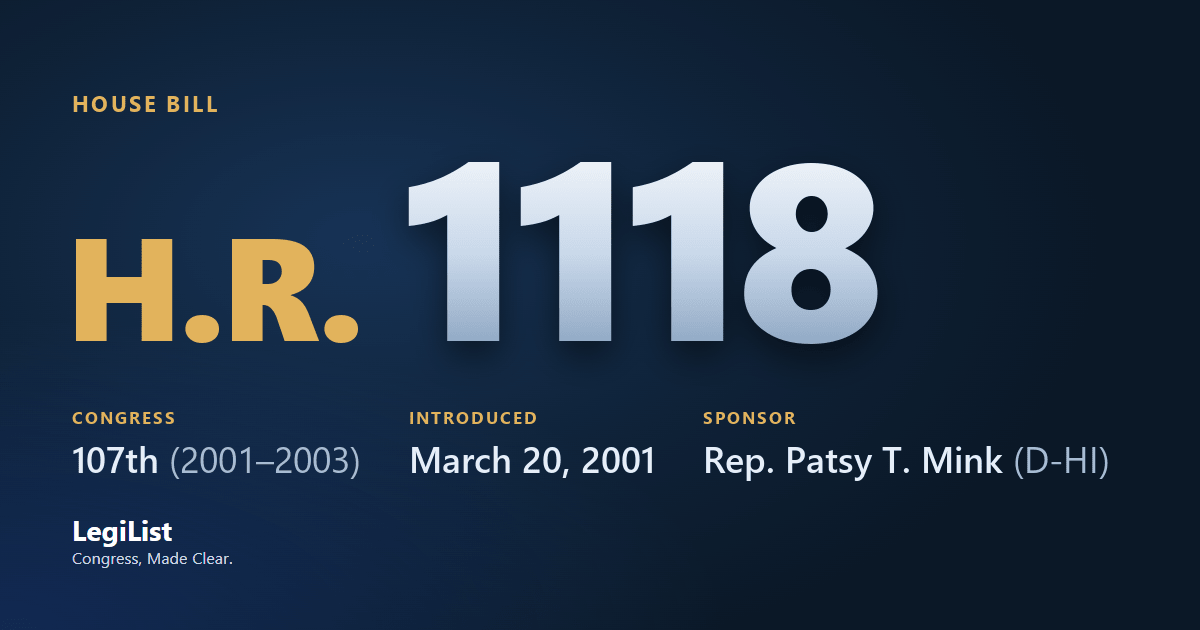
Comprehensive Early Childhood Education Act of 2001
Latest action · May 8, 2001 Referred to the Subcommittee on Education Reform.
Progress
Where this bill reached, and when. A stage with no date was not reached; one that failed a vote and later carried shows the date it carried.
- IntroducedMar 20, 2001
- Passed HouseNot reached
- Passed SenateNot reached
- To the PresidentNot reached
- Became lawNot reached
Summary
Directs the Secretary of Education to provide for: (1) financial assistance for comprehensive early childhood education programs to prime sponsors and other public and private nonprofit entities; (2) technical assistance, planning, and evaluation; (3) Federal standards for early childhood education, and development of a uniform minimum code for licensing facilities; (4) research and demonstration projects; and (5) procedures to assure that adequate nutrition services will be provided in early childhood education programs under this Act.
Authorizes the Secretary to provide financial assistance for: (1) preservice and inservice professional and nonprofessional training of individuals, including volunteers, for employment in early childhood education programs, to be conducted by the program agencies or higher education institutions; and (2) establishing and operating model early childhood education programs for the children of civilian Federal employees.
Establishes a Special Committee on Federal Standards for Early Childhood Education. Sets forth requirements for early childhood education councils, special grants to States, use of public facilities for child development programs, and Federal share of program costs. Prohibits discrimination, political activities, sectarian instruction, medical or psychological examination or treatment requirements, or research or experimentation on children (other than routine testing) without parents' informed consent, under programs assisted by this Act.
Cosponsors 1
Members who signed on, in the order they did. All signed on Jun 28, 2001.
| Seat | Cosponsor | Signed on | |
|---|---|---|---|
| D-CA | Barbara Lee | Jun 28, 2001 |
Committees 1
Where it was sent and what each committee and subcommittee did with it, in order.
| Chamber | Committee | What it did |
|---|---|---|
| House | Education and Workforce Committee | Referred Mar 20, 2001 |
| Workforce Protections Subcommittee | Referred May 8, 2001 | |
| Early Childhood, Elementary, and Secondary Education Subcommittee | Referred May 8, 2001 |
Actions 5
Everything that happened, newest first.
- May 8, 2001Referred to the Subcommittee on Workforce Protections.
- May 8, 2001Referred to the Subcommittee on Education Reform.
- Mar 22, 2001Sponsor introductory remarks on measure. (CR H1097)
- Mar 20, 2001Introduced in House
- Mar 20, 2001Referred to the House Committee on Education and the Workforce.
In the Congressional Record 1
Days the Record’s own index lists this bill, newest first, with the pages and the members it names. Pages starting H are the House, S the Senate, E Extensions of Remarks.
| Where | In the Record | Members | Date |
|---|---|---|---|
| House | Debate and remarks H1097 | Patsy T. Mink D-HI | Mar 22, 2001 |
Titles 2
Every title it has carried, official and short, at each stage.
- Official Title as Introduced
- To establish comprehensive early childhood education programs, early childhood education staff development programs, model Federal Government early childhood education programs, and for other purposes.
- Short Titles as Introduced
- Comprehensive Early Childhood Education Act of 2001
Subjects
Assigned by the Library of Congress. Policy area: Education.
- Administrative procedure
- Administrative remedies
- Agriculture and Food
- Bilingual education
- Child development
- Child mental health services
- Child nutrition
- Collection of accounts
- Commerce
- Community and school
- Congress
- Congressional reporting requirements
- Construction costs
- Construction industries
- Construction workers
- Continuing education
- Day care
- Department of Education
- Disabled
- Disabled children
- Economics and Public Finance
- Education
- Education of disabled students
- Education of disadvantaged children
- Educational accountability
- Educational facilities
- Educational innovations
- Educational planning
- Educational research
- Elementary and secondary education
- Elementary education
- Executive reorganization
- Families
- Family planning and birth control
- Family services
- Federal advisory bodies
- Federal aid to child health services
- Federal aid to disability services
- Federal aid to education
- Federal aid to higher education
- Federal aid to maternal health services
- Federal employees
- Federal-state relations
- Fees
- Government contractors
- Government Operations and Politics
- Government paperwork
- Government publicity
- Hawaiians
- Head Start programs
- Health
- Higher education
- Indian children
- Indian education
- Job hunting
- Judicial review of administrative acts
- Kindergarten
- Labor and Employment
- Law
- Licenses
- Migrant education
- Minimum wages
- Minorities
- Minority education
- Multicultural education
- Nonprofit organizations
- Paraprofessional school personnel
- Parent and child
- Parent-school relationships
- Physical examinations
- Poor
- Poor children
- Preschool education
- Problem children
- Reprogramming of appropriated funds
- Research and development
- School buildings
- School districts
- School-age child care
- Science, Technology, Communications
- Single-parent families
- Social Welfare
- Special education
- Student aid
- Subcontractors
- Teacher education
- Teacher salaries
- Unemployed
- Volunteer workers in education
- Wages
- Women
- Working mothers
- Youth
Text 1
Each version as it was printed, newest first.
- Mar 20, 2001Introduced in House
Support LegiList
This page is free, carries no paywall, and is built and maintained by one person. If the record here is useful to you, a few dollars keeps it going.
Everything here is as published by Congress: the summary is the Congressional Research Service's, the action wording is the clerks', and the subjects are the Library of Congress's. How far it got is read from the actions themselves, taking the most recent one of each kind, so a bill that failed a vote and later passed is shown as having passed. Records come from this bill on Congress.gov and govinfo.gov; cost estimates are the Congressional Budget Office's, and the hearings are the printed hearings GovInfo publishes, which can appear months after the hearing.