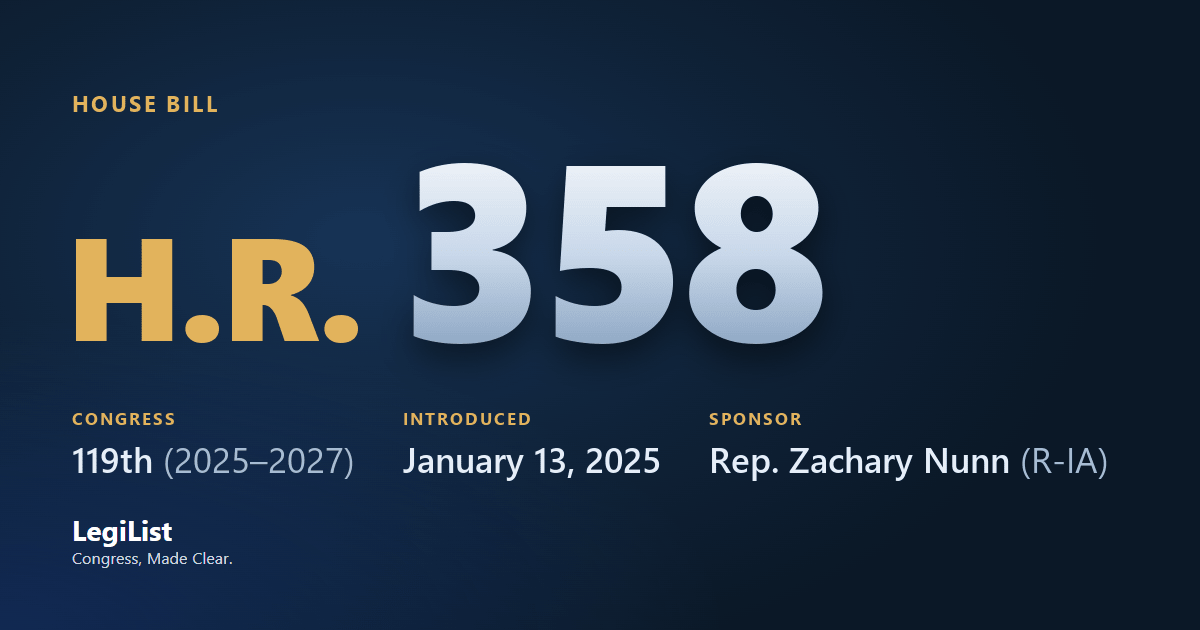
No Corruption in Government Act
Latest action · Jan 13, 2025 Referred to the Committee on House Administration, and in addition to the Committees on Ways and Means, the Judiciary, and Oversight and Government Reform, for a period to be subsequently determined by the Speaker, in each case for consideration of such provisions as fall within the jurisdiction of the committee concerned.
Progress
Where this bill reached, and when. A stage with no date was not reached; one that failed a vote and later carried shows the date it carried.
- IntroducedJan 13, 2025
- Passed HouseNot reached
- Passed SenateNot reached
- To the PresidentNot reached
- Became lawNot reached
Summary
No Corruption in Government Act
This bill lengthens the limitations on former Congress Members' contact with the legislative branch and restricts certain financial transactions by Members and their spouses.
Specifically, the bill lengthens the cooling off period that prohibits former Members from contacting Members, officers, or employees of the House or Senate on behalf of a third party. During this post-employment waiting period, a former Member may not communicate with the intent to influence the official actions of a Member, officer, or employee of the House of Representatives or Senate. The bill lengthens the waiting period from one to three years after a Member of the House leaves office and from two to six years after a Senator leaves office.
Next, the bill prohibits Members of Congress and their spouses from holding, buying, or selling financial instruments such as stocks, securities futures, and commodities while the Member holds office. However, covered financial instruments may be held in a qualified blind trust. A Member or spouse who violates this provision must disgorge any resulting profits, may not take a related financial loss as an income tax deduction, and may be fined up to $50,000. The supervising ethics office of each chamber must audit Members' compliance with these requirements every two years.
Additionally, the bill eliminates automatic annual increases to Members' pay beginning in the 120th Congress.
Cosponsors 2
Members who signed on, in the order they did. Signatures ran from Jan 13, 2025 to Jan 22, 2025; 1 is an original cosponsor, there from the day it was introduced.
| Seat | Cosponsor | Signed on | |
|---|---|---|---|
| D-WA | Marie Gluesenkamp Perez | Original | Jan 13, 2025 |
| D-NC | Donald G. Davis | Jan 22, 2025 |
Committees 4
Where it was sent and what each committee and subcommittee did with it, in order.
| Chamber | Committee | What it did |
|---|---|---|
| House | Committee on House Administration | Referred Jan 13, 2025 |
| House | Ways and Means Committee | Referred Jan 13, 2025 |
| House | Judiciary Committee | Referred Jan 13, 2025 |
| House | Oversight and Government Reform Committee | Referred Jan 13, 2025 |
Actions 2
Everything that happened, newest first.
- Jan 13, 2025Introduced in House
- Jan 13, 2025Referred to the Committee on House Administration, and in addition to the Committees on Ways and Means, the Judiciary, and Oversight and Government Reform, for a period to be subsequently determined by the Speaker, in each case for consideration of such provisions as fall within the jurisdiction of the committee concerned.
In the Congressional Record 1
Days the Record’s own index lists this bill, newest first, with the pages and the members it names. Pages starting H are the House, S the Senate, E Extensions of Remarks.
| Where | In the Record | Members | Date |
|---|---|---|---|
| House | Debate and remarks H2082 | Zachary Nunn R-IA | May 15, 2025 |
Research
What has been written about this bill: committee reports, cost estimates, the sponsor’s authority statement, printed hearings and the Congressional Research Service’s work.
Constitutional authority
The sponsor’s statement, as printed in the Congressional Record, vol. 171, no. 6, January 13, 2025, page H112.
Printed hearings 1
Hearings whose printed record names this bill, newest first: hearings on it, and wider hearings where it came up.
| Number | Hearing | Committee | Held |
|---|---|---|---|
| 119-10 | MEMBER DAY17 pages | Small Business Committee | May 6, 2025 |
CRS reports 3
Congressional Research Service work that CRS links to this bill or the law it became, newest first.
Cite it 3
Products on other subjects that cite it, usually among other measures.
| Product | Title | Kind | Published |
|---|---|---|---|
| R48641 | Proposals to Limit Member of Congress Financial Activities: Analysis of Introduced Legislation in the 119th Congress | Report | Nov 19, 2026 |
| 97-1011 | Salaries of Members of Congress: Recent Actions and Historical Tables | Report | Nov 18, 2026 |
| TE10119 | Taking Stock of the STOCK Act | Testimony | Nov 19, 2025 |
Related bills 2
Companion bills and other measures the record links to this one.
| Bill | Title | Relationship | Latest action |
|---|---|---|---|
| S 86 | A bill to repeal the provision of law that provides automatic pay adjustments for Members of Congress. | Related bill | Jan 14, 2025 |
| HR 7628 | To repeal the provision of law that provides automatic pay adjustments for Members of Congress. | Related bill | Feb 20, 2026 |
Titles 3
Every title it has carried, official and short, at each stage.
- Official Title as Introduced
- To amend title 5, United States Code, to prohibit insider trading by Members of Congress and their spouses, to amend title 18, United States Code, to extend the length of the post-employment ban on lobbying by Members of Congress, to repeal the automatic adjustment in the pay of Members of Congress, and for other purposes.
- Short Title(s) as Introduced
- No Corruption in Government Act
- Short Title(s) as Introduced for portions of this bill
- Prohibit Insider Trading Act
Subjects
Assigned by the Library of Congress. Policy area: Congress.
Text 1
Each version as it was printed, newest first.
- Jan 13, 2025Introduced in House
Support LegiList
This page is free, carries no paywall, and is built and maintained by one person. If the record here is useful to you, a few dollars keeps it going.
Everything here is as published by Congress: the summary is the Congressional Research Service's, the action wording is the clerks', and the subjects are the Library of Congress's. How far it got is read from the actions themselves, taking the most recent one of each kind, so a bill that failed a vote and later passed is shown as having passed. Records come from this bill on Congress.gov and govinfo.gov; cost estimates are the Congressional Budget Office's, and the hearings are the printed hearings GovInfo publishes, which can appear months after the hearing.