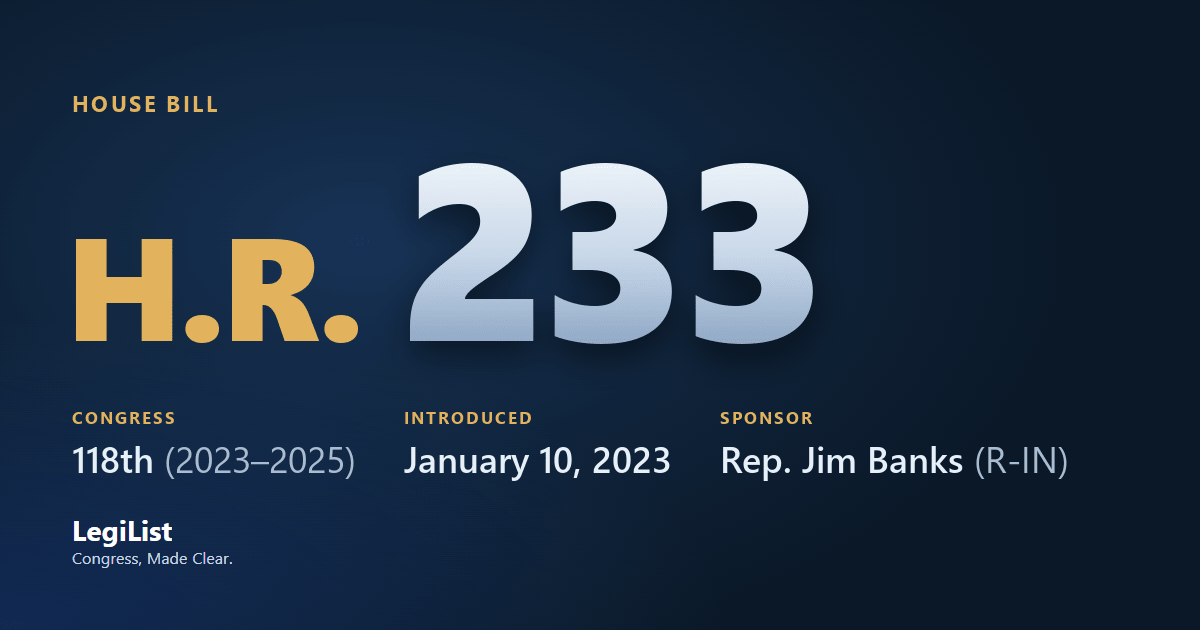
Qualified Immunity Act of 2023
Latest action · Jan 10, 2023 Referred to the House Committee on the Judiciary.
Progress
Where this bill reached, and when. A stage with no date was not reached; one that failed a vote and later carried shows the date it carried.
- IntroducedJan 10, 2023
- Passed HouseNot reached
- Passed SenateNot reached
- To the PresidentNot reached
- Became lawNot reached
Summary
Qualified Immunity Act of 2023
This bill provides statutory authority for qualified immunity for law enforcement officers in civil cases involving constitutional violations.
Current law provides a statutory civil cause of action against state and local government actors (e.g., law enforcement officers) for violations of constitutional rights, also known as Section 1983 lawsuits. The Supreme Court has also found an implied cause of action against federal law enforcement officers in certain situations (e.g., Fourth Amendment violations), also known as Bivens lawsuits. However, under the judicial doctrine of qualified immunity, government officials performing discretionary duties are generally shielded from civil liability, unless their actions violate clearly established rights of which a reasonable person would have known.
The bill provides statutory authority for these principles with respect to law enforcement officers. Specifically, under the bill, law enforcement officers are entitled to qualified immunity if (1) at the time of the alleged violation, the constitutional right at issue was not clearly established or the state of the law was not sufficiently clear for every reasonable officer to know that the conduct was unconstitutional; or (2) a court has held that the specific conduct at issue is constitutional.
The bill applies to federal, state, and local law enforcement officers. It also specifies that law enforcement agencies and local governments may not be held liable if their officers are entitled to qualified immunity.
Cosponsors 40
Members who signed on, in the order they did. Signatures ran from Jan 11, 2023 to Sep 6, 2024.
| Seat | Cosponsor | Signed on | |
|---|---|---|---|
| R-FL | Bill Posey | Jan 11, 2023 | |
| R-NJ | Christopher H. Smith | Jan 11, 2023 | |
| R-NY | Claudia Tenney | Jan 11, 2023 | |
| R-PA | Daniel Meuser | Jan 11, 2023 | |
| R-CO | Lauren Boebert | Jan 11, 2023 | |
| R-IL | Mary E. Miller | Jan 11, 2023 | |
| R-TX | Beth Van Duyne | Jan 12, 2023 | |
| R-CA | Doug LaMalfa | Jan 12, 2023 | |
| R-MS | Michael Guest | Jan 12, 2023 | |
| R-PA | Mike Kelly | Jan 12, 2023 | |
| R-GA | Andrew S. Clyde | Jan 24, 2023 | |
| R-KY | Andy Barr | Jan 24, 2023 | |
| R-TN | David Kustoff | Jan 24, 2023 | |
| R-IN | Greg Pence | Jan 24, 2023 | |
| R-IN | James R. Baird | Jan 24, 2023 | |
| R-TX | John R. Carter | Jan 24, 2023 | |
| R-OH | Mike Carey | Jan 24, 2023 | |
| R-NE | Don Bacon | Jan 25, 2023 | |
| R-AZ | Debbie Lesko | Feb 14, 2023 | |
| R-NC | Richard Hudson | Mar 14, 2023 | |
| R-CO | Doug Lamborn | Mar 28, 2023 | |
| R-NC | Dan Bishop | Jun 12, 2023 | |
| R-VA | Bob Good | Jun 13, 2023 | |
| R-TX | Tony Gonzales | Oct 2, 2023 | |
| R-AL | Barry Moore | Feb 15, 2024 | |
| R-IN | Larry Bucshon | Feb 15, 2024 | |
| R-NC | Virginia Foxx | Feb 28, 2024 | |
| R-GA | Austin Scott | Mar 5, 2024 | |
| R-MN | Brad Finstad | Mar 11, 2024 | |
| R-FL | Kat Cammack | Mar 13, 2024 | |
| R-NY | Nicole Malliotakis | Mar 13, 2024 | |
| R-WI | Glenn Grothman | Apr 10, 2024 | |
| R-IN | Victoria Spartz | Apr 12, 2024 | |
| R-NJ | Thomas H. Kean, Jr. | May 10, 2024 | |
| R-NY | Andrew R. Garbarino | May 24, 2024 | |
| R-NY | Michael Lawler | Jun 11, 2024 | |
| R-NY | Nicholas A. Langworthy | Jun 14, 2024 | |
| R-WI | Derrick Van Orden | Jun 25, 2024 | |
| R-WV | Carol D. Miller | Jun 27, 2024 | |
| R-MD | Andy Harris | Sep 6, 2024 |
Committees 1
Where it was sent and what each committee and subcommittee did with it, in order.
| Chamber | Committee | What it did |
|---|---|---|
| House | Judiciary Committee | Referred Jan 10, 2023 |
Actions 2
Everything that happened, newest first.
- Jan 10, 2023Introduced in House
- Jan 10, 2023Referred to the House Committee on the Judiciary.
In the Congressional Record 1
Days the Record’s own index lists this bill, newest first, with the pages and the members it names. Pages starting H are the House, S the Senate, E Extensions of Remarks.
Research
What has been written about this bill: committee reports, cost estimates, the sponsor’s authority statement, printed hearings and the Congressional Research Service’s work.
Constitutional authority
The sponsor’s statement, as printed in the Congressional Record, vol. 169, no. 8, January 10, 2023, page H151.
Titles 2
Every title it has carried, official and short, at each stage.
- Official Title as Introduced
- To amend the Revised Statutes to codify the defense of qualified immunity in the case of any action under section 1979, and for other purposes.
- Short Title(s) as Introduced
- Qualified Immunity Act of 2023
Subjects
Assigned by the Library of Congress. Policy area: Civil Rights and Liberties, Minority Issues.
Text 1
Each version as it was printed, newest first.
- Jan 10, 2023Introduced in House
Support LegiList
This page is free, carries no paywall, and is built and maintained by one person. If the record here is useful to you, a few dollars keeps it going.
Everything here is as published by Congress: the summary is the Congressional Research Service's, the action wording is the clerks', and the subjects are the Library of Congress's. How far it got is read from the actions themselves, taking the most recent one of each kind, so a bill that failed a vote and later passed is shown as having passed. Records come from this bill on Congress.gov and govinfo.gov; cost estimates are the Congressional Budget Office's, and the hearings are the printed hearings GovInfo publishes, which can appear months after the hearing.