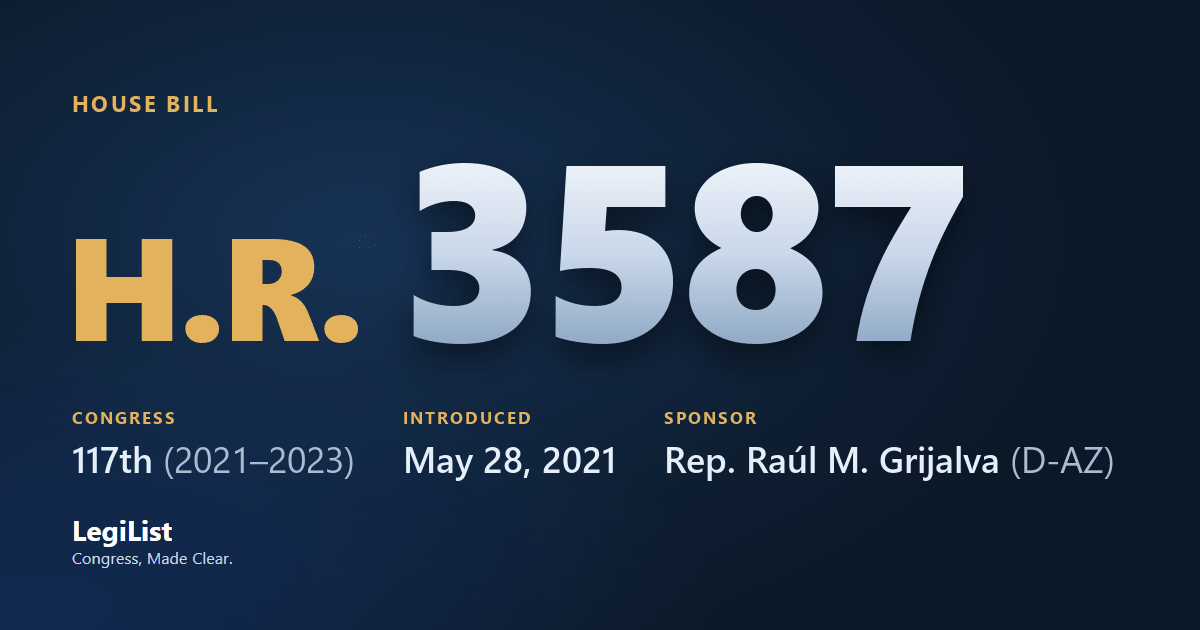
RESPECT Act
Latest action · Nov 1, 2022 Referred to the Subcommittee on Antitrust, Commercial, and Administrative Law.
Progress
Where this bill reached, and when. A stage with no date was not reached; one that failed a vote and later carried shows the date it carried.
- IntroducedMay 28, 2021
- Passed HouseNot reached
- Passed SenateNot reached
- To the PresidentNot reached
- Became lawNot reached
Summary
Requirements, Expectations, and Standard Procedures for Effective Consultation with Tribes Act or the RESPECT Act
This bill establishes tribal consultation procedures for federal agencies.
Specifically, the bill requires federal agencies to consult with tribal governments (1) before undertaking any proposed federal activity or finalizing any federal regulatory action that may have a tribal impact, and (2) for all activities that would affect any part of federal land sharing a border with Indian land. Tribal impact refers to any federal action that may have an impact on tribal governments, including tribal cultural practices and tribal treaty-protected rights.
Agencies must prepare tribal impact statements to identify potential tribal impacts of a proposed activity or action. Agencies must also make a good faith effort to identify areas that contain sacred sites important to tribal governments.
The bill further outlines consultation requirements, including outreach and meeting arrangements. In general, the consultation shall conclude only upon the execution of a memorandum of agreement between the agency and the tribal government or the members of a designated tribal leader task force.
Next, the bill requires agencies to take certain actions during the decision stage for a proposed activity (e.g., public comment) and for a regulatory action.
Agencies must recognize and respect tribal self-government and sovereignty and grant tribal governments maximum discretion in the administration of federal statutes and regulations.
Tribal governments may seek judicial review of a determination of an agency under this bill if the tribal government has exhausted all other administrative remedies.
Cosponsors 27
Members who signed on, in the order they did. Signatures ran from May 28, 2021 to Nov 29, 2022; 8 are original cosponsors, there from the day it was introduced.
| Seat | Cosponsor | Signed on | |
|---|---|---|---|
| D-CA | Alan S. Lowenthal | Original | May 28, 2021 |
| D-FL | Darren Soto | Original | May 28, 2021 |
| D-CA | Grace F. Napolitano | Original | May 28, 2021 |
| D-CA | Jared Huffman | Original | May 28, 2021 |
| D-IL | Jesús G. "Chuy" García | Original | May 28, 2021 |
| D-MI | Rashida Tlaib | Original | May 28, 2021 |
| D-TN | Steve Cohen | Original | May 28, 2021 |
| D-NM | Teresa Leger Fernandez | Original | May 28, 2021 |
| D-DC | Eleanor Holmes Norton | Jun 4, 2021 | |
| D-CA | Mike Levin | Jun 4, 2021 | |
| D-OR | Suzanne Bonamici | Jun 11, 2021 | |
| D-MN | Betty McCollum | Jun 22, 2021 | |
| D-NY | Mondaire Jones | Jun 22, 2021 | |
| D-OR | Earl Blumenauer | Jun 25, 2021 | |
| D-CA | Mark Takano | Jul 19, 2021 | |
| D-NV | Dina Titus | Aug 24, 2021 | |
| D-CA | Raul Ruiz | Aug 24, 2021 | |
| D-NM | Melanie A. Stansbury | Oct 20, 2021 | |
| D-NY | Alexandria Ocasio-Cortez | Apr 5, 2022 | |
| D-MA | James P. McGovern | Apr 5, 2022 | |
| D-CO | Joe Neguse | Apr 5, 2022 | |
| D-CA | Juan Vargas | Apr 5, 2022 | |
| D-CA | Julia Brownley | Apr 5, 2022 | |
| D-MA | Lori Trahan | Apr 5, 2022 | |
| D-CA | Nanette Diaz Barragán | Apr 5, 2022 | |
| D-AZ | Ruben Gallego | Apr 5, 2022 | |
| D-AK | Mary Sattler Peltola | Nov 29, 2022 |
Committees 2
Where it was sent and what each committee and subcommittee did with it, in order.
| Chamber | Committee | What it did |
|---|---|---|
| House | Natural Resources Committee | Referred May 28, 2021 |
| Indian and Insular Affairs Subcommittee | Hearings May 20, 2021Referred Jun 28, 2021 | |
| House | Judiciary Committee | Referred May 28, 2021 |
| Administrative State, Regulatory Reform, and Antitrust Subcommittee | Referred Nov 1, 2022 |
Actions 5
Everything that happened, newest first.
- Nov 1, 2022Referred to the Subcommittee on Antitrust, Commercial, and Administrative Law.
- Jun 28, 2021Referred to the Subcommittee for Indigenous Peoples of the United States.
- May 28, 2021Introduced in House
- May 28, 2021Referred to the Committee on the Judiciary, and in addition to the Committee on Natural Resources, for a period to be subsequently determined by the Speaker, in each case for consideration of such provisions as fall within the jurisdiction of the committee concerned.
- May 20, 2021Hearings Held by the Subcommittee for Indigenous Peoples of the United States Prior to Introduction and Referral.
Research
What has been written about this bill: committee reports, cost estimates, the sponsor’s authority statement, printed hearings and the Congressional Research Service’s work.
Constitutional authority
The sponsor’s statement, as printed in the Congressional Record, vol. 167, no. 94, May 28, 2021, page H2679.
CRS reports 3
Congressional Research Service work that CRS links to this bill or the law it became, newest first.
Cite it 3
Products on other subjects that cite it, usually among other measures.
| Product | Title | Kind | Published |
|---|---|---|---|
| R48093 | Federal-Tribal Consultation: Background and Issues for Congress | Report | Sep 23, 2026 |
| R48452 | Indigenous Sacred Sites: Overview and Issues for Congress | Report | Mar 14, 2025 |
| R48317 | Indigenous Knowledge and Data: Overview and Issues for Congress | Report | Dec 20, 2024 |
Titles 3
Every title it has carried, official and short, at each stage.
- Official Title as Introduced
- To prescribe procedures for effective consultation and coordination by Federal agencies with federally recognized Tribal Governments regarding Federal Government actions that impact Tribal lands and interests to ensure that meaningful Tribal input is an integral part of the Federal decision-making process.
- Short Title(s) as Introduced
- Requirements, Expectations, and Standard Procedures for Effective Consultation with Tribes Act
- RESPECT Act
Subjects
Assigned by the Library of Congress. Policy area: Native Americans.
Text 1
Each version as it was printed, newest first.
- May 28, 2021Introduced in House
Everything here is as published by Congress: the summary is the Congressional Research Service's, the action wording is the clerks', and the subjects are the Library of Congress's. How far it got is read from the actions themselves, taking the most recent one of each kind, so a bill that failed a vote and later passed is shown as having passed. Records come from this bill on Congress.gov and govinfo.gov; cost estimates are the Congressional Budget Office's, and the hearings are the printed hearings GovInfo publishes, which can appear months after the hearing.