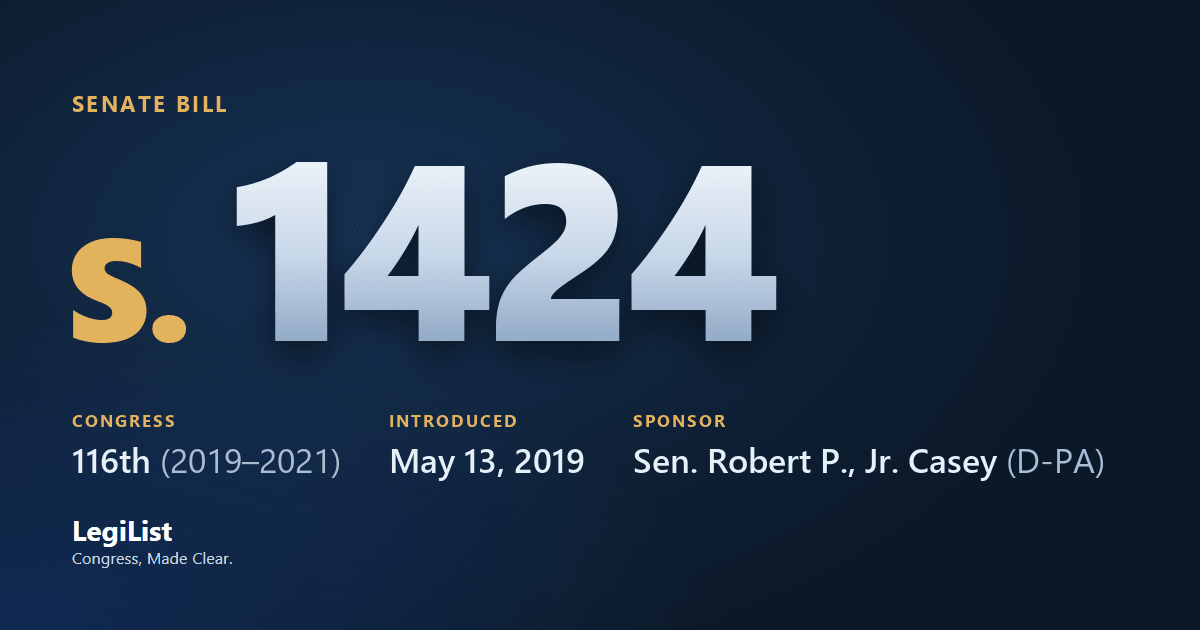
MORE Savings Act
Latest action · May 13, 2019 Read twice and referred to the Committee on Finance.
Progress
Where this bill reached, and when. A stage with no date was not reached; one that failed a vote and later carried shows the date it carried.
- IntroducedMay 13, 2019
- Passed SenateNot reached
- Passed HouseNot reached
- To the PresidentNot reached
- Became lawNot reached
Summary
Maximizing Opioid Recovery Emergency Savings Act or the MORE Savings Act
This bill modifies coverage of opioid treatments and recovery support services under Medicare, Medicaid, and private health insurance.
Specifically, the bill requires the Center for Medicare and Medicaid Innovation to test a model in which specified opioid treatments and recovery support services are provided under Medicare without cost-sharing (e.g., coinsurance, copayments, and deductibles).
The bill also allows state Medicaid programs to cover recovery support services as part of medication-assisted treatment (MAT) and increases the applicable Federal Medical Assistance Percentage for MAT.
Private health insurers must also cover specified opioid treatments and MAT-associated recovery support services without cost-sharing.
Cosponsors 4
Members who signed on, in the order they did. Signatures ran from May 13, 2019 to Jul 30, 2019, with 2 there on the day it was introduced.
| Seat | Cosponsor | Signed on | |
|---|---|---|---|
| D-MN | Amy Klobuchar | Original | May 13, 2019 |
| D-NH | Jeanne Shaheen | Original | May 13, 2019 |
| D-NH | Margaret Wood Hassan | May 16, 2019 | |
| D-CT | Richard Blumenthal | Jul 30, 2019 |
Actions 2
Everything that happened, newest first.
- May 13, 2019Introduced in Senate
- May 13, 2019Read twice and referred to the Committee on Finance.
Related bills 1
Companion bills and other measures the record links to this one.
| Bill | Title | Relationship | Latest action |
|---|---|---|---|
| HR 7627 | MORE Savings Act | Identical bill | Jul 16, 2020 |
Subjects
Assigned by the Library of Congress. Policy area: Health.
Text 1
Each version as it was printed, newest first.
- May 13, 2019Introduced in Senate
Everything here is as published by Congress: the summary is the Congressional Research Service's, the action wording is the clerks', and the subjects are the Library of Congress's. How far it got is read from the actions themselves, taking the most recent one of each kind, so a bill that failed a vote and later passed is shown as having passed. Records come from this bill on Congress.gov and govinfo.gov.