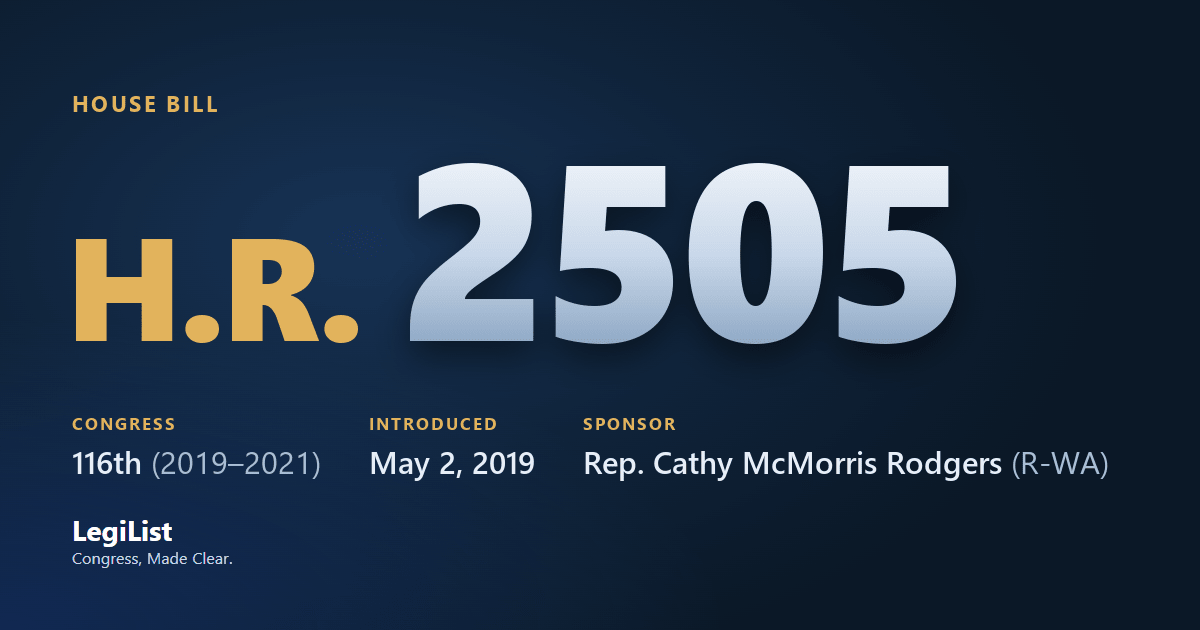
Unauthorized Spending Accountability Act of 2019
Latest action · Oct 30, 2019 Committee on Homeland Security and Governmental Affairs Subcommittee on Federal Spending Oversight and Emergency Management. Hearings held. With printed Hearing: S.Hrg. 116-132.
Progress
Where this bill reached, and when. A stage with no date was not reached; one that failed a vote and later carried shows the date it carried.
- IntroducedMay 2, 2019
- Passed HouseNot reached
- Passed SenateNot reached
- To the PresidentNot reached
- Became lawNot reached
Summary
Unauthorized Spending Accountability Act of 2019
This bill establishes a three-year budgetary level reduction schedule with respect to unauthorized programs funded through the annual appropriations process.
The term "budgetary level" refers to an allocation provided to the congressional appropriations committees under section 302(a) of the Congressional Budget Act of 1974 by a congressional budget resolution or a deeming resolution.
The schedule applies to programs included in the Congressional Budget Office's annual report listing programs that are funded through the appropriations process and have an authorization of appropriations that has either expired or will expire during the year.
For the first year after a program's authorization has expired, the bill requires the budgetary level to be reduced by 10% of the funds appropriated for the program in the expiring fiscal year. The bill then requires reductions of 15% in the second and third years before terminating the program at the end of the third unauthorized year.
Programs that are reauthorized during the three-year period are exempt from the budgetary level reductions if the reauthorization contains a sunset provision limiting the authorization of appropriations period to no more than three years.
The bill establishes the Spending and Accountability Commission to review all mandatory spending programs and submit to Congress a legislative proposal to establish an authorization cycle for discretionary spending programs. The commission may recommend legislation to replace the budgetary level reductions required by this bill with reductions in mandatory spending.
The commission's reauthorization schedule must limit reauthorizations to three years, include the budgetary level reductions established by this bill, and establish a mechanism for replacing the budgetary level reductions with reductions to mandatory spending programs.
The House of Representatives must consider the commission's proposal using specified expedited legislative procedures.
Cosponsors 27
Members who signed on, in the order they did. Signatures ran from May 2, 2019 to Jun 12, 2019; 16 are original cosponsors, there from the day it was introduced.
| Seat | Cosponsor | Signed on | |
|---|---|---|---|
| R-TX | Bill Flores | Original | May 2, 2019 |
| R-AL | Bradley Byrne | Original | May 2, 2019 |
| R-UT | Chris Stewart | Original | May 2, 2019 |
| R-AL | Gary J. Palmer | Original | May 2, 2019 |
| R-UT | John R. Curtis | Original | May 2, 2019 |
| R-TX | John Ratcliffe | Original | May 2, 2019 |
| R-TX | Lance Gooden | Original | May 2, 2019 |
| R-NC | Mark Meadows | Original | May 2, 2019 |
| R-NC | Mark Walker | Original | May 2, 2019 |
| R-FL | Matt Gaetz | Original | May 2, 2019 |
| R-TX | Michael C. Burgess | Original | May 2, 2019 |
| R-SC | Ralph Norman | Original | May 2, 2019 |
| R-NC | Richard Hudson | Original | May 2, 2019 |
| R-UT | Rob Bishop | Original | May 2, 2019 |
| R-NC | Ted Budd | Original | May 2, 2019 |
Withdrew 4 Ann Kirkpatrick D-AZ Oct 31, 2019·Bruce Westerman R-AR Oct 31, 2019·Peter Welch D-VT Oct 31, 2019·Xochitl Torres Small D-NM Oct 31, 2019
Committees 4
Where it was sent and what each committee and subcommittee did with it, in order.
| Chamber | Committee | What it did |
|---|---|---|
| House | Oversight and Government Reform Committee | Referred May 2, 2019 |
| House | Rules Committee | Referred May 2, 2019 |
| House | Budget Committee | Referred May 2, 2019 |
| Senate | Homeland Security and Governmental Affairs Committee | |
| Federal Spending Oversight and Emergency Management Subcommittee | Hearings Oct 30, 2019 |
Actions 3
Everything that happened, newest first.
- Oct 30, 2019Committee on Homeland Security and Governmental Affairs Subcommittee on Federal Spending Oversight and Emergency Management. Hearings held. With printed Hearing: S.Hrg. 116-132.
- May 2, 2019Introduced in House
- May 2, 2019Referred to the Committee on Oversight and Reform, and in addition to the Committees on Rules, and the Budget, for a period to be subsequently determined by the Speaker, in each case for consideration of such provisions as fall within the jurisdiction of the committee concerned.
Research
What has been written about this bill: committee reports, cost estimates, the sponsor’s authority statement, printed hearings and the Congressional Research Service’s work.
Constitutional authority
The sponsor’s statement, as printed in the Congressional Record, vol. 165, no. 72, May 2, 2019, page H3442.
Related bills 2
Companion bills and other measures the record links to this one.
| Bill | Title | Relationship | Latest action |
|---|---|---|---|
| HR 2056 | Unauthorized Spending Accountability Act of 2021 | Reintroduced Bill | Mar 18, 2021 |
| HR 2174 | Unauthorized Spending Accountability Act of 2017 | Reintroduction of | Apr 26, 2017 |
Titles 2
Every title it has carried, official and short, at each stage.
- Official Title as Introduced
- To provide for a reauthorizing schedule for unauthorized Federal programs, and for other purposes.
- Short Title(s) as Introduced
- Unauthorized Spending Accountability Act of 2019
Subjects
Assigned by the Library of Congress. Policy area: Economics and Public Finance.
Text 1
Each version as it was printed, newest first.
- May 2, 2019Introduced in House
Support LegiList
This page is free, carries no paywall, and is built and maintained by one person. If the record here is useful to you, a few dollars keeps it going.
Everything here is as published by Congress: the summary is the Congressional Research Service's, the action wording is the clerks', and the subjects are the Library of Congress's. How far it got is read from the actions themselves, taking the most recent one of each kind, so a bill that failed a vote and later passed is shown as having passed. Records come from this bill on Congress.gov and govinfo.gov; cost estimates are the Congressional Budget Office's, and the hearings are the printed hearings GovInfo publishes, which can appear months after the hearing.