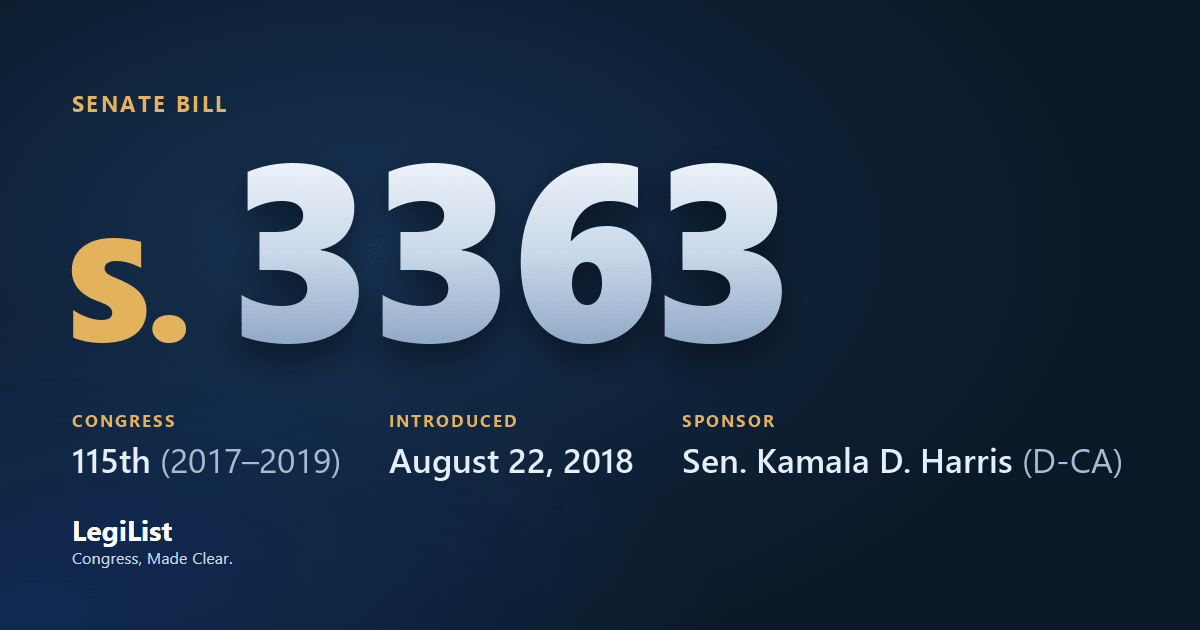
Maternal CARE Act
Latest action · Aug 22, 2018 Read twice and referred to the Committee on Finance.
Progress
Where this bill reached, and when. A stage with no date was not reached; one that failed a vote and later carried shows the date it carried.
- IntroducedAug 22, 2018
- Passed SenateNot reached
- Passed HouseNot reached
- To the PresidentNot reached
- Became lawNot reached
Summary
Maternal Care Access and Reducing Emergencies Act or the Maternal CARE Act
This bill requires the Department of Health and Human Services to award grants to health professional training programs for training that addresses implicit bias (e.g., racial bias) in the practice of obstetrics and gynecology.
The Centers for Medicare & Medicaid Services and the Health Resources and Services Administration must award grants to up to 10 states for pregnancy medical home programs that reduce adverse maternal health outcomes and racial disparities. Among other requirements, such programs must prioritize the care of Medicaid enrollees.
The National Academy of Medicine must make recommendations for incorporating bias recognition in clinical skills tests at medical schools.
Cosponsors 18
Members who signed on, in the order they did. Signatures ran from Aug 22, 2018 to Dec 19, 2018; 13 are original cosponsors, there from the day it was introduced.
| Seat | Cosponsor | Signed on | |
|---|---|---|---|
| D-MD | Benjamin L. Cardin | Original | Aug 22, 2018 |
| D-FL | Bill Nelson | Original | Aug 22, 2018 |
| D-MI | Debbie Stabenow | Original | Aug 22, 2018 |
| D-AL | Doug Jones | Original | Aug 22, 2018 |
| D-OR | Jeff Merkley | Original | Aug 22, 2018 |
| D-NY | Kirsten E. Gillibrand | Original | Aug 22, 2018 |
| D-HI | Mazie K. Hirono | Original | Aug 22, 2018 |
| D-CT | Richard Blumenthal | Original | Aug 22, 2018 |
| D-OR | Ron Wyden | Original | Aug 22, 2018 |
| D-OH | Sherrod Brown | Original | Aug 22, 2018 |
| D-WI | Tammy Baldwin | Original | Aug 22, 2018 |
| D-IL | Tammy Duckworth | Original | Aug 22, 2018 |
| D-DE | Thomas R. Carper | Original | Aug 22, 2018 |
| D-MD | Chris Van Hollen | Aug 27, 2018 | |
| D-VA | Tim Kaine | Sep 27, 2018 | |
| D-PA | Robert P. Casey Jr. | Oct 3, 2018 | |
| D-NJ | Cory A. Booker | Oct 11, 2018 | |
| I-VT | Bernard Sanders | Dec 19, 2018 |
Committees 1
Where it was sent and what each committee and subcommittee did with it, in order.
| Chamber | Committee | What it did |
|---|---|---|
| Senate | Finance Committee | Referred Aug 22, 2018 |
Actions 2
Everything that happened, newest first.
- Aug 22, 2018Introduced in Senate
- Aug 22, 2018Read twice and referred to the Committee on Finance.
Related bills 1
Companion bills and other measures the record links to this one.
| Bill | Title | Relationship | Latest action |
|---|---|---|---|
| HR 6698 | Maternal CARE Act | Identical bill | Sep 8, 2018 |
Titles 3
Every title it has carried, official and short, at each stage.
- Official Title as Introduced
- A bill to support States in their work to end preventable morbidity and mortality in maternity care by using evidence-based quality improvement to protect the health of mothers during pregnancy, childbirth, and in the postpartum period and to reduce neonatal and infant mortality, to eliminate racial disparities in maternal health outcomes, and for other purposes.
- Short Titles as Introduced
- Maternal CARE Act
- Maternal Care Access and Reducing Emergencies Act
Subjects
Assigned by the Library of Congress. Policy area: Health.
- Child health
- Congressional oversight
- Disability and health-based discrimination
- Employment and training programs
- Family planning and birth control
- Government studies and investigations
- Health
- Health care quality
- Health personnel
- Health programs administration and funding
- Home and outpatient care
- Medicaid
- Medical education
- Medical research
- Minority health
- Racial and ethnic relations
- Sex and reproductive health
- State and local government operations
- Women's health
Text 1
Each version as it was printed, newest first.
- Aug 22, 2018Introduced in Senate
Everything here is as published by Congress: the summary is the Congressional Research Service's, the action wording is the clerks', and the subjects are the Library of Congress's. How far it got is read from the actions themselves, taking the most recent one of each kind, so a bill that failed a vote and later passed is shown as having passed. Records come from this bill on Congress.gov and govinfo.gov; cost estimates are the Congressional Budget Office's, and the hearings are the printed hearings GovInfo publishes, which can appear months after the hearing.