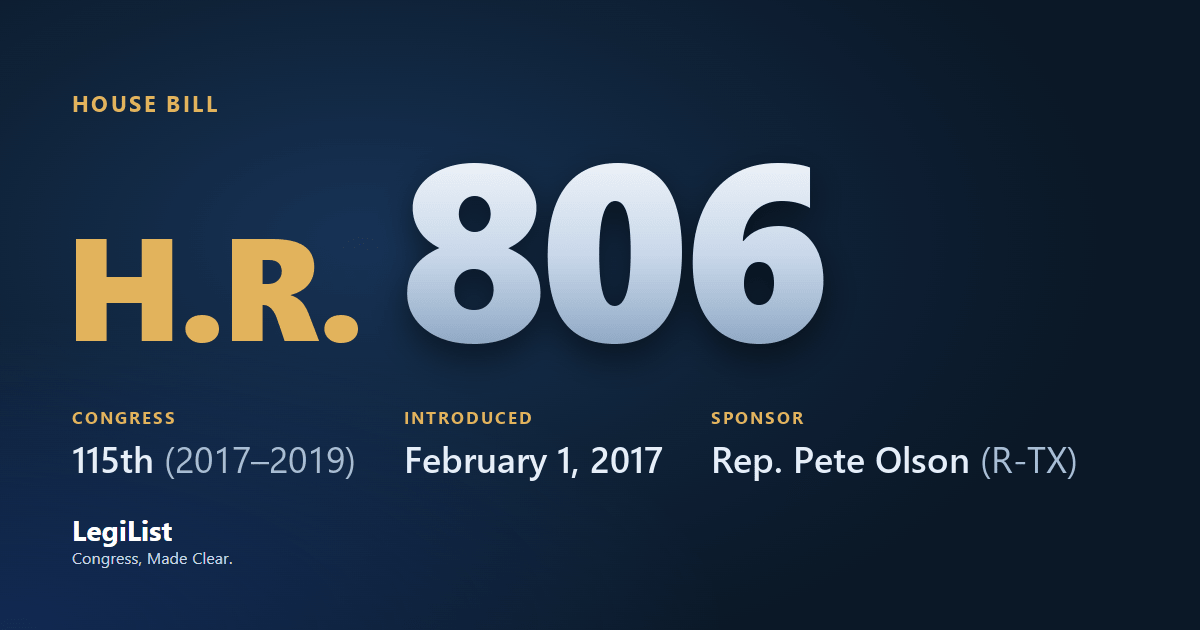
Ozone Standards Implementation Act of 2017
Latest action · Jul 19, 2017 Received in the Senate and Read twice and referred to the Committee on Environment and Public Works.
Progress
Where this bill reached, and when. A stage with no date was not reached; one that failed a vote and later carried shows the date it carried.
- IntroducedFeb 1, 2017
- Passed HouseJul 18, 2017
- Passed SenateNot reached
- To the PresidentNot reached
- Became lawNot reached
Summary
(This measure has not been amended since it was reported to the House on July 14, 2017. The summary of that version is repeated here.)
Ozone Standards Implementation Act of 2017
This bill amends the Clean Air Act to revise the National Ambient Air Quality Standards (NAAQS) program.
(Sec. 2) The bill delays the implementation of the ozone NAAQS that were published in 2015. The bill extends until: (1) October 26, 2024, the deadline for states to submit designations to implement the 2015 ozone NAAQS; and (2) October 26, 2025, the deadline for the Environmental Protection Agency (EPA) to designate state areas as attainment, nonattainment, or unclassifiable areas with respect to the 2015 ozone NAAQS. States must submit a state implementation plan (SIP) by October 26, 2026, to implement, maintain, and enforce the 2015 ozone NAAQS.
The bill exempts from the 2015 ozone standards certain preconstruction permit applications that were completed or submitted before a final designation was made.
(Sec. 3) The bill also changes the review cycle for criteria pollutant NAAQS from a 5-year review cycle to a 10-year review cycle. The EPA may not complete its next review of ozone NAAQS before October 26, 2025.
The EPA may consider, as a secondary consideration, likely technological feasibility in establishing and revising NAAQS for a pollutant if a range of air quality levels for such pollutant are requisite to protect public health with an adequate margin of safety.
Prior to establishing or revising NAAQS, the EPA must obtain advice from its scientific advisory committee regarding potential adverse public health, welfare, social, economic, or energy effects which may result from attaining and maintaining NAAQS.
The EPA must publish regulations and guidance for implementing NAAQS concurrently with the issuance of a new or revised standard. New or revised NAAQS shall not apply to preconstruction permits for constructing or modifying a stationary source of air pollutants until those regulations and guidance have been published.
The bill provides that in Extreme Ozone Nonattainment Areas, contingency measures are not required to be included in nonattainment plans. Technological achievability and economic feasibility must be taken into consideration in plan revisions for milestones for particulate matter nonattainment areas.
The bill redefines "exceptional events," by including stagnation of air masses that are not ordinarily occurring.
The EPA must: (1) report on foreign emissions and their impact on compliance with the NAAQS program in the United States, (2) study and report on the atmospheric formation of ozone and effective control strategies, and (3) incorporate the results of the study into rules and guidance implementing the 2015 ozone standards.
(Sec. 4) The bill exempts states from sanctions or fees for nonattainment or deficiency relating to certain ozone and particulate matter if the state can demonstrate specified circumstances preventing attainment. This exemption shall not affect any obligation of states or localities under the Clean Air Act to attain a NAAQS for ozone or particulate matter.
(Sec. 6) The bill specifies that no additional funds are authorized for carrying out the requirements of this bill.
Recorded votes 7
Newest first. Open one to see how every member voted.
| Roll call | Question | Result | Date |
|---|---|---|---|
| House 391 | On Passage | Passed229–199 | Jul 18, 2017 |
| House 390 | On Motion to Recommit with Instructions | Failed191–235 | Jul 18, 2017 |
| House 389 | On Agreeing to the Amendment | Failed190–236 | Jul 18, 2017 |
| House 388 | On Agreeing to the Amendment | Failed186–242 | Jul 18, 2017 |
| House 387 | On Agreeing to the Amendment | Failed191–235 | Jul 18, 2017 |
Cosponsors 24
Members who signed on, in the order they did. Signatures ran from Feb 1, 2017 to Jul 13, 2017; 19 are original cosponsors, there from the day it was introduced.
| Seat | Cosponsor | Signed on | |
|---|---|---|---|
| R-TX | Bill Flores | Original | Feb 1, 2017 |
| R-OH | Bill Johnson | Original | Feb 1, 2017 |
| R-MO | Billy Long | Original | Feb 1, 2017 |
| R-KY | Brett Guthrie | Original | Feb 1, 2017 |
| R-TX | Brian Babin | Original | Feb 1, 2017 |
| R-WV | David B. McKinley | Original | Feb 1, 2017 |
| R-WV | Evan H. Jenkins | Original | Feb 1, 2017 |
| D-TX | Henry Cuellar | Original | Feb 1, 2017 |
| R-OH | James B. Renacci | Original | Feb 1, 2017 |
| R-TX | Jeb Hensarling | Original | Feb 1, 2017 |
| D-CA | Jim Costa | Original | Feb 1, 2017 |
| R-ND | Kevin Cramer | Original | Feb 1, 2017 |
| R-CA | Kevin McCarthy | Original | Feb 1, 2017 |
| R-IN | Larry Bucshon | Original | Feb 1, 2017 |
| R-TX | Michael C. Burgess | Original | Feb 1, 2017 |
| R-TX | Randy K. Weber, Sr. | Original | Feb 1, 2017 |
| R-OH | Robert E. Latta | Original | Feb 1, 2017 |
| D-GA | Sanford D. Bishop, Jr. | Original | Feb 1, 2017 |
| R-LA | Steve Scalise | Original | Feb 1, 2017 |
| R-IN | Todd Rokita | Feb 7, 2017 | |
| R-CA | David G. Valadao | Feb 15, 2017 | |
| R-TX | Pete Sessions | Jul 11, 2017 | |
| R-WI | Glenn Grothman | Jul 12, 2017 | |
| R-TX | Lamar Smith | Jul 13, 2017 |
Committees 2
Where it was sent and what each committee and subcommittee did with it, in order.
| Chamber | Committee | What it did |
|---|---|---|
| House | Energy and Commerce Committee | Referred Feb 1, 2017Markup Jun 28, 2017Reported Jul 14, 2017 |
| Environment Subcommittee | Referred Feb 3, 2017Hearings Mar 22, 2017Reported Jun 15, 2017 | |
| Senate | Environment and Public Works Committee | Referred Jul 19, 2017 |
Actions 38
Everything that happened, newest first.
- Jul 19, 2017Received in the Senate and Read twice and referred to the Committee on Environment and Public Works.
- Jul 18, 2017Rule H. Res. 451 passed House.
- Jul 18, 2017Considered under the provisions of rule H. Res. 451. (consideration: CR H5943-5968)
- Jul 18, 2017Rule provides for consideration of H.R. 806 with 1 hour of general debate. Previous question shall be considered as ordered without intervening motions except motion to recommit with or without instructions. Measure will be considered read. Specified amendments are in order.
- Jul 18, 2017House resolved itself into the Committee of the Whole House on the state of the Union pursuant to H. Res. 451 and Rule XVIII.
In the Congressional Record 4
Days the Record’s own index lists this bill, newest first, with the pages and the members it names. Pages starting H are the House, S the Senate, E Extensions of Remarks.
| Where | In the Record | Members | Date |
|---|---|---|---|
| House | Debate and remarks H6134 | Pramila Jayapal D-WA | Jul 20, 2017 |
| House | Debate and remarks H5927–H5935, H5939, H5943–H5968Text printed H5927, H5954Amendments H5935, H5954, H5955, H5956, H5957, H5958, H5959, H5960Motions H5966Recorded votes H5940, H5962, H5963, H5964, H5965, H5966, H5967Polis amendment (eliminate exemption for aggregation of emissions from oil and gas development sources and include hydrogen sulfide as a hazardous air pollutants under the Clean Air Act)Cartwright motion to recommit (prohibit implementation if Clean Air Scientific Advisory Committee finds that such application could increase health risks to vulnerable populations)Castor amendment (prohibit implementation if Clean Air Scientific Advisory Committee finds that such application could increase health risks to vulnerable populations)consideration (H. Res. 451), previous questionenactMcNerney amendment (prohibit limitations on appropriations)Tonko amendment (prohibit basing technological feasibility as sole criteria for determining national ambient air quality standards) | Andy Biggs R-AZ, David B. McKinley R-WV, Debbie Dingell D-MI, Donald S. Beyer, Jr. D-VA (amendment), Doris O. Matsui D-CA, Gerald E. Connolly D-VA, Jared Polis D-CO (amendment), Jerry McNerney D-CA (amendment), John Shimkus R-IL, Kathy Castor D-FL (amendment), Keith Ellison D-MN, Kevin McCarthy R-CA, Lamar Smith R-TX, Mark Sanford R-SC, Matt Cartwright D-PA (motion), Michael C. Burgess R-TX, Nanette Diaz Barragán D-CA, Paul A. Gosar R-AZ, Paul Tonko D-NY (amendment), Pete Olson R-TX, Peter A. DeFazio D-OR, Tony Cárdenas D-CA | Jul 18, 2017 |
| House | Declaratory Statements H5921 | — | Jul 17, 2017 |
| House | Debate and remarks H5868 | Kevin McCarthy R-CA | Jul 14, 2017 |
Research
What has been written about this bill: committee reports, cost estimates, the sponsor’s authority statement, printed hearings and the Congressional Research Service’s work.
Committee report
Congressional Budget Office cost estimate
- Jul 14, 2017H.R. 806, Ozone Standards Implementation Act of 2017As ordered reported by the House Committee on Energy and Commerce on June 28, 2017
Constitutional authority
The sponsor’s statement, as printed in the Congressional Record, vol. 163, no. 17, February 1, 2017, page H878.
Printed hearings 3
Hearings whose printed record names this bill, newest first: hearings on it, and wider hearings where it came up.
| Number | Hearing | Committee | Held |
|---|---|---|---|
| Serial No. 115-129 | LEGISLATION ADDRESSING NEW SOURCE REVIEW PERMITTING REFORM151 pages | Energy and Commerce Committee | May 16, 2018 |
| Serial No. 115-17 | H.R. 806, OZONE STANDARDS IMPLEMENTATION ACT OF 2017219 pages | Energy and Commerce Committee | Mar 22, 2017 |
| Serial No. 115-8 | MODERNIZING ENVIRONMENTAL LAWS: CHALLENGES AND OPPORTUNITIES FOR EXPANDING INFRASTRUCTURE AND PROMOTING DEVELOPMENT AND MANUFACTURING250 pages | Energy and Commerce Committee | Feb 16, 2017 |
CRS reports 3
Congressional Research Service work that CRS links to this bill or the law it became, newest first.
Cite it 3
Products on other subjects that cite it, usually among other measures.
| Product | Title | Kind | Published |
|---|---|---|---|
| R43092 | Implementing EPA’s 2015 Ozone Air Quality Standards Archived | Report | Aug 16, 2018 |
| R44744 | Clean Air Act Issues in the 115th Congress: In Brief Archived | Report | Aug 13, 2018 |
| IN10891 | White House Directs EPA to Review Air Quality Standards and Permitting Process Archived | Insight | Apr 26, 2018 |
Amendments 6
Amendments offered to this bill.
Related bills 1
Companion bills and other measures the record links to this one.
| Bill | Title | Relationship | Latest action |
|---|---|---|---|
| HRES 451 | Providing for consideration of the bill (H.R. 806) to facilitate efficient State implementation of ground-level ozone standards, and for other purposes. | Procedurally related | Jul 18, 2017 |
Titles 4
Every title it has carried, official and short, at each stage.
- Official Title as Introduced
- To facilitate efficient State implementation of ground-level ozone standards, and for other purposes.
- Short Titles as Introduced
- Ozone Standards Implementation Act of 2017
- Short Titles as Reported to House
- Ozone Standards Implementation Act of 2017
- Short Titles as Passed House
- Ozone Standards Implementation Act of 2017
Subjects
Assigned by the Library of Congress. Policy area: Environmental Protection.
- Administrative law and regulatory procedures
- Air quality
- Atmospheric science and weather
- Congressional oversight
- Economic performance and conditions
- Environmental assessment, monitoring, research
- Environmental Protection
- Environmental Protection Agency (EPA)
- Environmental regulatory procedures
- Environmental technology
- Government studies and investigations
- Licensing and registrations
Text 4
Each version as it was printed, newest first.
- Jul 19, 2017Referred in Senate
- Jul 18, 2017Engrossed in House
- Jul 14, 2017Reported in House
- Feb 1, 2017Introduced in House
Support LegiList
This page is free, carries no paywall, and is built and maintained by one person. If the record here is useful to you, a few dollars keeps it going.
Everything here is as published by Congress: the summary is the Congressional Research Service's, the action wording is the clerks', and the subjects are the Library of Congress's. How far it got is read from the actions themselves, taking the most recent one of each kind, so a bill that failed a vote and later passed is shown as having passed. Records come from this bill on Congress.gov and govinfo.gov; cost estimates are the Congressional Budget Office's, and the hearings are the printed hearings GovInfo publishes, which can appear months after the hearing.