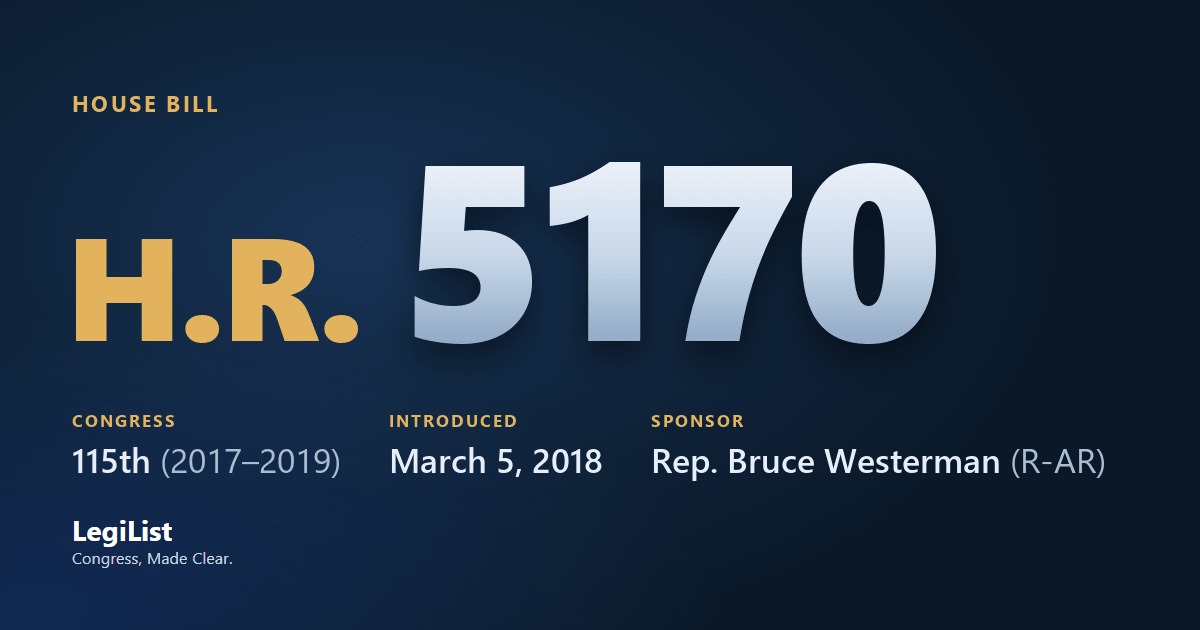
FLIP Act
Latest action · Mar 28, 2018 Referred to the Subcommittee on Conservation and Forestry.
Progress
Where this bill reached, and when. A stage with no date was not reached; one that failed a vote and later carried shows the date it carried.
- IntroducedMar 5, 2018
- Passed HouseNot reached
- Passed SenateNot reached
- To the PresidentNot reached
- Became lawNot reached
Summary
Federal Lands Infrastructure Partnership Act or the FLIP Act
This bill extends through FY2022, and revises allocations from, the Land and Water Conservation Fund.
The bill makes allocations available from the fund for the Payment In-Lieu of Taxes Program. This program compensates local governments for tax revenue lost due to tax-exempt federal lands within their boundaries.
Allocations shall be made available from the fund through FY2024 to promote offshore energy exploration, innovation, and education.
The Department of the Interior shall carry out a federal energy permit streamlining pilot program for the outer Continental Shelf.
The bill directs Interior to: (1) establish an Offshore Energy Innovation Hub; (2) award offshore energy innovation grants to institutions of higher education; and (3) prepare a list of the science, technology, engineering, and math-related academic fields that address current and future workforce needs for offshore energy-related activities.
Cosponsors
Members who signed on, in the order they did.
Committees 3
Where it was sent and what each committee and subcommittee did with it, in order.
| Chamber | Committee | What it did |
|---|---|---|
| House | Natural Resources Committee | Referred Mar 5, 2018 |
| Energy and Mineral Resources Subcommittee | Referred Mar 13, 2018 | |
| Federal Lands Subcommittee | Referred Mar 13, 2018 | |
| Water, Wildlife and Fisheries Subcommittee | Referred Mar 13, 2018 | |
| House | Agriculture Committee | Referred Mar 5, 2018 |
| Forestry and Horticulture Subcommittee | Referred Mar 28, 2018 | |
| House | Education and Workforce Committee | Referred Mar 5, 2018 |
Actions 6
Everything that happened, newest first.
- Mar 28, 2018Referred to the Subcommittee on Conservation and Forestry.
- Mar 13, 2018Referred to the Subcommittee on Energy and Mineral Resources.
- Mar 13, 2018Referred to the Subcommittee on Federal Lands.
- Mar 13, 2018Referred to the Subcommittee on Water, Power and Oceans.
- Mar 5, 2018Introduced in House
Research
What has been written about this bill: committee reports, cost estimates, the sponsor’s authority statement, printed hearings and the Congressional Research Service’s work.
Constitutional authority
The sponsor’s statement, as printed in the Congressional Record, vol. 164, no. 38, March 5, 2018, page H1373.
CRS reports 2
Congressional Research Service work that CRS links to this bill or the law it became, newest first.
Cite it 2
Products on other subjects that cite it, usually among other measures.
| Product | Title | Kind | Published |
|---|---|---|---|
| RL33531 | Land and Water Conservation Fund: Overview, Funding History, and Issues Archived | Report | Jun 19, 2019 |
| R44121 | Land and Water Conservation Fund: Appropriations for “Other Purposes” Archived | Report | May 14, 2019 |
Titles 3
Every title it has carried, official and short, at each stage.
- Official Title as Introduced
- To amend title 54, United States Code, to reauthorize and reform the Land and Water Conservation Fund, and for other purposes.
- Short Titles as Introduced
- FLIP Act
- Federal Lands Infrastructure Partnership Act
Subjects
Assigned by the Library of Congress. Policy area: Public Lands and Natural Resources.
- Alternative and renewable resources
- Appropriations
- Atmospheric science and weather
- Electric power generation and transmission
- Endangered and threatened species
- Forests, forestry, trees
- Higher education
- Hunting and fishing
- Infrastructure development
- Intergovernmental relations
- Land use and conservation
- Marine and coastal resources, fisheries
- Military history
- Monuments and memorials
- Oil and gas
- Public Lands and Natural Resources
- Science and engineering education
- State and local finance
- User charges and fees
- Water resources funding
- Wilderness and natural areas, wildlife refuges, wild rivers, habitats
- Wildlife conservation and habitat protection
Text 1
Each version as it was printed, newest first.
- Mar 5, 2018Introduced in House
Everything here is as published by Congress: the summary is the Congressional Research Service's, the action wording is the clerks', and the subjects are the Library of Congress's. How far it got is read from the actions themselves, taking the most recent one of each kind, so a bill that failed a vote and later passed is shown as having passed. Records come from this bill on Congress.gov and govinfo.gov; cost estimates are the Congressional Budget Office's, and the hearings are the printed hearings GovInfo publishes, which can appear months after the hearing.