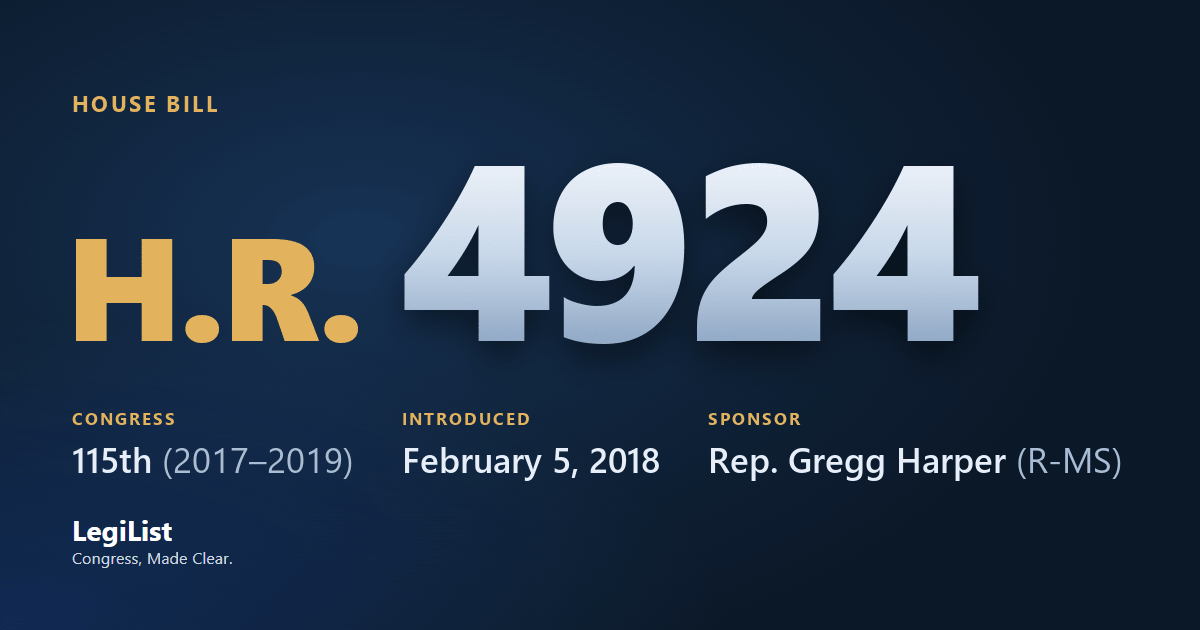
Congressional Accountability Act of 1995 Reform Act
Latest action · Feb 7, 2018 Received in the Senate and Read twice and referred to the Committee on Homeland Security and Governmental Affairs.
Progress
Where this bill reached, and when. A stage with no date was not reached; one that failed a vote and later carried shows the date it carried.
- IntroducedFeb 5, 2018
- Passed HouseFeb 6, 2018
- Passed SenateNot reached
- To the PresidentNot reached
- Became lawNot reached
Summary
Congressional Accountability Act of 1995 Reform Act
TITLE I--REFORM OF DISPUTE RESOLUTION PROCEDURES
Subtitle A--Reform of Procedures for Initiation, Investigation, and Resolution of Claims
(Sec. 101) This bill amends the Congressional Accountability Act of 1995 (CAA) to revise administrative and judicial dispute resolution procedures for certain claims by employees alleging that employing offices have violated their CAA rights and protections, including protections against sexual harassment.
The bill eliminates the requirement that an employee participate in counseling and mediation before filing a claim with the Office of Compliance (OOC) alleging a violation. The OOC must investigate claims. If the OOC finds reasonable cause to believe there was a violation or is unable to make a determination, the OOC must conduct a hearing to consider the claim and render a decision.
Within 45 days after filing the claim, the employee may file a civil action in a U.S. district court. This action terminates the OOC investigation and prohibits subsequent formal hearings regarding the claim.
An employee may also file a civil action within 90 days after being notified by the OOC that the investigation found no reasonable cause to believe that the employing office committed a CAA violation.
After the OOC receives a claim from an employee of the Architect of the Capitol (AOC) or of the Capitol Police alleging a CAA violation, the OOC may recommend that the employee use AOC or Capitol Police grievance procedures for a specific period of time.
(Sec. 102) If the claim alleges that a Member of Congress committed a CAA discrimination or retaliation violation, the OOC must notify the Member of: (1) the possibility that the Member may be required to reimburse the Treasury for awards or settlements in connection with the claim; and (2) the right to intervene in related mediations, hearings, or civil actions.
The OOC must establish an electronic reporting and tracking system for initiating claim proceedings and keeping track of subsequent actions and proceedings.
An employee must file a claim within 180 days after the alleged violation.
(Sec. 103) The OOC is authorized to issue subpoenas without a party's request. Investigation results must be provided to the employee and the employing office. It is the sense of Congress that such subpoenas be issued only if other methods are insufficient to enable the OOC to conclude the investigation and provide the results within 120 days after the filing of the claim.
Any investigative reports concerning allegations of discrimination or retaliation by a Member of Congress must be reported to congressional ethics committees.
At any time during the investigation, the OOC may recommend that the employee and employing office pursue mediation regarding the claim.
(Sec. 104) At any time during the investigation, the employee and employing office may jointly file a request for mediation with the OOC. At their request, the mediation may be extended for one additional 30-day period.
Subtitle B--Other Reforms
(Sec. 111) Current and former Members of Congress must reimburse the Treasury if an employee receives an award or settlement for the Member's alleged act of discrimination or retaliation. Such funds could be withheld from the Member's salary or retirement account if he or she doesn't meet specified payment deadlines.
(Sec. 112) Congressional ethics committees must receive the final disposition of claims alleging CAA violations by Members of Congress and senior staff of employing offices. The disposition must be:
- an order or agreement to pay an award or settlement, including an agreement reached pursuant to mediation;
- a final decision of an OOC hearing officer or of the OOC's Board; or
- a final decision in a civil action of a U.S. district court judge.
(Sec. 113) Upon an employee's request, the employing office may permit the employee to work remotely or grant the employee a paid leave of absence while a claim is pending. These provisions do not override a collective bargaining agreement.
(Sec. 114) All claims and investigations must be confidential.
(Sec. 115) Non-congressional legislative offices that violate CAA requirements must reimburse the Treasury for resulting award or settlement payments.
TITLE II--IMPROVING OPERATIONS OF OFFICE OF COMPLIANCE
(Sec. 201) OOC reporting requirements are modified for claims, awards, and settlements. The OOC must publish specified information about claims, awards, and settlements on its public website.
(Sec. 202) Within one year and biennially thereafter, the OOC must survey employing offices regarding the workplace environment in such offices, including attitudes on sexual harassment. The Library of Congress (LOC) shall be considered an employing office.
(Sec. 203) The OOC shall establish a program for the permanent retention of its records, including those of CAA investigations, mediations, hearings, and other procedures.
(Sec. 204) The Government Accountability Office shall: (1) study, and make recommendations to improve, OOC management practices; and (2) audit, and make recommendations to improve, cybersecurity systems and practices.
TITLE III--MISCELLANEOUS REFORMS
(Sec. 301) CAA nondiscrimination requirements and remedies are extended to uncompensated legislative branch interns, detailees, and fellows.
(Sec. 302) The same requirements and remedies are provided to LOC employees, with a special rule allowing those employees to use LOC alternative grievance procedures.
(Sec. 303) The bill specifies that the CAA applies to the China Review Commission, the Congressional-Executive China Commission, the Helsinki Commission, the John C. Stennis Center for Public Service Training and Development, and their employees.
(Sec. 304) Non-congressional CAA employing offices must develop programs to train and educate employees about their CAA rights and protections.
(Sec. 305) The bill renames the OOC the Office of Congressional Workplace Rights.
TITLE IV--EFFECTIVE DATE
(Sec. 401) The bill takes effect 180 days after enactment.
Cosponsors 38
Members who signed on, in the order they did. Signatures ran from Feb 5, 2018 to Feb 6, 2018; 12 are original cosponsors, there from the day it was introduced.
| Seat | Cosponsor | Signed on | |
|---|---|---|---|
| R-NE | Adrian Smith | Original | Feb 5, 2018 |
| R-VA | Barbara Comstock | Original | Feb 5, 2018 |
| R-GA | Barry Loudermilk | Original | Feb 5, 2018 |
| R-AL | Bradley Byrne | Original | Feb 5, 2018 |
| D-CA | Jackie Speier | Original | Feb 5, 2018 |
| D-MD | Jamie Raskin | Original | Feb 5, 2018 |
| R-NC | Mark Walker | Original | Feb 5, 2018 |
| D-PA | Robert A. Brady | Original | Feb 5, 2018 |
| R-IL | Rodney Davis | Original | Feb 5, 2018 |
| R-IN | Susan W. Brooks | Original | Feb 5, 2018 |
| D-FL | Theodore E. Deutch | Original | Feb 5, 2018 |
| D-CA | Zoe Lofgren | Original | Feb 5, 2018 |
| D-NH | Ann M. Kuster | Feb 6, 2018 | |
| R-MO | Ann Wagner | Feb 6, 2018 | |
| R-PA | Brian K. Fitzpatrick | Feb 6, 2018 |
Committees 4
Where it was sent and what each committee and subcommittee did with it, in order.
| Chamber | Committee | What it did |
|---|---|---|
| House | Committee on House Administration | Referred Feb 5, 2018 |
| House | Oversight and Government Reform Committee | Referred Feb 5, 2018 |
| House | Ways and Means Committee | Referred Feb 5, 2018 |
| Senate | Homeland Security and Governmental Affairs Committee | Referred Feb 7, 2018 |
Actions 8
Everything that happened, newest first.
- Feb 7, 2018Received in the Senate and Read twice and referred to the Committee on Homeland Security and Governmental Affairs.
- Feb 6, 2018Mr. Harper moved to suspend the rules and pass the bill.
- Feb 6, 2018Considered under suspension of the rules. (consideration: CR H797-813)
- Feb 6, 2018DEBATE - The House proceeded with forty minutes of debate on H.R. 4924.
- Feb 6, 2018Passed/agreed to in House: On motion to suspend the rules and pass the bill Agreed to by voice vote. (text: CR H797-803)
In the Congressional Record 1
Days the Record’s own index lists this bill, newest first, with the pages and the members it names. Pages starting H are the House, S the Senate, E Extensions of Remarks.
| Where | In the Record | Members | Date |
|---|---|---|---|
| House | Debate and remarks H797–H813Text printed H797–H803Analyses H811 | Barbara Comstock R-VA, Bradley Byrne R-AL, Christopher H. Smith R-NJ, Eleanor Holmes Norton D-DC, Gregg Harper R-MS, Jackie Speier D-CA, Jamie Raskin D-MD, Kevin Brady R-TX, Leonard Lance R-NJ, Mia B. Love R-UT, Nancy Pelosi D-CA, Rodney Davis R-IL, Ron DeSantis R-FL, Sheila Jackson Lee D-TX, Susan W. Brooks R-IN, Theodore E. Deutch D-FL, Zoe Lofgren D-CA | Feb 6, 2018 |
Research
What has been written about this bill: committee reports, cost estimates, the sponsor’s authority statement, printed hearings and the Congressional Research Service’s work.
Constitutional authority
The sponsor’s statement, as printed in the Congressional Record, vol. 164, no. 22, February 5, 2018, page H784.
Related bills 6
Companion bills and other measures the record links to this one.
| Bill | Title | Relationship | Latest action |
|---|---|---|---|
| HR 652 | Congressional Intern Protection Act of 2017 | Related bill | Jan 24, 2017 |
| S 2401 | Congressional Accountability Act of 1995 Reform Act | Related bill | Feb 7, 2018 |
| S 2952 | Congressional Accountability Act of 1995 Reform Act | Related bill | May 29, 2018 |
| S 3749 | Congressional Accountability Act of 1995 Reform Act | Related bill | Dec 21, 2018 |
| HR 4393 | To amend the Congressional Accountability Act of 1995 to clarify that employees of the Commission on Security and Cooperation in Europe and the Congressional-Executive Commission on the People's Republic of China are to be treated as covered employees for purposes of such Act. | Related bill | Nov 14, 2017 |
| HR 4822 | Congressional Accountability Act of 1995 Reform Act | Related bill | Jan 18, 2018 |
Titles 3
Every title it has carried, official and short, at each stage.
- Official Title as Introduced
- To amend the Congressional Accountability Act of 1995 to reform the procedures provided under such Act for the initiation, investigation, and resolution of claims alleging that employing offices of the legislative branch have violated the rights and protections provided to their employees under such Act, including protections against sexual harassment, and for other purposes.
- Short Titles as Introduced
- Congressional Accountability Act of 1995 Reform Act
- Short Titles as Passed House
- Congressional Accountability Act of 1995 Reform Act
Subjects
Assigned by the Library of Congress. Policy area: Congress.
- Administrative remedies
- Alternative dispute resolution, mediation, arbitration
- Asia
- Assault and harassment offenses
- China
- Civil actions and liability
- Computer security and identity theft
- Congress
- Congressional agencies
- Congressional committees
- Congressional officers and employees
- Congressional operations and organization
- Congressional oversight
- Employee leave
- Employment discrimination and employee rights
- Government employee pay, benefits, personnel management
- Government ethics and transparency, public corruption
- Government information and archives
- Government studies and investigations
- House Committee on Ethics
- House of Representatives
- Human rights
- Lawyers and legal services
- Legislative rules and procedure
- Library of Congress
- Members of Congress
- Policy sciences
- Right of privacy
- Rule of law and government transparency
- Senate
- Senate Select Committee on Ethics
- Sex offenses
- Sex, gender, sexual orientation discrimination
- Worker safety and health
Text 3
Each version as it was printed, newest first.
- Feb 7, 2018Referred in Senate
- Feb 6, 2018Engrossed in House
- Feb 5, 2018Introduced in House
Support LegiList
This page is free, carries no paywall, and is built and maintained by one person. If the record here is useful to you, a few dollars keeps it going.
Everything here is as published by Congress: the summary is the Congressional Research Service's, the action wording is the clerks', and the subjects are the Library of Congress's. How far it got is read from the actions themselves, taking the most recent one of each kind, so a bill that failed a vote and later passed is shown as having passed. Records come from this bill on Congress.gov and govinfo.gov; cost estimates are the Congressional Budget Office's, and the hearings are the printed hearings GovInfo publishes, which can appear months after the hearing.