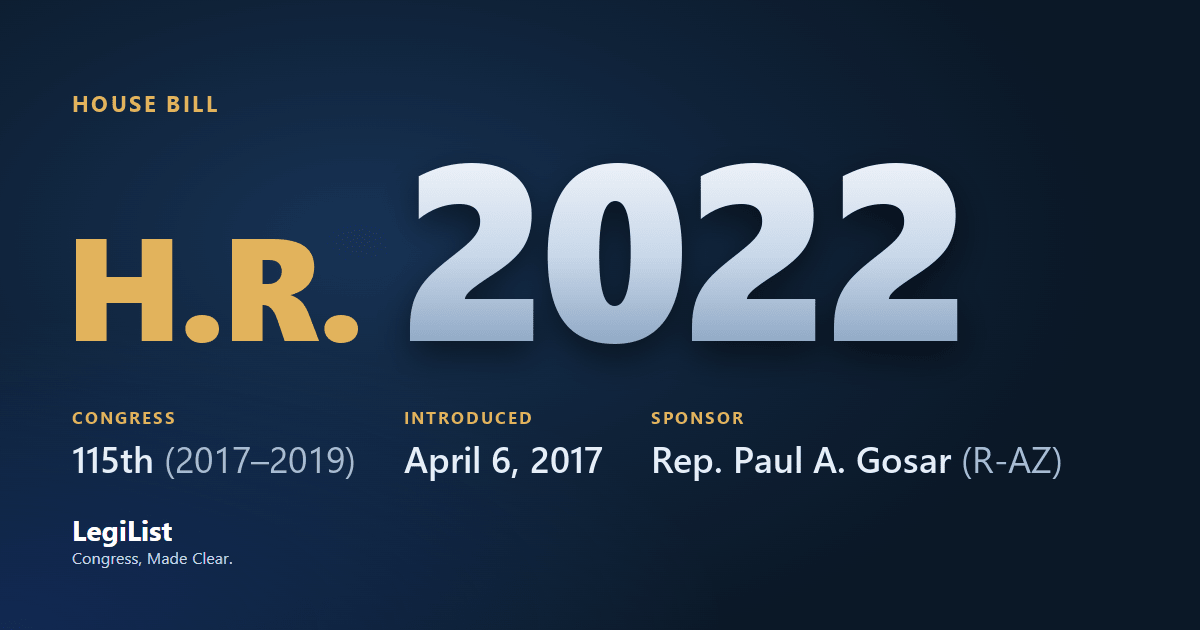
LATTS Act of 2017
Latest action · Apr 7, 2017 Referred to the Subcommittee on Health.
Progress
Where this bill reached, and when. A stage with no date was not reached; one that failed a vote and later carried shows the date it carried.
- IntroducedApr 6, 2017
- Passed HouseNot reached
- Passed SenateNot reached
- To the PresidentNot reached
- Became lawNot reached
Summary
Label and Transport Tissues Safely Act of 2017 or the LATTS Act of 2017
This bill prohibits the sale of human tissue for research or education unless the seller has a non-transplant tissue bank license, each package of tissue is labeled with specified information, and each package is wrapped in the prescribed manner.
The Department of Health and Human Services (HHS) shall establish a process for the approval, suspension, and revocation of non-transplant tissue bank licenses.
False labeling of packages of human tissue is prohibited.
HHS or any accrediting body authorized by HHS is allowed to enter and inspect any facility that is subject to a non-transplant tissue bank license.
HHS shall recall any human tissue specimen that is an imminent or substantial hazard to public health.
The bill makes it unlawful to knowingly sell or otherwise transfer any human tissue specimen if the transfer affects interstate commerce.
Cosponsors 4
Members who signed on, in the order they did. Signatures ran from May 17, 2017 to May 16, 2018.
| Seat | Cosponsor | Signed on | |
|---|---|---|---|
| R-FL | John H. Rutherford | May 17, 2017 | |
| R-OH | Steve Stivers | Nov 8, 2017 | |
| R-VA | Thomas A. Garrett, Jr. | May 1, 2018 | |
| R-SC | Ralph Norman | May 16, 2018 |
Committees 1
Where it was sent and what each committee and subcommittee did with it, in order.
| Chamber | Committee | What it did |
|---|---|---|
| House | Energy and Commerce Committee | Referred Apr 6, 2017 |
| Health Subcommittee | Referred Apr 7, 2017 |
Actions 3
Everything that happened, newest first.
- Apr 7, 2017Referred to the Subcommittee on Health.
- Apr 6, 2017Introduced in House
- Apr 6, 2017Referred to the House Committee on Energy and Commerce.
Research
What has been written about this bill: committee reports, cost estimates, the sponsor’s authority statement, printed hearings and the Congressional Research Service’s work.
Constitutional authority
The sponsor’s statement, as printed in the Congressional Record, vol. 163, no. 60, April 6, 2017, page H2791.
Titles 3
Every title it has carried, official and short, at each stage.
- Official Title as Introduced
- To ensure certain safety measures are utilized in the interest of public health security with respect to labeling and transporting human tissue specimen or collection of specimens into interstate commerce.
- Short Titles as Introduced
- LATTS Act of 2017
- Label and Transport Tissues Safely Act of 2017
Subjects
Assigned by the Library of Congress. Policy area: Health.
- Administrative law and regulatory procedures
- Business records
- Department of Health and Human Services
- Fraud offenses and financial crimes
- Hazardous wastes and toxic substances
- Health
- Health information and medical records
- Infectious and parasitic diseases
- Licensing and registrations
- Medical education
- Medical research
- Organ and tissue donation and transplantation
- Product safety and quality
Text 1
Each version as it was printed, newest first.
- Apr 6, 2017Introduced in House
Support LegiList
This page is free, carries no paywall, and is built and maintained by one person. If the record here is useful to you, a few dollars keeps it going.
Everything here is as published by Congress: the summary is the Congressional Research Service's, the action wording is the clerks', and the subjects are the Library of Congress's. How far it got is read from the actions themselves, taking the most recent one of each kind, so a bill that failed a vote and later passed is shown as having passed. Records come from this bill on Congress.gov and govinfo.gov; cost estimates are the Congressional Budget Office's, and the hearings are the printed hearings GovInfo publishes, which can appear months after the hearing.