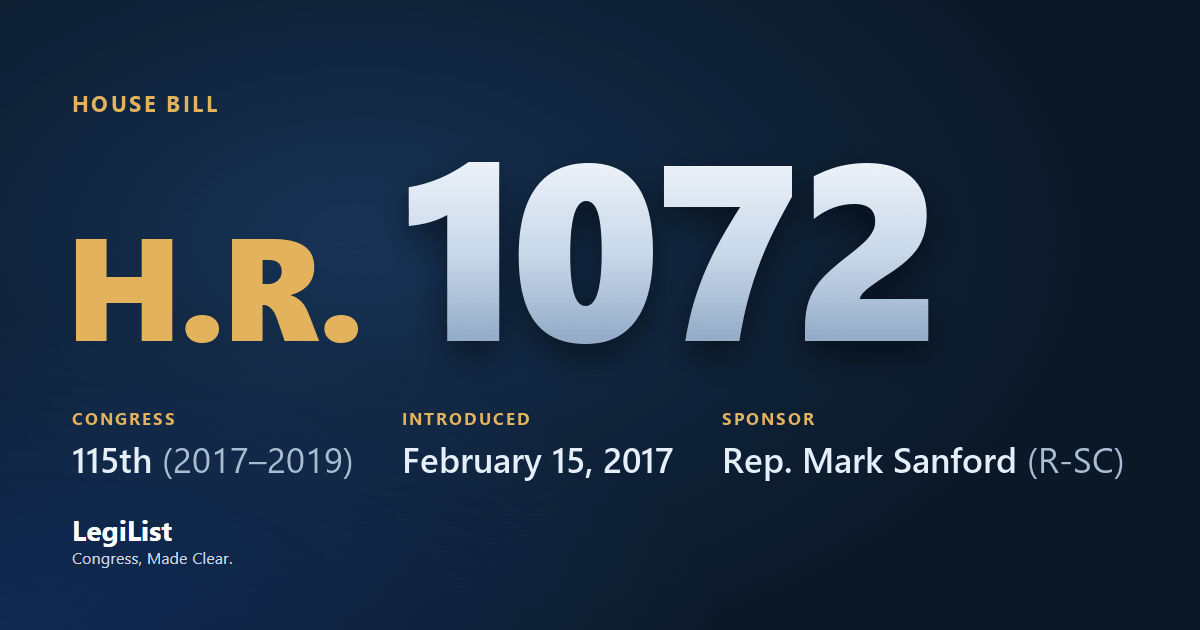
Obamacare Replacement Act
Latest action · Feb 17, 2017 Referred to the Subcommittee on Health.
Progress
Where this bill reached, and when. A stage with no date was not reached; one that failed a vote and later carried shows the date it carried.
- IntroducedFeb 15, 2017
- Passed HouseNot reached
- Passed SenateNot reached
- To the PresidentNot reached
- Became lawNot reached
Summary
Obamacare Replacement Act
This bill amends the Internal Revenue Code, the Public Health Service Act, the Employee Retirement Income Security Act of 1974 (ERISA), and the Social Security Act to repeal certain provisions regarding health insurance, including: the requirement for individuals to maintain minimum essential coverage, limitations on insurers varying premiums by age or health status, requirements for health insurance to cover preexisting conditions, and the prohibition on lifetime or annual limits on benefits.
The bill allows a refundable tax credit for a percentage of health insurance premiums and a tax credit for health savings account (HSA) contributions.
The bill eliminates HSA contribution limits and allows all individuals to make contributions to HSAs. HSAs may be used to pay for over-the-counter medications and health insurance. HSA distributions for abortion are subject to income tax.
The tax deduction for medical care is expanded to include exercise equipment and services, nutritional supplements, and certain primary care fees. Physicians may deduct uncompensated and charity care.
The bill provides for the establishment and governance of: (1) independent health pools, which offer health insurance coverage to their members; and (2) association health plans, which are group health plans sponsored by business associations.
Individual health insurance coverage is governed by the laws of a state designated by the health insurance issuer.
The Centers for Medicare and Medicaid Services must (currently, may) waive Medicaid requirements to enable states to carry out experimental, pilot, or demonstration projects.
Stop-loss insurance obtained by certain health plans or plan sponsors is exempt from requirements for health insurance.
The bill amends the McCarran-Ferguson Act to declare that nothing in that Act affects antitrust laws regarding health insurance.
Cosponsors 7
Members who signed on, in the order they did. Signatures ran from Feb 15, 2017 to Apr 3, 2017; 5 are original cosponsors, there from the day it was introduced.
| Seat | Cosponsor | Signed on | |
|---|---|---|---|
| R-WV | Alexander X. Mooney | Original | Feb 15, 2017 |
| R-SC | Jeff Duncan | Original | Feb 15, 2017 |
| R-NC | Mark Meadows | Original | Feb 15, 2017 |
| R-AZ | Paul A. Gosar | Original | Feb 15, 2017 |
| R-VA | Thomas A. Garrett, Jr. | Original | Feb 15, 2017 |
| R-KY | Thomas Massie | Mar 7, 2017 | |
| R-FL | Matt Gaetz | Apr 3, 2017 |
Committees 4
Where it was sent and what each committee and subcommittee did with it, in order.
| Chamber | Committee | What it did |
|---|---|---|
| House | Energy and Commerce Committee | Referred Feb 15, 2017 |
| Health Subcommittee | Referred Feb 17, 2017 | |
| House | Ways and Means Committee | Referred Feb 15, 2017 |
| House | Education and Workforce Committee | Referred Feb 15, 2017 |
| House | Judiciary Committee | Referred Feb 15, 2017 |
Actions 3
Everything that happened, newest first.
- Feb 17, 2017Referred to the Subcommittee on Health.
- Feb 15, 2017Introduced in House
- Feb 15, 2017Referred to the Committee on Energy and Commerce, and in addition to the Committees on Ways and Means, Education and the Workforce, and the Judiciary, for a period to be subsequently determined by the Speaker, in each case for consideration of such provisions as fall within the jurisdiction of the committee concerned.
Research
What has been written about this bill: committee reports, cost estimates, the sponsor’s authority statement, printed hearings and the Congressional Research Service’s work.
Constitutional authority
The sponsor’s statement, as printed in the Congressional Record, vol. 163, no. 27, February 15, 2017, page H1244.
CRS reports 1
Congressional Research Service work that CRS links to this bill or the law it became, newest first.
Cite it 1
Products on other subjects that cite it, usually among other measures.
| Product | Title | Kind | Published |
|---|---|---|---|
| R45216 | Background Information on Health Coverage Options Addressed in Executive Order 13813 Archived | Report | Jun 6, 2018 |
Related bills 8
Companion bills and other measures the record links to this one.
| Bill | Title | Relationship | Latest action |
|---|---|---|---|
| HR 143 | Health Insurance Industry Antitrust Enforcement Act of 2017 | Related bill | Jan 23, 2017 |
| S 222 | Obamacare Replacement Act | Related bill | Jan 24, 2017 |
| HR 314 | Health Care Choice Act of 2017 | Related bill | Jan 25, 2017 |
| HR 372 | Competitive Health Insurance Reform Act of 2017 | Related bill | Mar 23, 2017 |
| HR 1101 | Small Business Health Fairness Act of 2017 | Related bill | Mar 23, 2017 |
Titles 2
Every title it has carried, official and short, at each stage.
- Official Title as Introduced
- To repeal provisions of the Patient Protection and Affordable Care Act and provide private health insurance reform, and for other purposes.
- Short Titles as Introduced
- Obamacare Replacement Act
Subjects
Assigned by the Library of Congress. Policy area: Health.
- Abortion
- Accounting and auditing
- Administrative law and regulatory procedures
- Administrative remedies
- Advisory bodies
- Bank accounts, deposits, capital
- Bankruptcy
- Child health
- Competition and antitrust
- Congressional oversight
- Contracts and agency
- Department of Labor
- Employee benefits and pensions
- Employment taxes
- Federal preemption
- Fraud offenses and financial crimes
- Government information and archives
- Health
- Health care costs and insurance
- Health care coverage and access
- Health personnel
- Income tax credits
- Income tax deductions
- Insurance industry and regulation
- Intergovernmental relations
- Licensing and registrations
- Medicaid
- Medicare
- Nutrition and diet
- Physical fitness and lifestyle
- Prescription drugs
- Sales and excise taxes
- Small business
- Social work, volunteer service, charitable organizations
- Sports and recreation facilities
- State and local government operations
- State and local taxation
- Tax administration and collection, taxpayers
- User charges and fees
Text 1
Each version as it was printed, newest first.
- Feb 15, 2017Introduced in House
Support LegiList
This page is free, carries no paywall, and is built and maintained by one person. If the record here is useful to you, a few dollars keeps it going.
Everything here is as published by Congress: the summary is the Congressional Research Service's, the action wording is the clerks', and the subjects are the Library of Congress's. How far it got is read from the actions themselves, taking the most recent one of each kind, so a bill that failed a vote and later passed is shown as having passed. Records come from this bill on Congress.gov and govinfo.gov; cost estimates are the Congressional Budget Office's, and the hearings are the printed hearings GovInfo publishes, which can appear months after the hearing.